
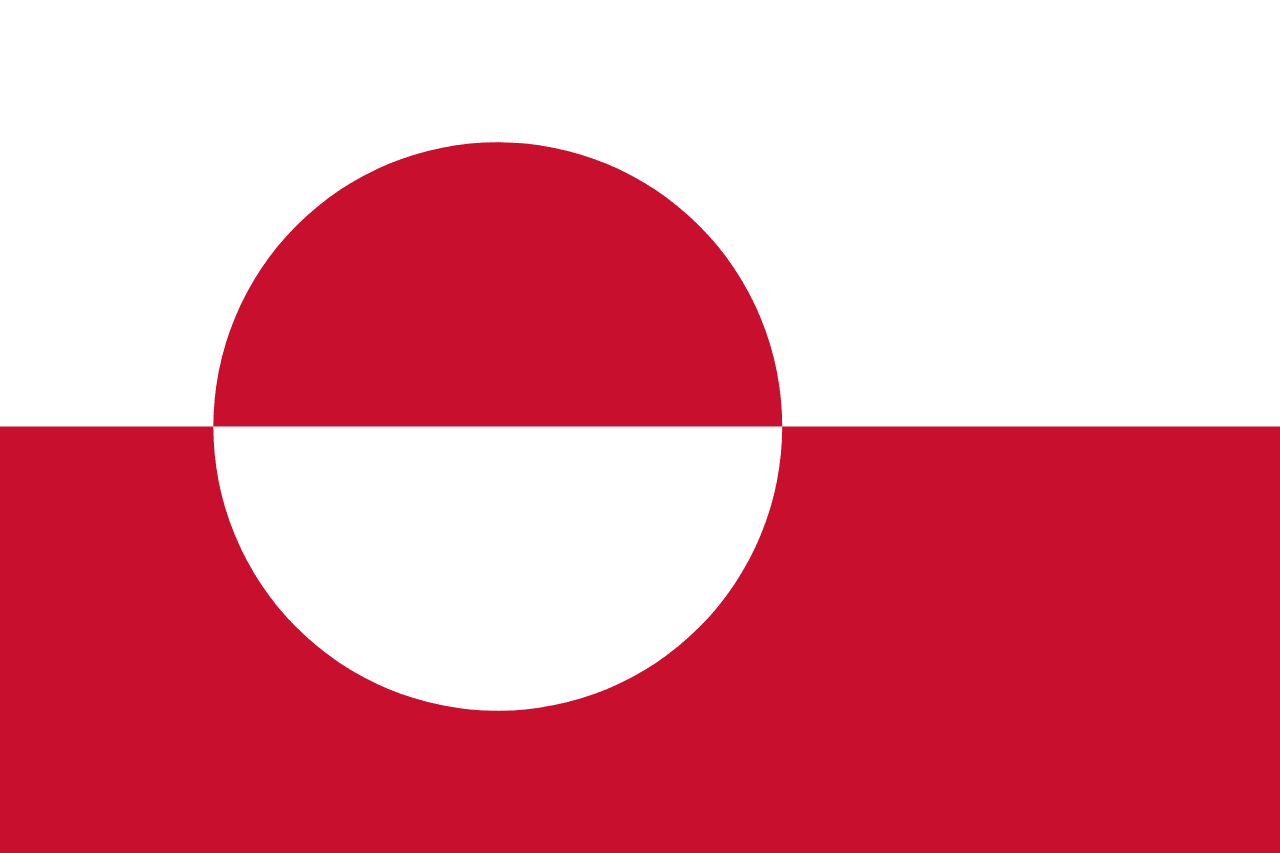
Few national symbols capture the character of their homeland as plainly as the flag of Greenland. Split cleanly into white above and red below, with a single off-center disc straddling the divide, the banner reads almost like a landscape compressed into cloth: ice meeting water, the low Arctic sun half-risen over the horizon. Officially flown since 1985, it was the first flag designed by and for Greenlanders themselves, and it carries a distinction that surprises many people who assume the world's largest island simply borrowed Denmark's. It did not. The result is a quietly radical piece of design and the only flag among the Nordic nations that refuses the Scandinavian cross.
A Banner of Just Two Colors
The Greenlandic flag uses only two colors, red and white, and resists the temptation to add anything more. White fills the upper band and the right portion of the disc; red fills the lower band and the disc's upper portion. That economy is deliberate. The palette deliberately echoes the colors of the Danish flag, the Dannebrog, signaling Greenland's continuing constitutional bond with the Kingdom of Denmark while still standing entirely on its own. There is no blue, no green, no gold. The restraint is part of the message: in a place defined by snow, ice, and the long polar light, two colors are enough to say everything.
The meaning behind those colors is rooted firmly in the natural world. White stands for the ice cap and the snow that blankets so much of the island for so much of the year, the vast frozen interior that makes Greenland what it is. Red represents the ocean that surrounds and sustains coastal life, and also the sun. The disc itself is the sun specifically, low on the horizon as it appears across Arctic skies. Read together, the colors trace the eternal rhythm of an Arctic existence: frozen land, open sea, and a sun that rises and sets in dramatic seasonal extremes.
How the Design Is Built
The construction is simple to describe and clever to look at. The field is divided into two equal horizontal bands, white on top and red on the bottom. Set into the flag, shifted toward the hoist (the side nearest the pole) rather than centered, is a large circle. Here the design does its most interesting trick: the disc is counterchanged against the bands behind it. Where the disc overlaps the white upper band it turns red, and where it overlaps the red lower band it turns white. In other words, each half of the circle is the opposite color of the stripe it sits on.
This counterchange is what gives the flag its visual energy. The disc seems to glow against the field, and because it straddles the dividing line exactly, it reinforces the horizon imagery: a sun half-above and half-below the line where ice meets ocean. The off-center placement, closer to the hoist, keeps the composition from feeling static and ensures the disc remains prominent even when the flag hangs limp. It is a small set of rules producing a striking, instantly recognizable image.
From Idea to Official Emblem
For most of the twentieth century Greenland, a Danish territory, flew the Dannebrog. The push for a distinct flag grew alongside Greenland's movement toward self-government. When Greenland gained home rule in 1979, the question of a national flag became live, and a public process invited proposals from the population. Designs poured in, including several featuring a Nordic cross in green and white that would have kept Greenland visually aligned with its Scandinavian neighbors.
The design that won, known in Greenlandic as Erfalasorput ("our flag"), came from Thue Christiansen, a Greenlandic artist and politician. His red-and-white disc concept was adopted and officially raised for the first time on 21 June 1985, a date chosen to coincide with the longest day of the year. Greenland thus gained a flag that was unmistakably its own, designed by a local hand and rooted in local imagery, while the shared red-and-white palette acknowledged the ongoing relationship with Denmark. Readers who want the wider story of the island's path to self-rule can explore our greenland country guide.
The Odd One Out Among Nordic Flags
To appreciate just how unusual Greenland's flag is, set it beside its neighbors. Denmark, Norway, Sweden, Finland, and Iceland all fly variations of the off-center Scandinavian cross, a design tradition stretching back centuries. Greenland, governed within the Kingdom of Denmark and culturally tied to the Nordic sphere, is the lone exception: its flag carries no cross at all. That makes it the only non-cross flag among the Nordic family, a striking declaration of distinct Inuit identity within a region of near-uniform vexillological style.
The disc-on-a-divided-field layout also invites comparison with flags far beyond the Arctic. Japan's flag is a red disc on white, and Bangladesh, Palau, and Laos all build their designs around a single prominent circle. What sets Greenland apart from every one of these is the counterchange: no other widely recognized national flag splits its central disc into two colors mirrored against a two-tone field. The red-and-white scheme it shares with Denmark, Indonesia, Poland, and others, but the half-and-half sun straddling a horizon line is Greenland's alone.
A Symbol of Belonging
For Greenlanders, Erfalasorput is more than decoration. Adopting a homegrown flag was an act of cultural affirmation for an Inuit-majority society that had spent generations under colonial and then territorial governance. The flag's imagery deliberately avoids European heraldic language, reaching instead for the immediate, lived realities of Arctic life. Choosing the sun, the ice, and the sea over a cross was itself a statement that Greenland's identity is grounded in its land and its people rather than borrowed wholesale from Europe.
That sense of ownership has only deepened as Greenland has expanded its autonomy. The flag appears on public buildings, on official documents, and in the hands of citizens at moments of national pride. It functions as a daily, visible reminder that Greenlanders define themselves on their own terms while remaining part of a larger kingdom, a balance the design's shared-but-distinct color palette captures with unusual elegance.
The Flag in Everyday Life
Across Greenland the flag turns up wherever community and identity are on display. Its most important annual outing is National Day on 21 June, the summer solstice and the anniversary of the flag's first raising, when the endless daylight of the Arctic summer fills the sky and communities gather to celebrate. The red-and-white disc flies at festivals, hangs in homes and schools, and accompanies Greenlandic teams and athletes who compete under their own colors in regional and Arctic sporting events. Travelers spot it on harbors, town halls, and souvenir stands from Nuuk to the smallest settlements, a compact emblem that needs no caption to identify the place it represents.
Frequently Asked Questions
When was the flag of Greenland adopted?
It was officially adopted and raised for the first time on 21 June 1985, the summer solstice. Before that, Greenland, as a Danish territory, flew the Danish flag, the Dannebrog.
What do the colors of the Greenlandic flag mean?
The flag uses red and white. White represents the ice cap and snow, while red represents the ocean and the sun. The disc itself symbolizes the sun, depicted low on the horizon as it appears in Arctic skies. The two colors also echo those of the Danish flag, reflecting Greenland's bond with Denmark.
Who designed the flag of Greenland?
It was designed by Thue Christiansen, a Greenlandic artist and politician. His entry was selected through a public process after Greenland gained home rule, and the flag is known in Greenlandic as Erfalasorput, meaning "our flag."
What continent is Greenland on, and how does its flag compare to others?
Greenland is geographically part of North America, though it is politically and culturally tied to the Nordic region within the Kingdom of Denmark. Its flag is notable as the only Nordic flag without a Scandinavian cross, and while it shares a red-and-white palette with flags like Denmark's and a central disc with flags like Japan's, its counterchanged half-red, half-white sun makes it unique.
- Solstice debut: The flag was first raised on 21 June 1985, the longest day of the year, now marked as Greenland's National Day.
- Nordic exception: It is the only flag in the Nordic countries that does not feature a cross.
- Counterchanged sun: The central disc switches colors across the dividing line, red where the field is white and white where the field is red.
- Local name: Greenlanders call it Erfalasorput, which translates roughly to "our flag."
- Shared palette, distinct meaning: The red and white nod to the Danish Dannebrog while standing for ice, ocean, and sun.