

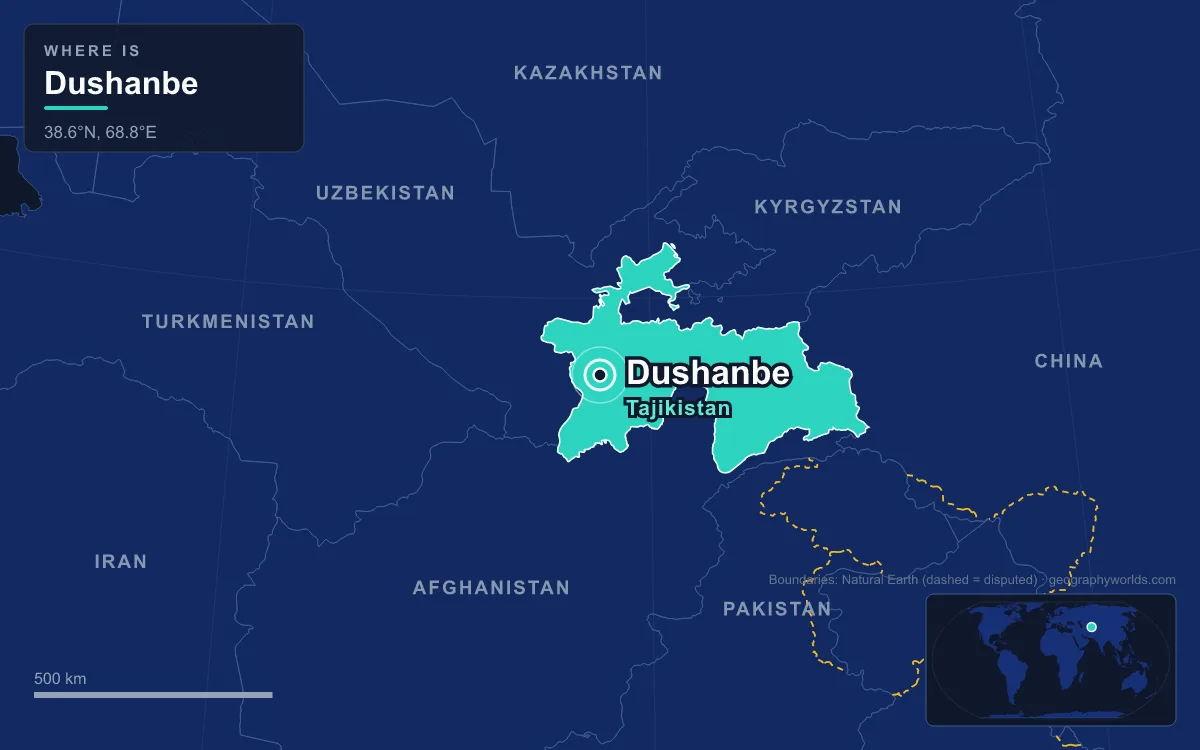
The capital of Tajikistan is Dushanbe, the country’s largest city, with a population of about 1,228,400 in February 2023. It lies in the Hisar Valley in western Tajikistan, where the Varzob River meets the Kofarnihon, at an elevation of 750 to 930 metres, with the Hisar Range rising to around 4,000 metres to its north and east. The name is the Tajik word for Monday, after the weekly bazaar that made a small market village worth fighting over. Dushanbe became a capital in 1924, was called Stalinabad from 1929 to 1961, and has been the capital of independent Tajikistan since 1991.
From Stalinabad to the Dushanbe Flagpole: Who Has Ruled from the Hisar Valley
Dushanbe’s political career began almost by accident. In 1920 the last Emir of Bukhara, overthrown by the Bolsheviks, took refuge in the town, and for a few months it served as the last capital of his emirate before he fled to Afghanistan on 4 March 1921. Basmachi fighters under Enver Pasha took Dushanbe in February 1922; the Bolsheviks recaptured it on 14 July 1922, and Enver was killed outside the town on 4 August. Years of fighting left the place in ruins. Its population fell from 3,140 in 1920 to just 283 in 1924, with only 40 houses standing.
Even so, Soviet planners chose it in October 1924 as capital of the new Tajik Autonomous Soviet Socialist Republic, then part of the Uzbek SSR. None of the historic Tajik-speaking cities, from Bukhara and Samarkand to Khujand, had been included in the new republic, so it needed a centre of its own. Dushanbe offered a market that already drew people from across the region, a position at the junction of valley routes, and a mild climate. The government began work there on 15 March 1925.
When the Tajik republic was upgraded to a full Soviet Socialist Republic in 1929, its capital was renamed Stalinabad on 19 October and absorbed the nearby villages of Shohmansur, Mavlono and Sari Osiyo. The old name returned on 10 November 1961 during de-Stalinisation. In the 1925–1932 term of mayor Abdukarim Rozykov, the town was replanned as a model Soviet city, and by 2 August 1979 its population reached 500,000, then the fastest growth rate in the Soviet Union.
Independence on 9 September 1991 was followed almost at once by the 1992–1997 civil war, fought largely along regional lines. The United Tajik Opposition briefly held the capital in 1992 before government forces backed by Russia and Uzbekistan retook it, and more than half of the city’s Russian population had left by 1993. A UN-supervised agreement on 27 June 1997 ended the war. Since then Emomali Rahmon has remained president, and the capital’s leadership has stayed close to him: Mahmadsaid Ubaidulloev served as mayor for a record 21 years until 2017, when the president’s son Rustam Emomali took the post. The clearest statement in steel of the new state is the Dushanbe Flagpole in front of the Palace of Nation, 165 metres tall, which flew its first flag on 24 May 2011 and was the tallest flagpole in the world until Jeddah’s surpassed it in 2014. It cost 3.5 million US dollars, part of 210 million dollars of projects for the 20th anniversary of independence.
The Imam Abu Hanifa Mosque and the Ismaili Centre: Faith After the Soviet Era
Tajikistan is constitutionally secular, but about 97.5 per cent of its people are nominally Muslim, most of them Sunni of the Hanafi school. Dushanbe’s religious landscape has been rebuilt since Soviet rule discouraged public worship. Around the turn of the 19th century the town had 14 mosques with attached schools and 2 madrasas; the new state has chosen to build on a far larger scale.
In October 2009, President Rahmon launched a new central mosque, paid for by Qatari investors, to replace the old Haji Yakub Mosque as the city’s main place of Friday prayer. Construction began in 2011 with a planned opening in 2014, but it slipped for years. The Imam Abu Hanifa Mosque finally opened on 8 June 2023, in the presence of Rahmon and the Emir of Qatar, Tamim bin Hamad Al Thani. It can hold 133,000 worshippers, 43,000 of them inside, making it the largest mosque by area in Central Asia and the largest religious building put up in Tajikistan since independence. The same year that the project was launched, Dushanbe’s mayor endorsed its recognition as the 2010 capital of Islamic culture.

Dushanbe is also home to a quieter but distinctive community. The Badakhshan region, which spans eastern Tajikistan and neighbouring parts of Afghanistan and Pakistan, is described as the only part of the world where Ismaili Muslims form the majority, and in 2009 the Aga Khan and President Rahmon inaugurated the Ismaili Centre in Dushanbe, the first in Central Asia and one of six worldwide. The capital once had a Jewish community too, about 600 people involved in trade and tailoring before 1920, when they were forced out to Hisor during the emir’s stay; they returned after the Red Army’s arrival and grew with migration from Bukhara in the 1920s and 1930s.
From the Monday Bazaar to Cotton Mills: Trade on the Varzob
Trade explains the name and the location. Dushanbe first appears in writing in 1676, in a letter from the Khan of Balkh to Tsar Fyodor III, as Kasabai Dushanbe, “the town of Monday”. Its weekly market sat where routes crossed: east–west through the Hisar Valley towards Karategin and the Alay Valley, and north–south over the Anzob Pass from the Fergana and Zeravshan valleys down to the Vakhsh and Afghanistan. Travellers heading for Samarkand, Khujand, Kulob and the Pamirs stopped at its caravanserai. Around the turn of the 19th century it was a citadel on the steep left bank of the Varzob with about 10,000 residents, known for weaving, tanning and iron smelting, and it had 14 teahouses as well as its mosques. The mountain ranges that framed those routes are covered in our guide to the Pamir Mountains.
Soviet rule turned the market town into an industrial one. A railway link to the Trans-Caspian line, begun on 24 June 1926, was completed in November 1929. The city became a centre for cotton and silk processing, and during the Second World War the city and the wider republic took in about 100,000 evacuees, along with factories moved east from the front; industrial output rose two and a half times between 1940 and 1945. The Nurek Dam, finished in the 1960s about 90 km to the south-east and at the time the tallest dam in the world, still supplies most of the capital’s electricity.
Today Dushanbe produces about a fifth of Tajikistan’s economic output: its gross regional product in 2018 was 13.8 billion somoni, around 1.5 billion US dollars and 20.1 per cent of national GDP. About a third of the country’s industrial and white-collar workforce is based here, though the city holds less than 10 per cent of the population. Cotton yarn, fabrics and cables lead its exports, with Turkey and Iran the largest buyers, while Russia supplies more than half its imports. Tajikistan’s landlocked position between Afghanistan, China, Kyrgyzstan and Uzbekistan, which shapes every one of those trade flows, is explained in our page on the countries that border Tajikistan.
Rudaki Avenue, Trolleybuses and a Teahouse in Boulder: Daily Life in Dushanbe
Life in the capital runs along Rudaki Avenue, the main street, named after Rudaki (c. 858–940/41), the first major poet to write in New Persian. Along it lies Rudaki Park, laid out in the mid-1930s. The city’s first air service, to Bukhara in 1924, flew three times a week from a small airfield on what is now the avenue itself. Residents still ride the trolleybus network that dates from 1955, one of the most visible Soviet inheritances, alongside the apartment blocks that followed a 1960s plan to end the city’s housing shortage.

The valley shapes the weather. Dushanbe has a Mediterranean-type climate (Köppen Csa) with hot, dry summers and chilly winters, and it is wetter than other Central Asian capitals, with more than 500 mm of rain a year funnelled in by the valley in winter and spring. Snow falls on about 25 days a year, but the Hisar Range shields the city from the coldest Siberian air. Infrastructure has lagged behind growth: much of the water system dates from 1932, and in 2018 about 40 per cent of residents had no connection to the sewers. The National Library holds 3.11 million volumes, the largest collection in Central Asia, and the city has 15 parks, including Victory Park, created in 1975 to commemorate the Second World War.
Dushanbe’s best-known building abroad is in Colorado. In 1987 mayor Maksud Ikramov made Boulder a sister city, and Dushanbe sent a teahouse as a gift: forty Tajik artisans spent two years carving and painting it by hand, without power tools, then packed it into about 200 crates. It arrived in 1990 and eventually opened as the Boulder Dushanbe Teahouse, a reminder of the 14 teahouses of the old Monday market town. For how the capital fits into the wider region of former Soviet republics, see our guide to the Central Asian “stans”.
Quick Facts About Dushanbe
- Country: Tajikistan
- Continent: Asia (Central Asia)
- Country population: approximately 11.0 million
- Capital city status: Dushanbe is the capital of Tajikistan, the seat of national government, and the location of foreign embassies, parliament, and the head of state's official residence.
Frequently Asked Questions
What is the capital of Tajikistan?
The capital of Tajikistan is Dushanbe. Dushanbe is the seat of national government, hosts most foreign embassies and consulates, and is typically where the head of state and parliament are located.
What continent is Dushanbe in?
Dushanbe, the capital of Tajikistan, is located in Asia, in the Central Asia region. As Tajikistan's capital, Dushanbe serves as the country's primary connection to the broader Asian political, economic, and cultural sphere.
Why is Dushanbe the capital of Tajikistan?
Dushanbe was chosen as the capital of Tajikistan for reasons that typically combine geography, history, and politics. Capital city selections often reflect a desire for centrality (being accessible from across the country), historical importance (being a longstanding seat of government or culture), or neutrality (being acceptable to multiple regions or ethnic groups within the country). The specific reasons for Dushanbe's designation are detailed in the city's history above.
What is Dushanbe known for?
As the capital of Tajikistan, Dushanbe is best known for housing the country's central government institutions — parliament, presidential or royal residences, supreme court, and key ministries. It is also typically a major cultural and economic center within Tajikistan, hosting national museums, embassies, and signature monuments. The introduction and history sections above provide detailed coverage of the city's specific notable institutions and landmarks.
Related Pages
- Tajikistan Country Guide — full geography, climate, economy, and culture overview
- Flag of Tajikistan — meaning, history, and design of Tajikistan's national flag