
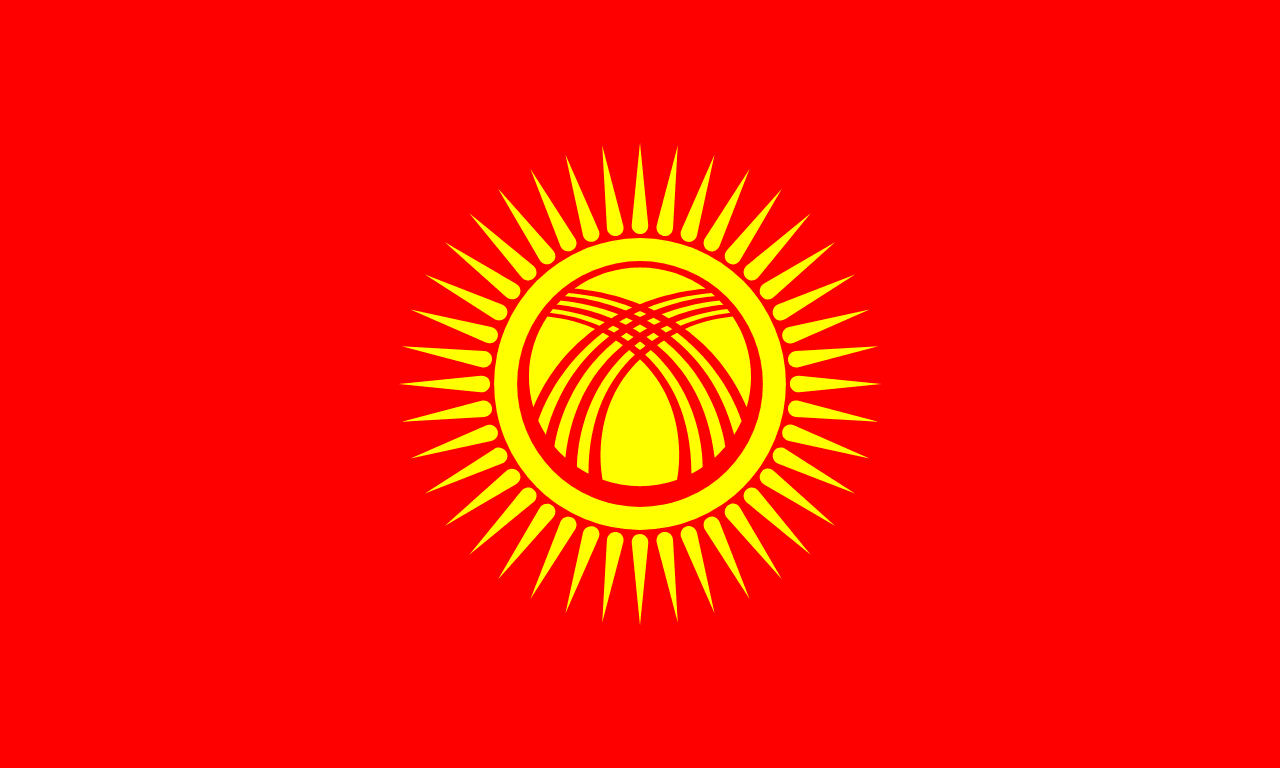
Few national flags manage to compress an entire way of life into a single geometric shape, but the flag of Kyrgyzstan does exactly that. Against a warm red field sits a golden sun, and at the center of that sun is something most outsiders cannot immediately name: a stylized view of a tunduk, the wooden crown that holds together the roof of a traditional Kyrgyz yurt. To look up at a real tunduk from inside a yurt is to see the sky framed by your own home. To see it on the flag is to understand that, for the Kyrgyz people, nation and hearth are inseparable. Adopted in 1992 in the first months of independence, this flag is one of Central Asia's most distinctive and personal emblems.
A Flag Born From Independence
For most of the twentieth century, the territory now known as Kyrgyzstan flew Soviet-style banners dominated by red fields, hammers, sickles, and stars. When the Soviet Union dissolved in 1991, the newly sovereign Kyrgyz Republic faced the same task as every former Soviet state: to design a symbol that spoke for a people rather than for an empire. The answer arrived in 1992, when the national flag was officially adopted. Rather than reaching for purely modern abstractions, the designers turned inward, drawing on the imagery of nomadic life that had defined the region for centuries. The result kept a familiar red but loaded it with entirely new meaning, replacing imposed ideology with motifs rooted in the steppe, the mountains, and the yurt.
What the Colors Mean
The flag uses just two colors, and their economy is part of its power. The dominant red field stands for bravery and valor, qualities long prized in a culture shaped by mounted herders, harsh winters, and contested mountain passes. Red also carries a romantic historical resonance: it is often associated with the banner said to have been raised by the legendary hero Manas, the central figure of the vast Kyrgyz oral epic that bears his name.
Resting on that field is a yellow, or golden, sun. The sun represents peace, warmth, and prosperity, and its placement at the heart of the flag suggests a nation looking toward a bright and settled future. Together, red and yellow create a high-contrast pairing that reads clearly whether the flag is flying over a government building in Bishkek or fluttering at a remote mountain festival. There are no blues, greens, or whites to dilute the message: just courage and the life-giving sun.
Reading the Design
The layout rewards a closer look. The sun is depicted with a set of radiating rays evenly spaced around its circle, evoking the warmth that reaches every corner of the country. Within the golden disc sits the real signature element: the tunduk, rendered as a circular frame crossed by intersecting struts.
In a Kyrgyz yurt, the tunduk is the wooden ring at the apex of the domed roof. It anchors the roof poles, lets smoke escape, and admits daylight; it is, quite literally, the thing that holds the home together and connects those inside to the sky above. By placing this domestic architectural detail inside the national sun, the flag makes a quietly profound claim: the foundation of the nation is the family home and the nomadic heritage that built it. The crisscrossing lines you see in the sun's center are not decoration but a top-down view of that crown of the yurt, the unifying point of every traditional dwelling.
Standing Apart in a Sea of Red and Sun
Red flags bearing a central sun or star are common around the world, which makes Kyrgyzstan's distinctiveness all the more striking. A glance toward East Asia invites comparison with banners that place a sun on a plain field, and several Central Asian neighbors also favor warm palettes and emblematic centerpieces. Yet none of them looks like this one up close.
The difference is the tunduk. Where other flags use suns, stars, or crescents that appear across many cultures, the Kyrgyz sun encloses a motif that belongs to no one else. You will not find a yurt's roof crown at the center of any other national flag on Earth. This specificity is the whole point: rather than borrowing a universal symbol, Kyrgyzstan chose an emblem that cannot be mistaken for another nation's. Among the world's red-and-gold flags, it is the architectural detail at the center, not the colors, that makes Kyrgyzstan's instantly identifiable to anyone who knows what they are seeing. To explore more about the country behind the banner, see our kyrgyzstan country guide.
A Symbol of Identity and Heritage
Kyrgyzstan sits in the heart of Central Asia, a landlocked country of dramatic mountain ranges, alpine lakes, and high summer pastures where herders still move with the seasons. The flag's imagery is not a museum piece; it reflects a living relationship with the land. The yurt remains a genuine part of Kyrgyz life, used in the highlands during the warm months and revered as a cultural touchstone year-round. Choosing the tunduk as the central emblem was therefore a statement that modern statehood and ancient nomadic tradition are not in conflict but woven from the same thread.
The flag also speaks to unity. Just as the tunduk binds the many poles of a yurt into a single stable structure, the symbol on the flag gestures toward a people gathered under one roof. For a young nation forging a sense of itself after decades within a larger union, that image of many parts held together by a common center carried obvious appeal.
The Flag in Everyday Life
Today the flag is woven into civic and public life across the country. It flies over ministries and schools, appears at the National Flag Day observances, and is raised during the festivities surrounding independence. International sporting events offer some of its most visible moments, when Kyrgyz athletes carry the red banner with its golden sun into stadiums and onto podiums, and supporters wave it in the stands. The tunduk motif also turns up beyond the flag itself, echoing through national emblems, official seals, and design across the country, a sign of just how central the symbol has become to the nation's visual identity.
Interesting Facts
- The flag was adopted in 1992, shortly after Kyrgyzstan gained independence following the dissolution of the Soviet Union.
- The central emblem is a tunduk, the crown of a traditional Kyrgyz yurt, making this one of the only national flags to feature a piece of domestic architecture.
- The red field is often linked to the banner of Manas, the hero of the monumental Kyrgyz epic poem.
- The golden sun stands for peace and prosperity, while the red represents bravery, keeping the palette to just two colors.
- Kyrgyzstan is located in Central Asia, on the continent of Asia, a landlocked nation known for its towering mountains and nomadic traditions.
Frequently Asked Questions
When was the flag of Kyrgyzstan adopted?
The current national flag was adopted in 1992, in the period immediately following the country's independence from the Soviet Union. It replaced the Soviet-era flag with a design rooted in Kyrgyz cultural heritage.
What do the colors and symbols on the flag mean?
The red field represents bravery and valor, while the yellow sun symbolizes peace and prosperity. At the center of the sun is a tunduk, the wooden crown of a traditional yurt, which represents the Kyrgyz home, family, and the unity of the nation.
What continent is Kyrgyzstan on?
Kyrgyzstan is located in Central Asia, on the continent of Asia. It is a landlocked country famous for its mountain ranges, high pastures, and enduring nomadic traditions.
How does the flag compare to similar flags?
Many national flags feature a red field with a central sun or star, but Kyrgyzstan's is unique because of the tunduk inside its sun. No other national flag places the roof crown of a traditional dwelling at its center, which makes this banner instantly distinguishable from other red-and-gold designs.
