
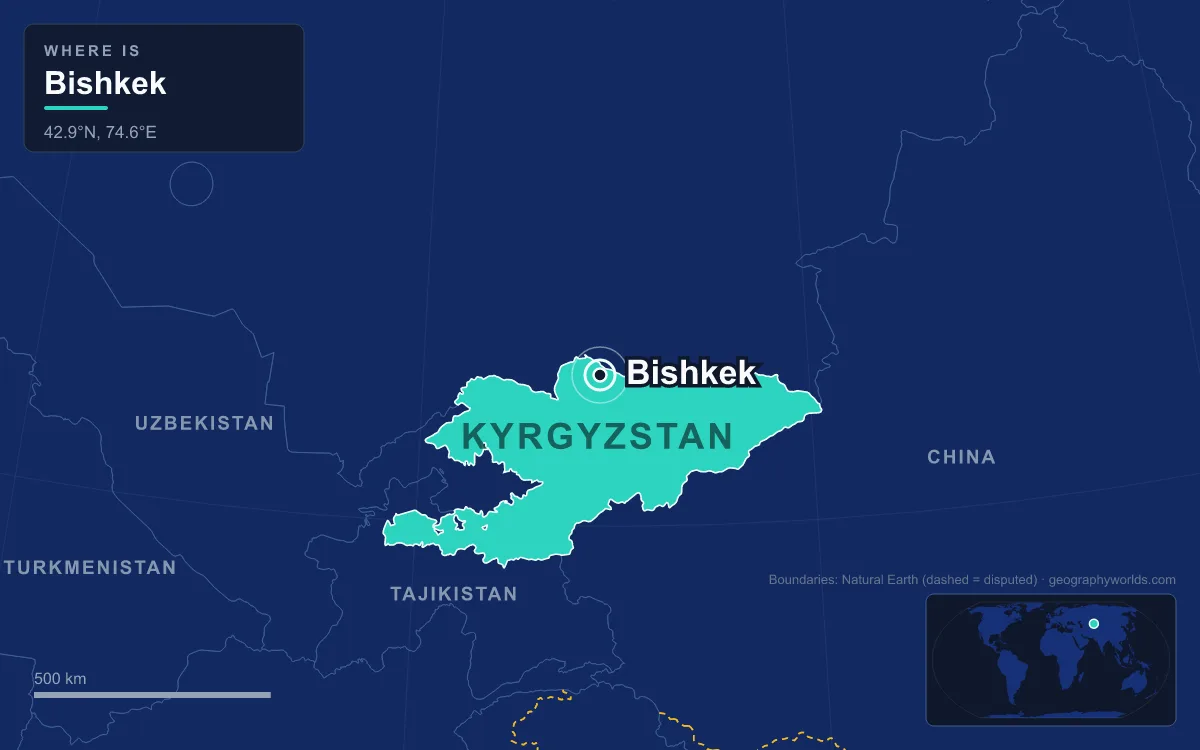
The capital of Kyrgyzstan is Bishkek, the country’s largest city, in the Chüy Valley in the north, close to the border with Kazakhstan. It sits at about 800 metres above sea level at the foot of the Kyrgyz Ala-Too range, whose peaks reach 4,895 metres, and it had around 1.2 million people in 2024, roughly a sixth of Kyrgyzstan’s 7.5 million. It is also a young capital with three names: a Kokand fort called Pishpek in 1825, a Russian settlement from 1868, the Soviet city of Frunze from 1926 to 1991, and Bishkek since then. Its grid of tree-lined streets, watered by irrigation ditches, still carries all three layers.
The White House and Ala-Too Square: Where Kyrgyz Power Changes Hands
Bishkek began as an instrument of power. The Khanate of Kokand built the mud fortress of Pishpek in 1825 to control caravan routes through the Tian Shan and to collect tribute from Kyrgyz tribes. On 4 September 1860 Russian forces under Colonel Apollon Zimmermann destroyed it, and in 1868 a Russian settlement rose on the same spot under the old name, inside Russian Turkestan’s Semirechye Oblast. From 1877 the imperial government handed fertile land to Russian peasant settlers, and the town grew from a garrison into a farming centre.
Its promotion came with Soviet map-making. In 1925 Pishpek became the capital of the new Kara-Kirghiz Autonomous Oblast, and in 1926 it was renamed Frunze after Mikhail Frunze, the Bolshevik commander who had been born there in 1885. In 1936 it became the capital of the Kirghiz Soviet Socialist Republic. On 5 February 1991 the Kyrgyz parliament restored a form of the old name, Bishkek, and the country became independent later that year as the Soviet Union broke up.
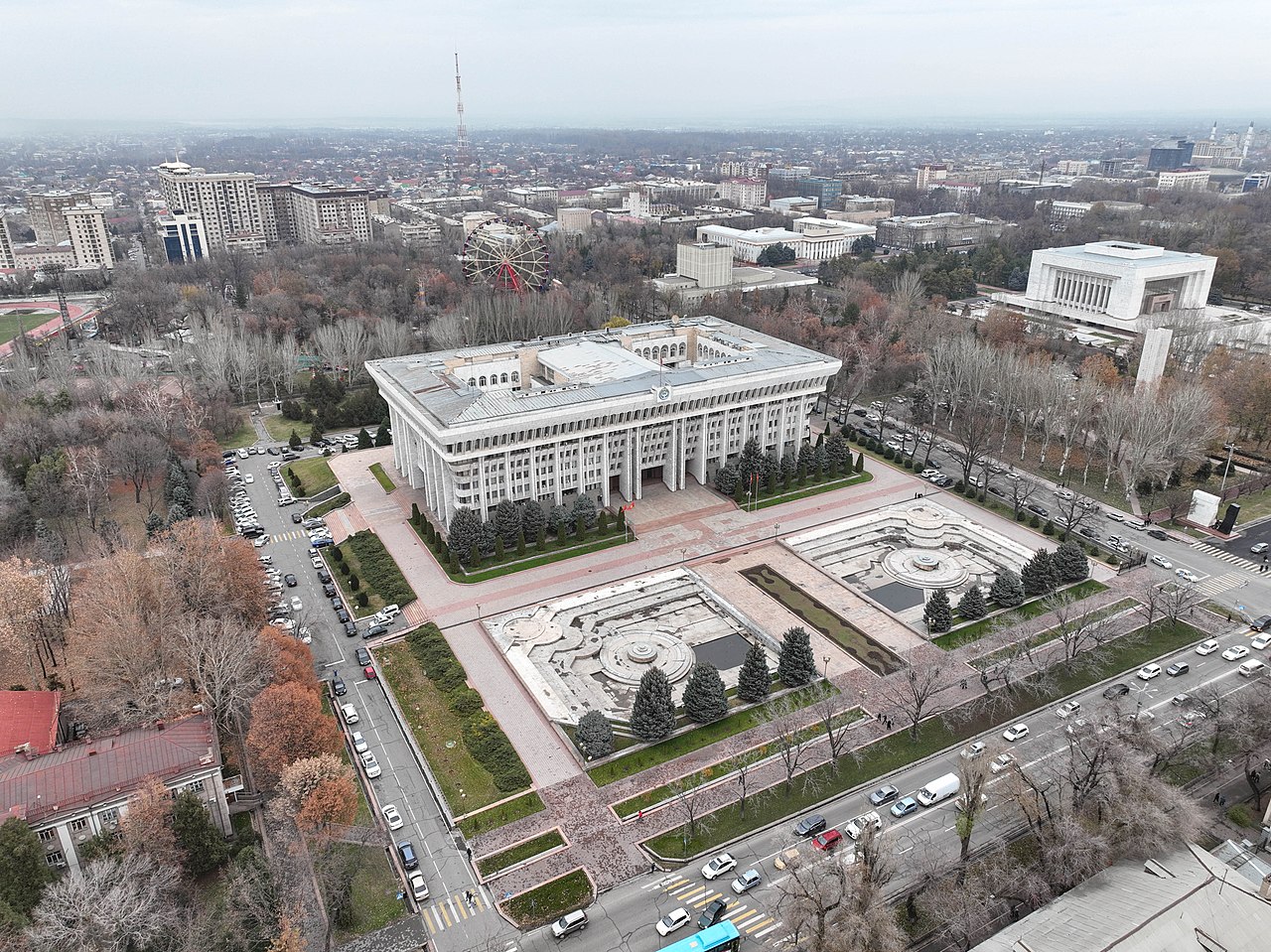
The seat of that power is a single block on Chüy Avenue. The White House, a seven-storey marble building in a Stalinist modern style modelled on a Moscow government building, took eight years to build and was finished in 1985 as the headquarters of the Communist Party of the Kirghiz SSR. Today deputies of the Supreme Council sit there, and the president occupies part of the seventh floor. Next to it lies Ala-Too Square, laid out in 1984 as Lenin Square with a large statue of Lenin at its centre. The Lenin statue was moved to a smaller square in 2003 and replaced by a figure called Erkindik (“Freedom”), and in 2011, for the 20th anniversary of independence, that gave way to a statue of Manas, the hero of the Kyrgyz national epic.

This square and this building are where Kyrgyzstan’s governments have fallen, three times in fifteen years. On 24 March 2005, during the Tulip Revolution, more than 15,000 people gathered on the square to protest against that year’s parliamentary elections, broke through to the White House and stormed it. President Askar Akayev fled by helicopter to Kazakhstan and on to Moscow, where he signed his resignation on 4 April. On 7 April 2010 crowds again filled the square and surrounded the building, now the headquarters of President Kurmanbek Bakiyev; police opened fire with live ammunition and almost 90 protesters were killed. Bakiyev was ousted, and a fire in the building destroyed records that later complicated his prosecution; he was sentenced in absentia in 2013 to 24 years. On 6 October 2020, two days after a disputed parliamentary vote, protesters seized the White House again and set part of it on fire. The election was annulled that day, and President Sooronbay Jeenbekov resigned on 15 October.
From the Tatar Mosque on Merchant Street to Imam Sarakhsi
Religious life in Bishkek has been rebuilt more than once. Before the 1917 revolution, the street that is now Chüy Avenue was called Kupecheskaya, or Merchant Street, and it held the Serafim Church, a Tatar mosque and a madrasa beside rows of small shops and clay-walled houses. In the 1920s the church became a social club and the mosque and madrasa were turned into a school. None of the three buildings survives, and the avenue itself has had six names, among them Stalin Street from 1936 and Lenin Avenue from 1974.
The population those buildings served was, for most of the city’s history, not Kyrgyz. From the founding of the settlement until the mid-1990s, Russians, Ukrainians, Germans and other Europeans formed the majority. The 1970 census counted only 12.3 percent of Frunze’s residents as ethnic Kyrgyz and more than 80 percent as European. Emigration after 1991 and migration from Kyrgyz villages reversed that. Ethnic Russians were about 20 percent of the city in 2004 and around 7–8 percent by 2011, and today about 75 percent of residents are Kyrgyz. Russian nonetheless remains the city’s main everyday language.
The clearest sign of the change is the Central Mosque of Imam Sarakhsi, named after a medieval Islamic scholar. Funded by Turkey’s religious affairs directorate, the Diyanet, it was begun in 2012 and inaugurated on 2 September 2018 in the presence of President Jeenbekov and Turkey’s President Recep Tayyip Erdoğan. It is built in an Ottoman revival style, with four minarets of three balconies each and a design that resembles the Kocatepe Mosque in Ankara, and it holds 9,000 worshippers indoors and 30,000 in total, making it one of the largest mosques in Central Asia. The ruins of the old Pishpek fortress lie just north of Jibek Jolu Street, near the new mosque, so the city’s oldest and newest monuments share a neighbourhood.

Across Kyrgyzstan about 90 percent of people were Muslim in 2017, most of them Sunni, and about 7 percent Christian. The capital is where the Christian minority concentrates. The first Russian Orthodox parishes in the country opened in Bishkek, Naryn and Osh in the 1870s to serve the new Russian forts, and in 2011 the Russian Orthodox Church created a separate Eparchy of Bishkek. The country’s only Catholic cathedral stands on Vasiljeva Street near the Bayat market; locals long called it the “German church”, just as the Orthodox one is called the “Russian church”.
Dordoy, Osh Bazaar and the Old Road Called Jibek Jolu
The site was a caravan stop before it was a town, possibly founded by Sogdian merchants on one of the branches of the Silk Road that crossed the Tian Shan. The route survives in a street name: Jibek Jolu, “Silk Road” in Kyrgyz, runs east to west about 2 kilometres north of Chüy Avenue as part of the main road through the Chüy Region, and both of the city’s long-distance bus stations stand on it.
Trade in Bishkek today means re-export. Dordoy Bazaar, on the north-eastern edge of the city near the bypass highway, dates from 1992 and stretches for more than a kilometre. It is built mostly of double-stacked shipping containers, with a shop in the lower box and storage in the upper one; a 2005 report counted 6,000 to 7,000 of them, laid out in rows over an area equal to about 160 rugby fields. Chinese consumer goods pass through it on their way to shops in Kazakhstan, Russia and Uzbekistan, and some economists rank this re-export trade among the two largest economic activities in Kyrgyzstan. About 70,000 people worked in and around Dordoy, formally or informally, in March 2024.
Osh Bazaar, on the west side of the city near the Western Bus Station, was created in 1983 and serves the city itself: food, household goods, clothes and musical instruments. Its national goods section, called Kyyal (“dream”), sells carved wooden trunks, traditional bedding, the wooden cradles called beshik, and Kyrgyz clothing made to order.

Formal finance is just as centralised. All 21 of the country’s commercial banks have their headquarters in Bishkek, while most of the Soviet-era factories have closed or shrunk since 1991. The city’s outside links reflect its position between larger powers. A spur line connects it to the Turkestan–Siberia Railway, and trains from the Bishkek-2 station, built in 1946 by German prisoners of war, run to Moscow in about three days. Manas International Airport, 25 kilometres north-west of the centre, hosted a United States military transit base from December 2001 until American troops left on 3 June 2014, and Russia has operated its own air base at Kant, about 20 kilometres east of the city, since 2003.
Aryks, Marshrutkas and Winter Smog on the Frunze-Era Grid
The centre of Bishkek is laid out on a rectangular grid. Most streets are lined on both sides by narrow irrigation channels, the aryks, which water the trees that shade the pavements in summer, when average daily highs reach about 31 °C in July. Winters are cold, with average January highs of about 3 °C, and the city receives around 440 millimetres of precipitation a year. The Ala-Too range, about 40 kilometres away, fills the southern skyline, and Ala Archa National Park is a 30- to 45-minute drive. The mountains protect the city from storms, but they also trap air: temperature inversions can hold fog over Bishkek for days.
That trapped air has made Bishkek the most polluted city in Kyrgyzstan. The hydrogeologist Zheenbek Kulbekov names three main causes: coal burned for heating in informal settlements, exhaust from private cars, and poor air circulation made worse by tall private buildings put up without regard to the Soviet-era city plans. The state hydrometeorology agency runs seven monitoring stations, and concentrations of formaldehyde in the centre have at times reached four times the permitted limit.
The buildings behind that problem come from the fastest growth in the city’s history. Most residents still live in Soviet-era flats, but from the 2010s a construction boom filled the south of the city with “business class” and “premium class” towers, many of them close to the Issyk-Ata fault line and criticised for weak seismic design, a risk shared with other cities built on active faults. Migrants who cannot afford those prices settle on the outskirts, in informal districts such as Ak Jar, Ak Örgö, Kelechek and Kalys-Ordo, which are estimated to house about 400,000 people, some 30 percent of the city.
Getting around mostly means buses and marshrutkas, the shared minibuses found across the former Soviet Union. Bishkek’s first bus service started in 1934 and its trolleybuses in 1951, but the trolleybus network was phased out in 2024. Sport has a new landmark as well. Alongside the Dolen Omurzakov Stadium, long the only ground in the country fit for international football, the city opened the yurt-shaped Bishkek Arena in August 2026: 51,000 seats, built for about US$60 million, and the stage for the opening ceremony of the 6th World Nomad Games. For how the capital fits into the country’s mountains, lakes and regions beyond the Chüy Valley, see our Kyrgyzstan country guide.
Quick Facts About Bishkek
- Country: Kyrgyzstan
- Continent: Asia (Central Asia)
- Country population: approximately 7.4 million
- Capital city status: Bishkek is the capital of Kyrgyzstan, the seat of national government, and the location of foreign embassies, parliament, and the head of state's official residence.
Frequently Asked Questions
What is the capital of Kyrgyzstan?
The capital of Kyrgyzstan is Bishkek. Bishkek is the seat of national government, hosts most foreign embassies and consulates, and is typically where the head of state and parliament are located.
What continent is Bishkek in?
Bishkek, the capital of Kyrgyzstan, is located in Asia, in the Central Asia region. As Kyrgyzstan's capital, Bishkek serves as the country's primary connection to the broader Asian political, economic, and cultural sphere.
Why is Bishkek the capital of Kyrgyzstan?
Bishkek was chosen as the capital of Kyrgyzstan for reasons that typically combine geography, history, and politics. Capital city selections often reflect a desire for centrality (being accessible from across the country), historical importance (being a longstanding seat of government or culture), or neutrality (being acceptable to multiple regions or ethnic groups within the country). The specific reasons for Bishkek's designation are detailed in the city's history above.
What is Bishkek known for?
As the capital of Kyrgyzstan, Bishkek is best known for housing the country's central government institutions — parliament, presidential or royal residences, supreme court, and key ministries. It is also typically a major cultural and economic center within Kyrgyzstan, hosting national museums, embassies, and signature monuments. The introduction and history sections above provide detailed coverage of the city's specific notable institutions and landmarks.
Related Pages
- Kyrgyzstan Country Guide — full geography, climate, economy, and culture overview
- Flag of Kyrgyzstan — meaning, history, and design of Kyrgyzstan's national flag