
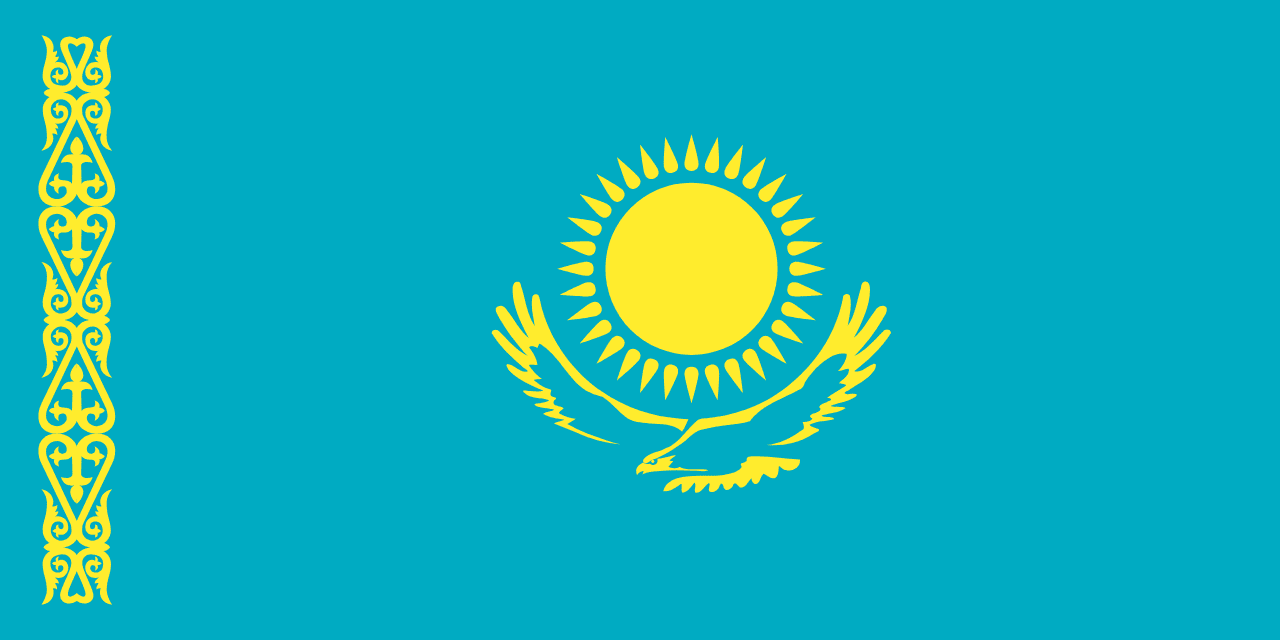
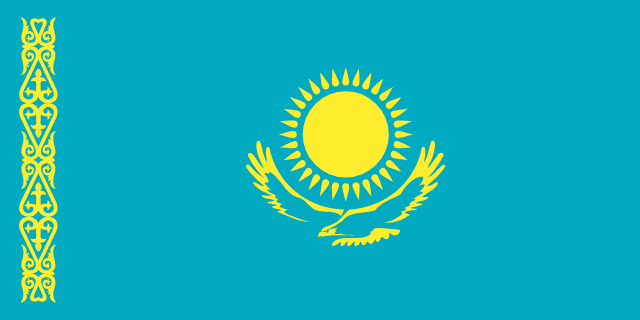
Few national flags manage to feel both ancient and modern at once, but the banner of Kazakhstan pulls it off with quiet confidence. A single expanse of luminous sky blue carries a golden sun overhead, a soaring eagle beneath it, and a slim vertical band of traditional ornament running down the hoist. Raised for the first time in 1992, just months after the country stepped out from under the Soviet Union, the flag reads less like a committee compromise and more like a portrait of the Kazakh steppe itself: open sky, golden light, and the birds that ride the wind above the grasslands.
This article walks through what each element means, how the layout is arranged, why the design appeared when it did, and how it sits alongside other flags that share its palette. By the end you'll be able to spot the details that make Kazakhstan's flag genuinely distinctive rather than just another blue-and-gold banner.
A Field of Sky Blue and Gold
The flag uses only two colors, and that restraint is part of its appeal. The dominant sky blue field is not an arbitrary decorative choice. It evokes the vast, cloudless skies that stretch over Central Asia's steppe, and it carries a deeper cultural weight as well: blue has long been associated with the Turkic peoples, of whom the Kazakhs are a part. In that sense the color speaks to both a physical landscape and a shared heritage that reaches back across centuries.
Against that blue sits gold, used for the sun, its rays, the eagle, and the ornamental strip. Gold reads as light, warmth, and abundance, and on this flag it anchors everything the blue surrounds. The pairing is deliberately simple. There are no reds, greens, or whites competing for attention, which lets the two colors do clear, complementary work: blue as the open backdrop, gold as the living things and the light that move within it.
Reading the Design From Top to Bottom
The composition centers on a golden sun with rays spreading outward, positioned in the upper portion of the field. Directly below the sun, a golden eagle appears in flight, wings outstretched as if catching a thermal high above the plains. Together the sun and eagle are read as emblems of freedom, of aspiration, and of a people looking upward and forward rather than back.
Running vertically along the hoist side — the edge nearest the flagpole — is a narrow band of golden ornamental pattern. This is not generic decoration: it draws on traditional Kazakh ornamentation, the kind of motif you'd find woven into textiles, carved into wood, or worked into metal across the region. By placing this pattern beside the modern symbols of sun and eagle, the design ties the new state's identity directly to its older craft traditions. The overall effect is balanced and unhurried, with plenty of open blue to let each gold element breathe.
Independence and the Birth of a New Banner
For most of the twentieth century, Kazakhstan flew the flag of a Soviet republic, dominated by Soviet red and the iconography of the union. That changed when the USSR dissolved at the end of 1991 and Kazakhstan became an independent nation. A newly sovereign country needs its own symbols, and in 1992 Kazakhstan adopted the sky-blue flag we know today.
The timing matters. Across the early 1990s, a whole cluster of newly independent states from the former Soviet sphere designed fresh flags, each searching for imagery that felt authentically national rather than imposed. Kazakhstan's answer leaned into its geography and its Turkic roots: instead of borrowing from a foreign template, it reached for the sky overhead and the wildlife of the steppe. The result was a clean break from the red-banner era and a statement that the country's identity would be drawn from its own land and heritage. For broader context on the nation behind the banner, the kazakhstan country guide covers its geography and culture in more depth.
How It Compares to Other Blue-and-Gold Flags
Blue and gold is a popular combination worldwide, so it's worth asking what keeps Kazakhstan's flag from blending in. Several flags use a similar palette but arrive at very different effects.
- Ukraine splits its flag into two equal horizontal bands of blue over gold — a stripe design with no central emblem, which looks nothing like Kazakhstan's single field with a centered motif.
- Sweden and several Nordic flags pair blue and gold but arrange them as Scandinavian crosses, an immediately different layout.
- Other Central Asian neighbors, such as Uzbekistan and Kyrgyzstan, also reference the sky and sun, but each uses its own distinct combination of stripes, crescents, or sun-ray counts.
What sets Kazakhstan apart is the specific gathering of elements: an undivided blue field, a single rayed sun, an eagle in flight directly beneath it, and that vertical strip of Kazakh ornament at the hoist. No other national flag combines exactly these features, which makes it hard to mistake once you know what to look for. The eagle in particular is unusual; relatively few national flags feature a bird rendered in flight as a freestanding symbol of freedom.
A Mirror of National Identity
For Kazakhstanis, the flag does more than identify the country on a map. Its imagery deliberately fuses the natural world with cultural memory. The steppe sky and the golden eagle are part of everyday life and lore across the region — eagle hunting, for instance, remains a living tradition among some communities — so the flag draws on symbols people genuinely recognize rather than abstract heraldry.
The ornamental band reinforces this. By giving traditional Kazakh design a permanent place on the national banner, the flag signals that craft, pattern, and heritage are not relics to be set aside but living parts of the modern state. The combination of sun, eagle, and ornament tells a compact story: a free people, rooted in their land and traditions, looking toward an open horizon.
The Flag in Modern Kazakhstan
Today the flag is woven into civic and public life. It flies over government buildings, schools, and embassies, and it appears at the international events where Kazakhstan presents itself to the world. At sporting competitions — the Olympics, regional games, and global tournaments — athletes carry and drape the sky-blue banner, and its distinctive gold sun and eagle make it instantly recognizable in a crowd of national colors.
The flag also anchors national celebrations and state ceremonies, where its display reinforces a shared sense of belonging. Because the design is so legible from a distance — bold gold on a single clean field — it works equally well on a stadium pole, a stamp, or a diplomatic backdrop. That visual clarity is one reason the 1992 design has endured as the steady emblem of an independent Kazakhstan.
Quick Facts Worth Knowing
- The flag was adopted in 1992, following independence from the Soviet Union.
- It uses just two colors: sky blue and gold.
- The blue field represents the sky and the broader Turkic peoples.
- The golden sun and eagle together symbolize freedom and aspiration.
- The vertical strip at the hoist is a traditional Kazakh ornamental pattern.
- Kazakhstan sits in Central Asia, spanning the boundary between Asia and Europe.
Frequently Asked Questions
When was the flag of Kazakhstan adopted?
Kazakhstan adopted its current flag in 1992, shortly after gaining independence from the Soviet Union. It replaced the Soviet-era republican flag and gave the newly sovereign nation a symbol drawn from its own landscape and heritage.
What do the colors of the Kazakhstan flag mean?
The sky-blue field stands for the open sky and the Turkic peoples to whom the Kazakhs belong. The gold used for the sun, eagle, and ornament represents light and abundance, while the sun and eagle together symbolize freedom.
What continent is Kazakhstan on?
Kazakhstan is located in Central Asia. It is a transcontinental country, with the vast majority of its territory in Asia and a smaller western portion extending into Europe, making it one of the largest landlocked nations in the world.
How is Kazakhstan's flag different from other blue-and-gold flags?
While flags like Ukraine's also use blue and gold, Ukraine's is two horizontal stripes with no emblem. Kazakhstan's flag is a single blue field with a centered golden sun and eagle plus a vertical strip of traditional Kazakh ornament at the hoist — a combination unique to it.