
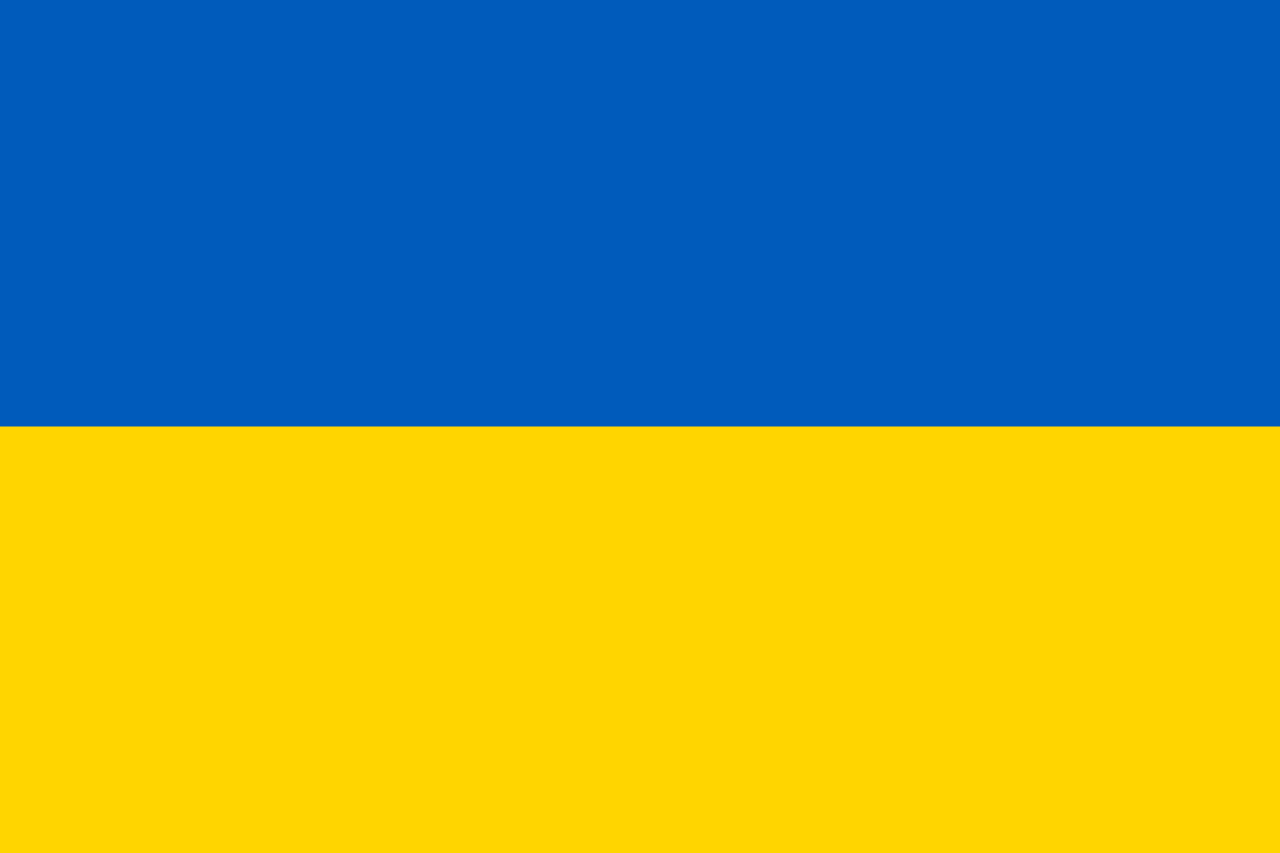
Few national banners are as instantly legible as Ukraine's. Two broad horizontal bands, blue resting above yellow, form one of the most economical designs in the world of flags, yet the image carries an emotional weight that has only grown in recent decades. There is no eagle, no star, no coat of arms stitched into the cloth, just two colors meeting in a single clean line. That simplicity is part of the point: the flag asks you to read a landscape rather than a heraldic puzzle, and almost anyone who looks at it can guess what it means before being told.
Officially adopted in its current form in 1992, shortly after Ukraine declared independence from the Soviet Union, the blue-and-yellow bicolor is far older than that date suggests. Its roots reach back to nineteenth-century heraldry and to a national movement that kept these colors alive through long periods when displaying them was risky or outright forbidden. Today the flag is everywhere in Ukrainian life, from government buildings to football terraces, and it has become recognizable far beyond the country's borders.
A Sky Over Ripening Fields
The symbolism of the Ukrainian flag is unusually direct. The upper band of blue represents the open sky, while the lower band of yellow stands for the country's vast wheat fields. Read together, top to bottom, the two stripes describe a single scene: a clear summer sky arching over the golden grain that has long defined Ukraine's agricultural heartland. The nation is sometimes called the breadbasket of Europe, and the flag turns that reputation into a visual statement that needs no caption.
This landscape reading is what gives the design its quiet power. Many flags rely on abstract associations, where a color is simply declared to mean liberty or courage. Ukraine's banner instead points outward at something tangible. When the wind moves across a field of ripe wheat beneath a cloudless sky, the country's flag is, in effect, already flying. That close tie between the colors and the physical land is precisely the idea captured in the often-repeated note that the colors represent the Ukrainian landscape.
The Design and Its Proportions
Structurally, the flag could hardly be more straightforward. It is a horizontal bicolor: the field is divided into two equal stripes of the same height, with blue occupying the top half and yellow the bottom. There are no charges, emblems, or additional stripes to complicate the layout, and the order of the colors matters enormously. Blue must sit above yellow; reverse them, and you produce a different banner entirely, one historically associated with other contexts.
The standard proportion of the flag is two units tall to three units wide, a common ratio that gives the design a balanced, slightly elongated rectangle. Because the layout is so spare, the exact shades carry a lot of responsibility. Ukrainian usage favors a strong azure blue and a warm, saturated yellow rather than pale or muted tones, so the contrast between sky and grain stays vivid even at a distance or on a small badge. That clarity is one reason the flag reads so well on everything from stadium scarves to lapel pins.
From Heraldry to Independence
The blue and yellow pairing did not appear overnight. It draws on Ukrainian heraldic tradition, and the colors were notably brought together as a national symbol around 1848, a year of revolutions across Europe when Ukrainians under Habsburg rule in the region of Galicia began asserting a distinct identity. The combination echoed older coats of arms and gradually came to stand for the Ukrainian people as a whole rather than any single province or noble house.
Through the turbulent twentieth century the colors surfaced repeatedly whenever Ukrainians had the chance to govern themselves, then receded under Soviet rule, when the official republican flag took on the familiar red of the USSR. The blue-and-yellow banner survived in the diaspora and in private memory, waiting. As the Soviet Union loosened and then collapsed, the historic colors returned to public life, and in 1992 the independent Ukrainian state formally adopted the horizontal blue-over-yellow bicolor as its official flag, closing a long circle that had opened more than a century earlier.
Look-Alikes and Close Cousins
Simple bicolors are common, so it helps to know what sets Ukraine's apart. The most frequent point of confusion is with flags that use a similar blue-and-yellow palette but arrange it differently. Sweden, for example, pairs blue and yellow as well, but does so with a Scandinavian cross rather than horizontal stripes, so the two are easy to tell apart once you look at the shape. Kazakhstan uses a sky-blue field with a golden sun and eagle, again a very different composition despite the shared colors.
Within the family of plain two-stripe horizontal flags, the deciding factors are color choice and order. Ukraine's specific combination of azure over gold is distinctive, and the strict top-to-bottom sequence is essential to its meaning. Flip the stripes so yellow sits above blue and you no longer have the national flag of Ukraine at all. For readers who want to dig deeper into the country itself, our ukraine country guide offers a fuller picture of the geography behind those two bands.
A Color Scheme Woven Into Identity
Beyond the flagpole, blue and yellow have become a kind of national shorthand that appears far from any official setting. The pairing turns up in embroidered shirts, in folk decoration, in the trim on buildings, and in the colors fans wear to matches. Because the symbolism is rooted in the everyday landscape rather than in a distant dynasty, ordinary Ukrainians can claim it easily, and the combination functions as much as a cultural signature as a state emblem.
That accessibility has made the flag a natural rallying image. In moments of celebration and in moments of hardship alike, the act of raising blue over yellow communicates belonging without a word of explanation. The colors have also become widely recognized abroad as a sign of solidarity, lit up on landmarks and worn by people with no Ukrainian heritage at all, which speaks to how clearly the simple design carries its message across languages.
The Flag in Modern Life
Ukraine marks a dedicated State Flag Day in late August, just ahead of its Independence Day, when the banner is raised in public ceremonies across the country. Beyond that annual occasion, the flag is woven into daily civic routine: it flies over schools, ministries, and town halls, accompanies athletes at international competitions, and appears at concerts, weddings, and street celebrations. Its sheer ubiquity is a reminder that the design's plainness is a strength, not a limitation.
For sports fans in particular, the bicolor is a gift. It paints cleanly onto faces, prints sharply onto scarves and jerseys, and is visible from the far end of any arena. The same qualities that make it instantly readable in a landscape make it ideal for the noisy, colorful theater of national sport, where a glance is all the time a supporter has to recognize their team's colors.
Interesting Facts at a Glance
- The flag is a horizontal bicolor of blue over yellow, with the two stripes of equal height.
- It was officially adopted in its current form in 1992, after Ukraine's independence.
- The blue band represents the sky and the yellow band represents fields of wheat.
- The color combination traces back to heraldic use, brought together as a national symbol around 1848.
- Order matters: blue must always sit above yellow.
- Ukraine, located in Eastern Europe, devotes a national State Flag Day to the banner each August.
Frequently Asked Questions
When was the flag of Ukraine adopted?
The current blue-over-yellow flag was officially adopted in 1992, soon after Ukraine declared independence from the Soviet Union. The color combination itself is much older, having served as a national symbol since the nineteenth century before being restored to official status in the early 1990s.
What do the blue and yellow colors mean?
The colors describe Ukraine's landscape. The upper blue band stands for the open sky, and the lower yellow band stands for the country's wheat fields. Together they evoke a clear sky over ripening grain, tying the flag directly to Ukraine's reputation as a major agricultural nation.
Who designed the Ukrainian flag?
There is no single named designer. The flag grew out of Ukrainian heraldic tradition, with the blue-and-yellow pairing drawn from earlier coats of arms and brought together as a national symbol around 1848. It evolved through generations of use rather than being invented by one person.
What continent is Ukraine on, and how does its flag compare to similar ones?
Ukraine is in Eastern Europe. Several flags share its blue-and-yellow palette, including Sweden and Kazakhstan, but those use a cross and a sun-and-eagle emblem respectively. Ukraine's flag is distinguished by being a plain horizontal bicolor with blue strictly above yellow, which makes it easy to set apart.
