
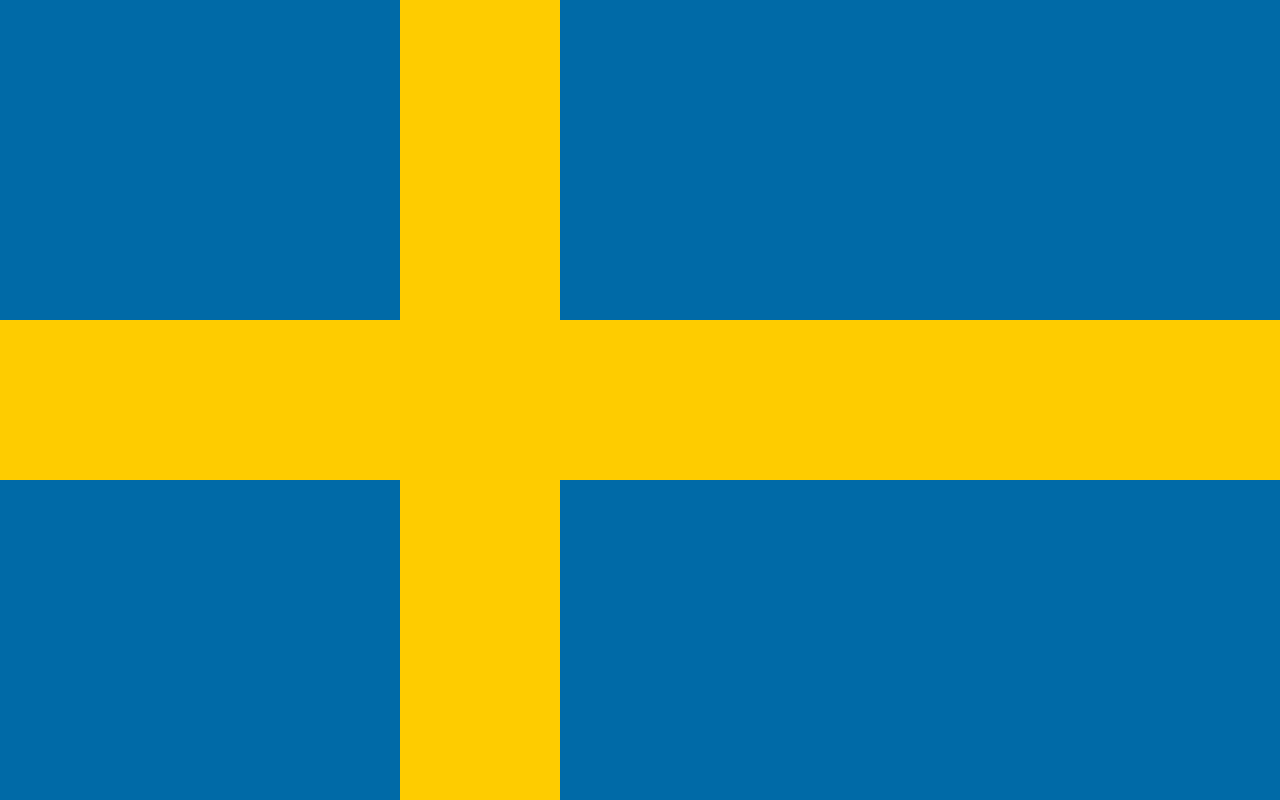
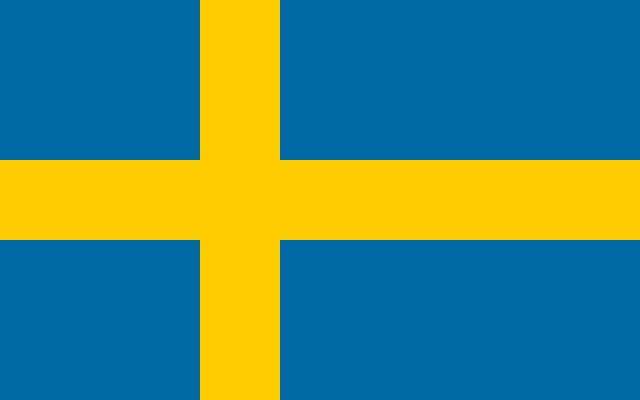
Few national emblems feel as quietly confident as the Swedish flag. A deep blue field crossed by a sunlit yellow band, it manages to be both bold and serene at once, a banner you might spot fluttering above a summer cottage, snapping in the wind at a hockey arena, or stitched onto the back of a backpacker drifting through Stockholm's old town. It belongs to a family of Nordic cross flags, yet its particular pairing of blue and gold gives it an identity all its own. This is also one of the oldest national flag designs still in continuous use, a piece of living heritage whose roots stretch back centuries before its colors and proportions were finally fixed into law.
A Cross Laid Across the Sky
The Swedish flag is instantly recognizable for one distinctive structural choice: the cross is not centered. Like every member of the Nordic family, Sweden's flag uses a cross whose vertical arm sits closer to the hoist, the edge nearest the flagpole. This shifts the visual weight toward the staff and stretches the cross's outer arm toward the fly, the free-flowing edge. The design divides the field into four rectangles, two squares near the pole and two longer panels reaching outward.
The yellow cross runs across a solid blue background, with no border, emblem, or coat of arms cluttering its surface. That simplicity is part of its power. There is nothing to misread and nothing to date it, only two colors and a single geometric gesture. The off-center cross is sometimes called a Scandinavian cross precisely because Sweden and its neighbors share this layout, a horizontal beam meeting a vertical one to form clean quadrants of color.
Why Blue and Yellow
The two colors are not decorative accidents. According to long-standing tradition, the blue and yellow carry meanings tied to national character: the colors are said to represent loyalty and generosity, virtues a nation might hope to embody. The combination is also closely linked to Sweden's older heraldry, echoing the gold and blue of the national coat of arms with its three crowns set against a blue ground.
The cross itself carries the older European symbolism shared across the Nordic flags. As a Christian cross laid out in the medieval style, it signals the region's deep historical ties to Christianity, a thread that runs through the heraldry of all the Scandinavian states. So the flag works on two levels at once: blue and gold speak to Swedish identity and values, while the cross places Sweden within a broader northern European tradition.
An Old Banner Finally Written Into Law
One of the most fascinating things about the Swedish flag is the gap between how old the design is and how recently it became official. The blue-and-yellow cross is no modern invention. Records of the design reach back to at least 1569, meaning Swedes were flying recognizably similar banners more than four and a half centuries ago. For much of that history the flag's exact shape and shades varied with use, custom, and the swirl of regional and dynastic politics across the Baltic.
It was not until 1906 that the flag's modern form was formally adopted and its specifications set down. That year marked the close of a period of union with Norway, and fixing the national flag in law was part of redefining Sweden as a fully independent state with its own clear symbols. So while the design is genuinely ancient, the flag as a precisely regulated national standard is a creation of the early twentieth century. That blend of long folk tradition and formal modern codification is exactly why it is so often cited as one of the oldest flags still in use today.
Sweden Among Its Nordic Cousins
Set the Swedish flag beside its neighbors and the family resemblance is unmistakable. Denmark's red flag with a white cross is generally regarded as the original Nordic cross and the inspiration for the rest. Norway adds a smaller cross inside its cross, Finland uses blue on white, and Iceland mirrors Norway's palette with different proportions. All of them share that signature off-center cross shifted toward the hoist.
So what keeps Sweden's flag from blurring into the group? Color, above all. The bright golden cross on a saturated blue field is a palette no other Nordic nation uses, making Sweden the easy one to pick out at a glance. Where Denmark and Norway lean on red and white, and Finland on a cool, pale scheme, Sweden's warm yellow against deep blue reads almost like a clear summer sky over a field of rapeseed. The shared geometry signals kinship; the distinctive colors signal independence. If you want the fuller story of the nation behind the banner, our sweden country guide digs into its geography, culture, and history.
A Symbol Woven Into Everyday Life
In Sweden the flag is less a ceremonial relic than a familiar part of the calendar. It appears on official flag days throughout the year and is closely associated with National Day on the sixth of June, when the blue and gold are flown across the country. You will also see it raised at countless private celebrations, from Midsummer gatherings to birthdays, where flying the flag is a warm domestic gesture rather than a strictly political statement.
The colors have escaped the flagpole entirely and become national shorthand. Swedish athletes carry blue and yellow into the Olympics, world championships, and football and hockey matches, where crowds paint their faces in the two shades. The palette turns up on packaging, design, and branding that wants to signal Swedish origin. Few color pairings are so tightly bound to a single national identity, and that is a quiet testament to how deeply the flag's scheme has settled into the culture.
A Flag of the Far North
Geographically, Sweden sits in northern Europe, occupying the eastern flank of the Scandinavian Peninsula alongside Norway and across the Baltic from Finland and the other states that ring that sea. This northern setting is woven into how people read the flag's colors, with the blue and gold often poetically tied to the long summer days, blue skies, and golden light of the high latitudes. Whatever the precise origin of the shades, the flag feels at home in its landscape, a banner that looks entirely natural against snow, sea, and the endless light of a northern June.
Quick Facts Worth Knowing
- The design uses an off-center Nordic cross, shifted toward the hoist, exactly like other Scandinavian flags.
- Its two colors are blue and yellow, traditionally linked to loyalty and generosity.
- The cross carries the region's shared Christian heraldic symbolism.
- The design dates back to at least 1569, making it one of the oldest in continuous use.
- It was formally adopted in its modern, regulated form in 1906.
- Sweden's warm blue-and-gold palette sets it apart from its red, white, and pale-blue Nordic relatives.
Frequently Asked Questions
When was the Swedish flag adopted?
The flag was officially adopted in its modern, legally defined form in 1906, around the end of Sweden's union with Norway. The underlying design, however, is far older, with records of the blue-and-yellow cross going back to at least 1569.
What do the colors of the Swedish flag mean?
The blue and yellow are traditionally said to represent loyalty and generosity, and they echo Sweden's older heraldry of gold on blue. The cross itself reflects the Christian symbolism shared across the Nordic flags.
Who designed the Swedish flag?
There is no single named designer. The flag grew out of centuries of Swedish heraldic tradition and use rather than being created by one individual, with the design documented from at least 1569 before being formalized into law in 1906.
What continent is Sweden on, and how does its flag compare to others?
Sweden is in northern Europe, on the Scandinavian Peninsula. Its flag belongs to the Nordic cross family alongside Denmark, Norway, Finland, and Iceland, all sharing the off-center cross. Sweden stands out through its distinctive yellow-on-blue color scheme.