
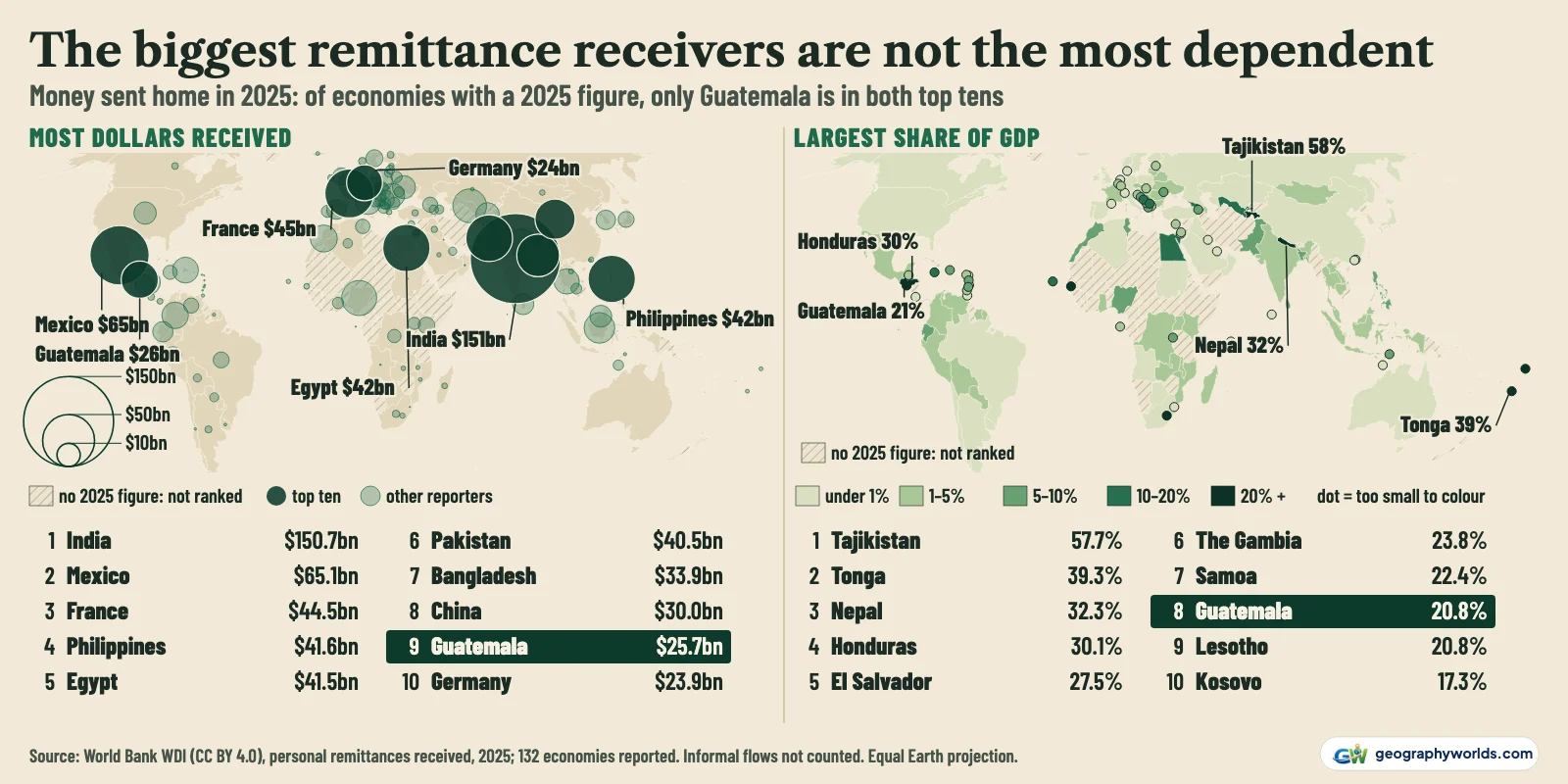
India received the most remittances of any country in 2025: $150.7 billion, more than double second-placed Mexico ($65.1 billion), according to the World Bank. France came third with $44.5 billion, then the Philippines ($41.6 billion), Egypt ($41.5 billion) and Pakistan ($40.5 billion). Measured against the size of the economy the order changes completely: Tajikistan leads at 57.7% of GDP, ahead of Tonga (39.3%) and Nepal (32.3%). Among economies with a 2025 figure, only Guatemala makes both top tens. These are official figures for the 132 economies with 2025 data, and they leave out money carried by hand or moved through informal channels.
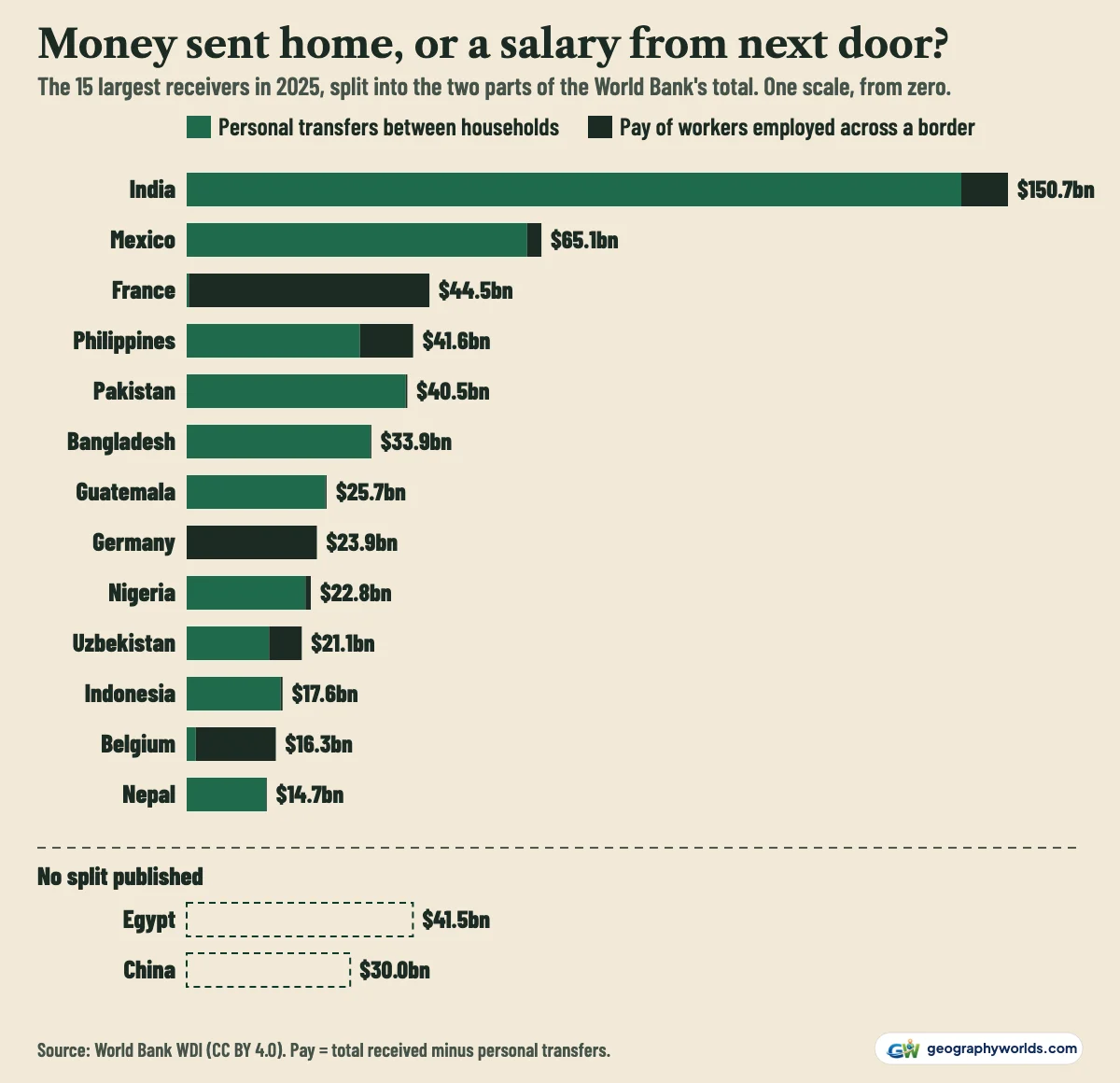
A remittance, in the World Bank's definition, covers two things: money passed between households across a border, and the pay of people employed in a country where they do not live. That second part explains one surprise in the table below.
| Rank | Economy | 2025 ($ billion) | Change on 2024 | % of GDP | Rank by % of GDP |
|---|---|---|---|---|---|
| 1 | India | 150.7 | +9.5% | 3.8 | 43 |
| 2 | Mexico | 65.1 | −4.2% | 3.6 | 48 |
| 3 | France | 44.5 | +9.4% | 1.3 | 77 |
| 4 | Philippines | 41.6 | +3.2% | 8.5 | 22 |
| 5 | Egypt | 41.5 | +40.5% | 11.4 | 14 |
| 6 | Pakistan | 40.5 | +15.9% | 9.9 | 18 |
| 7 | Bangladesh | 33.9 | +23.1% | 7.4 | 28 |
| 8 | China | 30.0 | +20.1% | 0.2 | 113 |
| 9 | Guatemala | 25.7 | +18.6% | 20.8 | 8 |
| 10 | Germany | 23.9 | +7.8% | 0.5 | 98 |
| 11 | Nigeria | 22.8 | +3.0% | 7.8 | 25 |
| 12 | Uzbekistan | 21.1 | +27.3% | 14.4 | 12 |
| 13 | Indonesia | 17.6 | +9.7% | 1.2 | 79 |
| 14 | Belgium | 16.3 | +5.6% | 2.3 | 62 |
| 15 | Nepal | 14.7 | +30.6% | 32.3 | 3 |
The 132 reporters together took in $925.6 billion in 2025, of which $703.6 billion went to low- and middle-income economies. India alone accounts for 16% of the reported total. Places four to six are close to a dead heat: the Philippines, Egypt and Pakistan sit within about a billion dollars of each other, and the Philippine central bank's own count of $39.62 billion would put the country behind both. Read those three places as a tie.
From the United States to Mexico and Central America
This corridor could hardly be more lopsided. BBVA Research, working from Banco de México data, reports that 97.1% of Mexico's remittances come from the United States, and 99.0% arrive as electronic transfers. The World Bank's $65.1 billion is the wider measure, adding pay and other transfers to the $61.8 billion in family remittances that Banxico counts.
2025 was also the year the run ended. After eleven straight annual increases, Banxico's total fell 4.6%, and the World Bank's fell 4.2%. The same BBVA note reports the opposite further south: Honduras up 25.3%, Guatemala up 18.7% and El Salvador up 17.8%. Guatemala's $25.7 billion makes it the No. 9 receiver in the world, at 20.8% of its GDP, and that combination is what puts it on both lists.
The United States now levies a 1 percent tax on certain remittance transfers made after 31 December 2025. BBVA suggests that senders rushing to beat it may have softened Mexico's fall in the final months of 2025, a possibility rather than a measured effect.
From the Gulf to Pakistan, and the rivals overtaking it in India
Pakistan still fits the old picture of Gulf money. In the fiscal year to June 2026, State Bank figures reported by Gulf News show a record $41.6 billion, with $9.78 billion from Saudi Arabia, $8.81 billion from the United Arab Emirates and $6.33 billion from the United Kingdom. Bangladesh's central bank recorded $32.8 billion in calendar 2025, against the World Bank's $33.9 billion.
India has moved on. In the Reserve Bank of India's survey for 2023-24, the United States supplied 27.7% of inward remittances, the UAE 19.2% and the United Kingdom 10.8%. The United States, the United Kingdom, Singapore, Canada and Australia together supplied more than half, ahead of the Gulf states. Of the World Bank's $150.7 billion for 2025, $142.1 billion is personal transfers, a line that also includes deposit withdrawals by non-resident Indians and gifts. The narrower count of workers' remittances was reported at about $110 billion for 2025-26, so "more than double Mexico" holds on the World Bank basis only. India stays first either way.
From Russia to Central Asia
The third corridor is smaller in dollars and heavier in consequence. Uzbekistan's central bank counted $18.9 billion in 2025, up from $8.1 billion in 2021, while the World Bank's total, which includes pay of workers employed abroad, is higher at $21.1 billion. Between January and October, Russia supplied $12.3 billion of the $15.8 billion received, nearly 78%.
Tajikistan is where this corridor becomes a national dependency. The World Bank records $10.2 billion, or 57.7% of GDP, up from 47.2% the year before. Other bodies put it lower: the Asian Development Bank estimates $9.2 billion, or 52% of GDP, and the Eurasian Fund for Stabilization and Development says 54.5%. Every one of those figures is the highest in the world by a wide margin, and the ADB notes that the money comes mostly from Russia. The World Bank's split shows about 70% as pay in every year since 2019, so it is a fixed estimate rather than a measurement.
The Eurasian fund projects the share falling to 43.2% of GDP in 2026 and 32.8% by 2029, citing tighter Russian migration policy and a weaker rouble. Those are projections, not results.
From Geneva to the French border: a salary, not a remittance
France's place in the top three looks odd until you split the total. Only $0.39 billion of its $44.5 billion is personal transfers. The other 99% is pay earned by French residents working for employers abroad, and that is why France appears on a list dominated by emigration countries. It also pays out: $22.7 billion left France under the same heading in 2025. The ranking here counts money received, gross, and at 1.3% of GDP this income is modest for the country.

Crossings like this one carry the fourth corridor. Switzerland counted about 403,000 cross-border commuters with G permits at the end of September 2024, and 57% of them lived in France. The Banque de France's annual report, as reported by Paperjam, counts €39.1 billion of wages received from abroad in 2025, close to the World Bank's pay figure once converted to dollars.
Germany shows the same pattern more sharply: $23.9 billion received, with just $4.5 million of it personal transfers. Belgium's $16.3 billion is 90% pay. The Philippines has a real wage component too, at 24%, as does Uzbekistan at 28%.
The small economies that lean hardest on this money
Turn the ranking around and almost every familiar name disappears. The ten most dependent economies received $76.4 billion between them in 2025, 51% of India's total. China's $30.0 billion amounts to 0.2% of its GDP. Tonga's $0.27 billion, by contrast, is 39.3% of an economy that sits at No. 105 in dollars received; the IMF's own count for fiscal 2025 is $265.5 million, close to the same figure.
| Rank | Economy | % of GDP | $ billion | Rank by dollars |
|---|---|---|---|---|
| 1 | Tajikistan | 57.7 | 10.2 | 23 |
| 2 | Tonga | 39.3 | 0.27 | 105 |
| 3 | Nepal | 32.3 | 14.7 | 15 |
| 4 | Honduras | 30.1 | 11.9 | 20 |
| 5 | El Salvador | 27.5 | 10.1 | 24 |
| 6 | The Gambia | 23.8 | 0.62 | 90 |
| 7 | Samoa | 22.4 | 0.29 | 103 |
| 8 | Guatemala | 20.8 | 25.7 | 9 |
| 9 | Lesotho | 20.8 | 0.54 | 95 |
| 10 | Kosovo | 17.3 | 2.2 | 62 |
Several kinds of dependence sit in that list. Nepal's $14.7 billion reached 32.3% of GDP, up from 26.0% a year earlier, and Nepal Rastra Bank reports $16.19 billion for the year to mid-July 2026. Honduras (30.1%) and El Salvador (27.5%) belong to the American corridor. Lesotho, entirely surrounded by South Africa, has 98.6% of its $0.54 billion recorded as pay, a ratio that barely moves from year to year and so is again an estimate. Guatemala edges Lesotho for eighth place only at the second decimal, 20.82% against 20.79%.
Dependence of this kind is a different measure from poverty, which has its own ranking in our guide to the poorest countries in the world. What a high share does mean is exposure: a change in a foreign labour market or visa rule lands directly on household budgets.
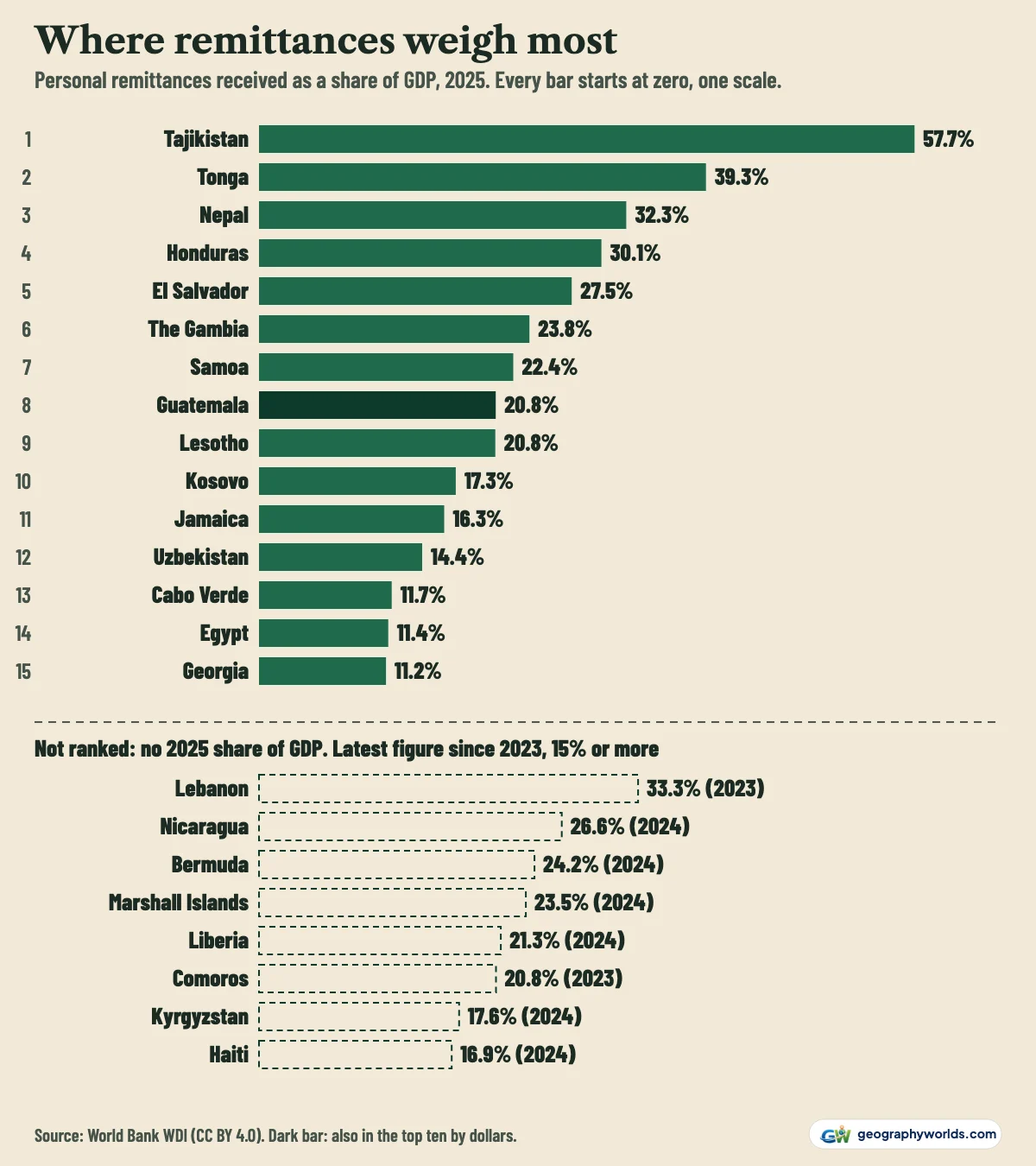
The list is incomplete in a way that matters. Lebanon has no figure after 2023, when remittances were 33.3% of GDP, which would place it third if the share had held. Comoros stands at 20.8% (2023). Nicaragua (26.6%), Bermuda (24.2%), the Marshall Islands (23.5%), Liberia (21.3%), Kyrgyzstan (17.6%) and Haiti (16.9%) last showed a share for 2024, and the Inter-American Development Bank puts Nicaragua near 30% for 2025. Bermuda reports 2025 dollars but no share, which is why 131 economies have a share against 132 with a dollar total. Six of these latest shares exceed Guatemala's, so counting them would drop it to 14th, and in 2024, with fuller reporting, no economy made both top tens. These cases stay separate because a blank is not a zero.
What the ledger cannot see
All these figures are recorded flows. The World Bank's own notes warn that remittances sent by informal channels, including cash or goods carried across borders, are often poorly covered, and the quality of the data is not high. Egypt shows how much that can matter.
The recorded total fell from $28.3 billion in 2022 to $19.5 billion in 2023, and reached $41.5 billion in 2025, a figure matched by the Central Bank of Egypt's. The World Bank attributed the slump to the widening gap between official and unofficial exchange rates, which pushed senders to informal channels, and EnterpriseAM reports flows returning to official channels after the March 2024 float of the pound. Part of the swing was money moving in and out of sight, not money appearing and vanishing.
85 of the 217 economies the World Bank tracks have no 2025 figure, so they are unranked rather than counted as zero. Most are small: the largest 2024 reporter missing from the 2025 table is Ethiopia, at $7.1 billion, well short of the top 15, and that figure jumped from $0.54 billion in 2023, which looks like a change in the series. Some gaps are larger. Vietnam's last figure in this series is for 2004, yet Ho Chi Minh City alone reported more than $10.34 billion in 2025, a sum only 22 ranked economies exceeded. Iran, Syria, Cuba and Somalia have no recent figure either.
Rebuilding this ranking yourself
Rankings use the World Bank's World Development Indicators as updated on 8 October 2026, for calendar 2025, in current US dollars. Regional and income-group aggregates were removed using the API's own country metadata, leaving 217 economies, some of them territories such as Hong Kong or Bermuda. You can download the data as a CSV with all 217 economies, including their 2024 figures and the year each last reported, and load that file into Parity if you want charts of a single corridor or region.
- World Bank, World Development Indicators: personal remittances received (BX.TRF.PWKR.CD.DT): current US dollars, 2025 and earlier years, last updated 8 October 2026; compiled from IMF balance-of-payments data and World Bank staff estimates; licence CC BY-4.0 as stated in the series metadata
- World Bank, World Development Indicators: personal remittances received, % of GDP (BX.TRF.PWKR.DT.GD.ZS): CC BY-4.0
- World Bank, World Development Indicators: personal transfers received (BX.TRF.PWKR.CD) and personal remittances paid (BM.TRF.PWKR.CD.DT): used to separate household transfers from wages of workers employed across a border; CC BY-4.0
- BBVA Research, Mexico remittances, close of 2025 (February 2026): Banco de México totals and origin shares
- Natural Earth country outlines (via world-atlas): public domain; map only
Remittances are the visible trace of people living somewhere other than home, so the natural next question is where those people have gone: our look at the countries with the most immigrants maps the other end of these corridors.