
Few flags in the Arab world manage to be both instantly recognizable and quietly meaningful, but the banner of the United Arab Emirates pulls it off. Raised for the first time in December 1971, the day a cluster of small Gulf sheikhdoms agreed to govern themselves as one federation, it is a young flag by world standards, yet it speaks in an ancient visual language. Its four colors are the shared inheritance of Arab peoples stretching back more than a thousand years, and they were chosen to announce that seven emirates had become a single nation. This article unpacks what those colors mean, how the design is arranged, where it came from, and how it lives in Emirati life today.
A Tricolor With a Twist
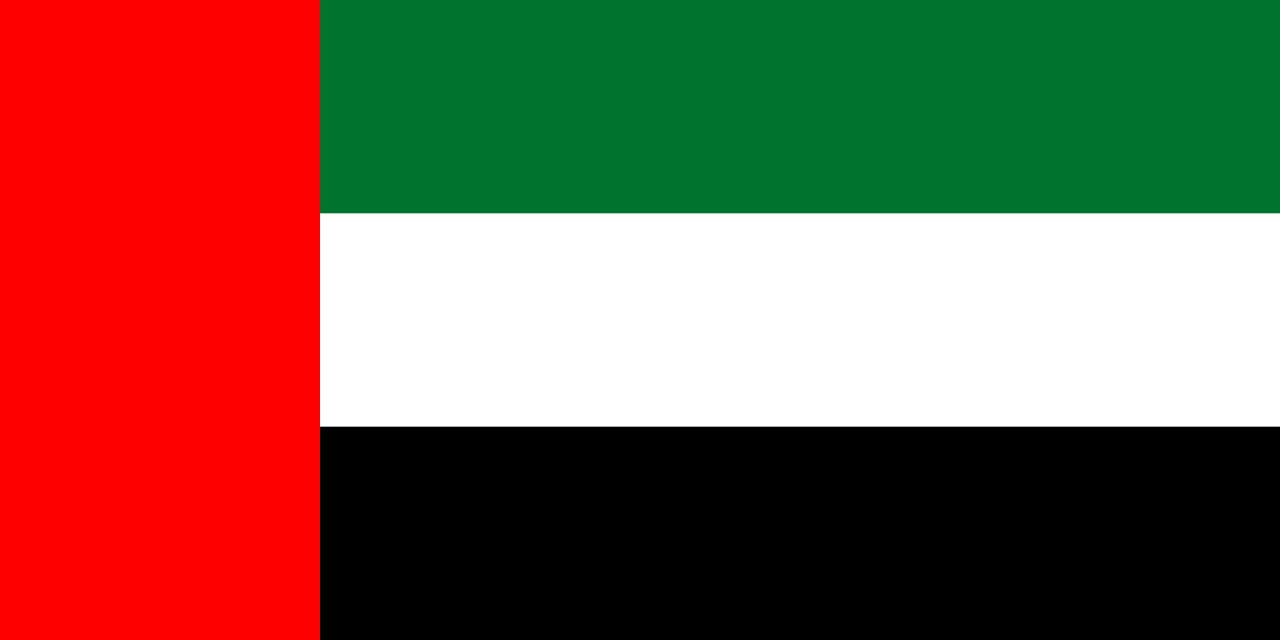
At a glance the UAE flag looks like a clean horizontal triband: three equal stripes of green, white, and black running from top to bottom. What sets it apart is the vertical red band running down the hoist, the edge nearest the flagpole, which cuts across all three stripes. That single red column transforms a simple stacked tricolor into something more dynamic, giving the flag a strong anchor and a sense of balance. The red band occupies roughly a quarter of the flag's width, while the green, white, and black stripes share the remaining space in equal horizontal layers.
This combination of a horizontal triband with a vertical hoist band is not unique in the region, but the specific proportion and color order make the Emirati version its own. The layout is deliberately uncomplicated, with no emblem, crest, or writing in the standard civil and state flag. That simplicity was a choice: the new federation wanted a symbol that any citizen could draw from memory and that would read clearly from a distance, whether flying over a desert fort or a glass tower in Abu Dhabi.
What the Four Colors Mean
The UAE flag uses the four Pan-Arab colors, a palette long associated with Arab unity and the great dynasties and movements of Arab history. On this flag the colors carry layered meaning. Red stands for the courage, strength, and sacrifice of the people, and historically it appears in the banners of several Gulf emirates. Green represents hope, fertility, and the land's capacity for growth, a powerful idea in a country shaped by desert. White signals peace, honesty, and neutrality. Black is often read as a symbol of resolve and the defeat of enemies, and in the modern era it is also linked to the oil wealth that transformed the nation.
Taken together the colors broadcast a single message of unity, fertility, neutrality, and prosperity. Importantly, each color also resonates with specific values in wider Arab culture, so the flag works on two levels at once: it tells the story of the Emirates while connecting that story to the broader Arab world. This dual meaning is part of why the design has aged so gracefully since its adoption.
Born With the Federation in 1971
The flag and the country share a birthday. Before 1971 the territory was a patchwork of British-protected sheikhdoms known as the Trucial States, each flying its own banner, many of them featuring red fields with white borders or panels. As Britain prepared to withdraw from the Gulf, the rulers of the emirates negotiated a union. When the United Arab Emirates was formally proclaimed, a new national flag was needed to express that union, and the four-color design was adopted at the moment of the federation's creation.
The choice to abandon the older red-and-white emirate banners in favor of the full Pan-Arab palette was significant. It set the new federal identity above any single emirate's heritage while still honoring the red that so many of them had flown. Since 1971 the basic design has remained remarkably stable; unlike many nations that have revised their flags repeatedly, the UAE has kept the same arrangement of colors for its entire history as a country, which has helped cement the banner as a fixed point of national identity.
Cousins on the Flagpole
Because so many Arab nations draw on the same red, green, white, and black palette, the UAE flag has a number of relatives that newcomers sometimes confuse. Jordan, Kuwait, Palestine, and Sudan all use Pan-Arab colors in horizontal arrangements with a triangle or band at the hoist, and at small sizes they can blur together. The clearest way to distinguish the UAE flag is to look for its three full-width horizontal stripes of green, white, and black with a plain vertical red bar on the left and no triangle, star, or chevron.
Kuwait's flag, for instance, uses a black trapezoid at the hoist rather than a straight red band, and Jordan and Palestine place a red triangle there. Sudan's red band sits along the top as a stripe, not vertically at the hoist. The UAE's choice of red, specifically, as the vertical element rather than black or as a triangle, is its signature. If you want to dig deeper into the country behind the banner, the united arab emirates country guide offers a fuller picture of its geography and culture.
A Symbol Stitched Into National Identity
For Emiratis the flag is more than government decoration. It marks the achievement of the founding generation who chose unity over isolation, and it appears everywhere from school assemblies to skyscraper facades. The country celebrates Flag Day, observed each year in early November to mark the date a national leader assumed leadership and raised the flag, and on that day citizens, schools, and companies hoist the banner together in a coordinated show of pride.
The flag also takes center stage during National Day on December 2, the anniversary of the 1971 union, when cities erupt in red, green, white, and black lights, car convoys, and fireworks. These rituals keep the meaning of the colors alive for each new generation, turning an abstract design into a lived emotional touchstone.
The Flag in Modern Life
Today the Emirati flag turns up in contexts the founders could scarcely have imagined. It flies behind athletes at the Olympics and on the jerseys of the national football team, it is painted across the fuselages of the country's airlines and rockets, and it has been carried to space by an Emirati astronaut. Giant versions are unfurled on towers and waved at Formula 1 races and air shows. Across all these settings the flag does the same job it did in 1971: it tells the world that seven emirates speak as one.
Here are a few quick facts worth remembering:
- The flag was adopted in 1971, the same year the federation of seven emirates was formed.
- It uses the four Pan-Arab colors: red, green, white, and black.
- The design is a horizontal triband of green, white, and black with a vertical red band at the hoist.
- The standard national flag carries no emblem, star, or writing, keeping it clean and easy to reproduce.
- The United Arab Emirates sits on the continent of Asia, in the southeastern corner of the Arabian Peninsula.
- Each color reflects specific values rooted in Arab cultural tradition as well as the national story.
Frequently Asked Questions
When was the United Arab Emirates flag adopted?
The flag was adopted in 1971, at the moment the United Arab Emirates was formed as a federation of seven emirates. The flag and the country effectively share the same founding year, and the design has remained unchanged ever since.
What do the colors of the UAE flag mean?
The flag uses the four Pan-Arab colors. Red represents courage and strength, green stands for hope and fertility, white symbolizes peace and neutrality, and black signals resolve and is associated with the country's oil wealth. Together they express unity, fertility, neutrality, and prosperity.
Who designed the UAE flag?
The flag was created for the founding of the federation in 1971 as the work of the new nation rather than a single celebrated individual in popular memory. Its design drew on the Pan-Arab color tradition and on the red banners that the earlier Trucial emirates had long flown.
What continent is the United Arab Emirates on, and how does its flag compare to similar ones?
The United Arab Emirates is located in Asia, on the Arabian Peninsula. Its flag shares the Pan-Arab palette with countries like Jordan, Kuwait, Palestine, and Sudan, but it is distinguished by its three full horizontal stripes of green, white, and black paired with a plain vertical red band at the hoist, with no triangle, star, or trapezoid.