
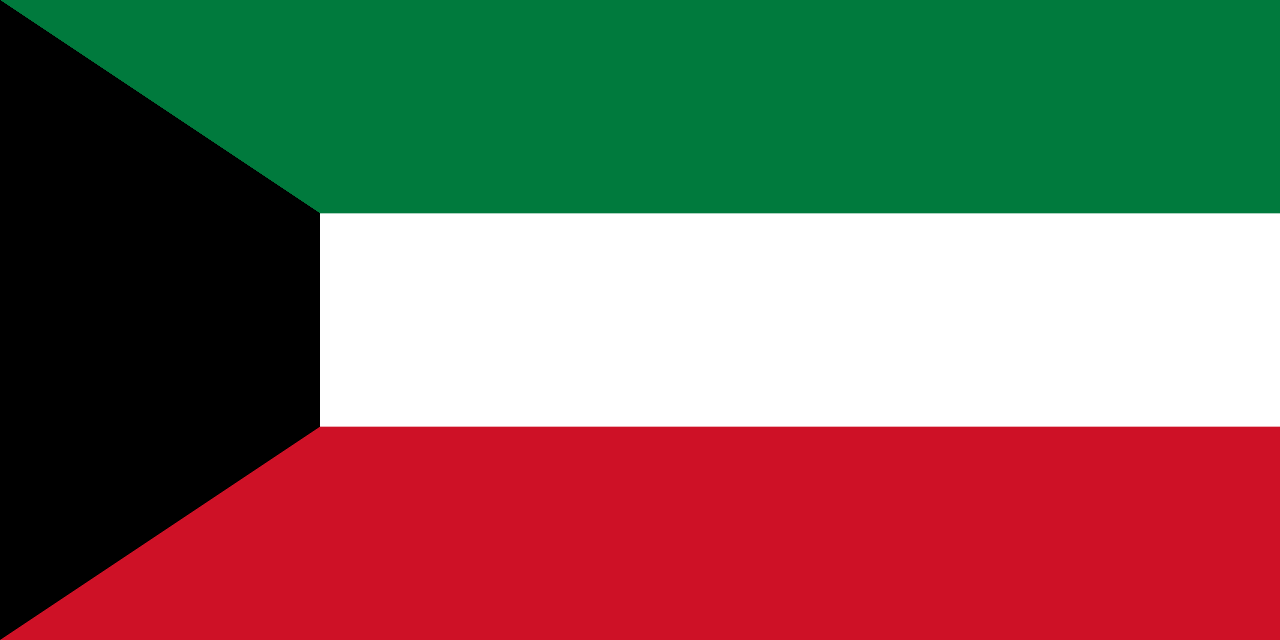
Among the banners of the Arabian Peninsula, the flag of Kuwait stands out for one bold geometric decision: a solid black trapezoid wedged against the hoist, unlike anything found on another country's national flag. The rest of the design is a clean horizontal arrangement of green, white, and red bands, a layout that places Kuwait firmly within the family of Arab nations while giving it an instantly recognizable signature. Raised for the first time in 1961, the year Kuwait gained its independence from Britain, the flag was a deliberate break from the plain red banners that had flown over Gulf sheikhdoms for generations. It announced a sovereign state with its own emblem, its own story, and its own place among the world's nations.
A Quartet of Colors and Their Meaning
Kuwait's flag carries four colors, and each one is drawn from the shared vocabulary of the wider Arab world. These are the Pan-Arab colors, a palette of green, white, red, and black that appears across the region and ties Kuwait to a broader cultural and political heritage rather than standing apart from it. On Kuwait's banner the colors are read together as a kind of compact poem about the nation's character.
Green represents the fertility of the land, the gardens and oases that survival in a desert climate depends upon. White signals purity and the honorable intentions of the people and their deeds. Red recalls the blood spilled in the defense of the homeland, a sober nod to sacrifice. And black, set apart in the trapezoid, is traditionally read as the defeat of enemies on the battlefield. Taken as a set, the four colors weave together themes of growth, virtue, sacrifice, and triumph, a message that resonates well beyond Kuwait's borders.
How the Design Is Laid Out
The construction is straightforward to describe yet visually distinctive. Three horizontal bands of equal height stack from top to bottom in the order green, white, red. Over the hoist edge, a black trapezoid is laid on top of all three bands, its wider side flush against the flagpole and its shorter parallel edge pointing inward toward the center of the flag. This is what distinguishes Kuwait from a simple horizontal tricolor: the black shape interrupts the bands at the hoist and gives the flag a sense of forward motion, almost as if the colors are streaming out from behind it.
Because the black element is a trapezoid rather than the more common triangle, the flag has a geometry that no other national banner shares. The angled edges of the shape catch the eye and prevent the design from reading as just another striped flag. It is a small but decisive piece of engineering, and it is the detail that flag enthusiasts point to first when they describe Kuwait's emblem.
From Plain Red Banners to a National Flag
Before 1961, the territory that became modern Kuwait flew flags in the older Gulf tradition, typically red fields sometimes bearing the country's name or simple inscriptions in white. These red banners were common among the emirates and sheikhdoms along the Arabian coast and did little to set one polity apart from its neighbors. As Kuwait moved toward full sovereignty, the leadership recognized that an independent nation needed an emblem of its own.
The new flag was adopted at independence, when Kuwait ended its protectorate relationship with Britain and took its seat among the world's sovereign states. By choosing the Pan-Arab colors, the designers anchored the young nation in a shared regional identity, and by adding the unique black trapezoid they ensured that Kuwait's banner could never be mistaken for any other. The flag has flown unchanged in its essentials ever since, a steady presence through decades of dramatic regional history. For travelers curious about the country behind the banner, our kuwait country guide offers a fuller picture of its geography and culture.
Comparing Kuwait's Flag to Its Neighbors
The Pan-Arab palette means Kuwait's flag invites comparison with several others, and the similarities are real. The flags of Jordan, Palestine, the United Arab Emirates, and Sudan all draw on the same green, white, red, and black combination, and at a glance a casual observer might group them together. This is intentional: the colors signal solidarity and a common heritage that stretches back to the early twentieth-century Arab Revolt and its banners.
What sets Kuwait apart is the geometry. Where Jordan and Palestine use a triangle at the hoist and the UAE places a vertical red bar at the hoist beside three horizontal stripes, Kuwait alone uses a trapezoid. That single shape is the deciding feature. So while the color scheme places Kuwait in good company, the silhouette is unmistakable. Once you have learned to look for the slanted black quadrilateral, you will never confuse Kuwait's flag with any of its relatives again.
A Symbol Woven Into National Life
For Kuwaitis the flag is far more than a diplomatic formality. It appears on public buildings and embassies, on ships and aircraft, and across the country during moments of collective celebration. National Day and Liberation Day, observed in late February, turn the streets into rivers of green, white, red, and black, with the flag draped from balconies, painted on faces, and flown from cars in long, honking convoys. The banner becomes a shared language of belonging during these days.
The colors also surface in sport, where Kuwaiti athletes and supporters carry them into stadiums, and in everyday civic design, where the palette echoes through logos and public spaces. The flag's strong, simple shapes make it equally effective at the scale of a stadium banner or a lapel pin. That versatility has helped it become a genuine touchstone of national pride rather than a remote official emblem.
Interesting Facts at a Glance
- The black trapezoid at the hoist is unique among the world's national flags, making Kuwait's design instantly identifiable.
- The flag uses the Pan-Arab colors, the same green, white, red, and black found on the banners of several other Arab nations.
- It was first raised in 1961, the year Kuwait became independent from Britain.
- Each color carries a distinct meaning: green for fertility, white for purity, red for the blood of defense, and black for the defeat of enemies.
- Before 1961, the region flew plain red banners in the older Gulf tradition.
- The flag's bold geometry reads clearly whether printed at tiny scale or flown across a stadium.
Frequently Asked Questions
When was the flag of Kuwait adopted?
Kuwait adopted its current flag in 1961, the year it gained independence from Britain. The banner replaced the older plain red flags of the Gulf tradition and has remained essentially unchanged since.
What do the colors of the Kuwaiti flag mean?
The flag uses the four Pan-Arab colors. Green stands for the fertility of the land, white for purity and honorable deeds, red for the blood shed in the nation's defense, and black for the defeat of its enemies.
What makes Kuwait's flag different from other Arab flags?
Many Arab flags share the green, white, red, and black palette, but Kuwait is the only one that uses a black trapezoid at the hoist. Others such as Jordan and Palestine use a triangle, so the trapezoid is Kuwait's unmistakable signature.
What continent is Kuwait on?
Kuwait lies in Asia, on the northeastern edge of the Arabian Peninsula along the Persian Gulf. It sits among the Gulf states whose flags often share its Pan-Arab color scheme.