
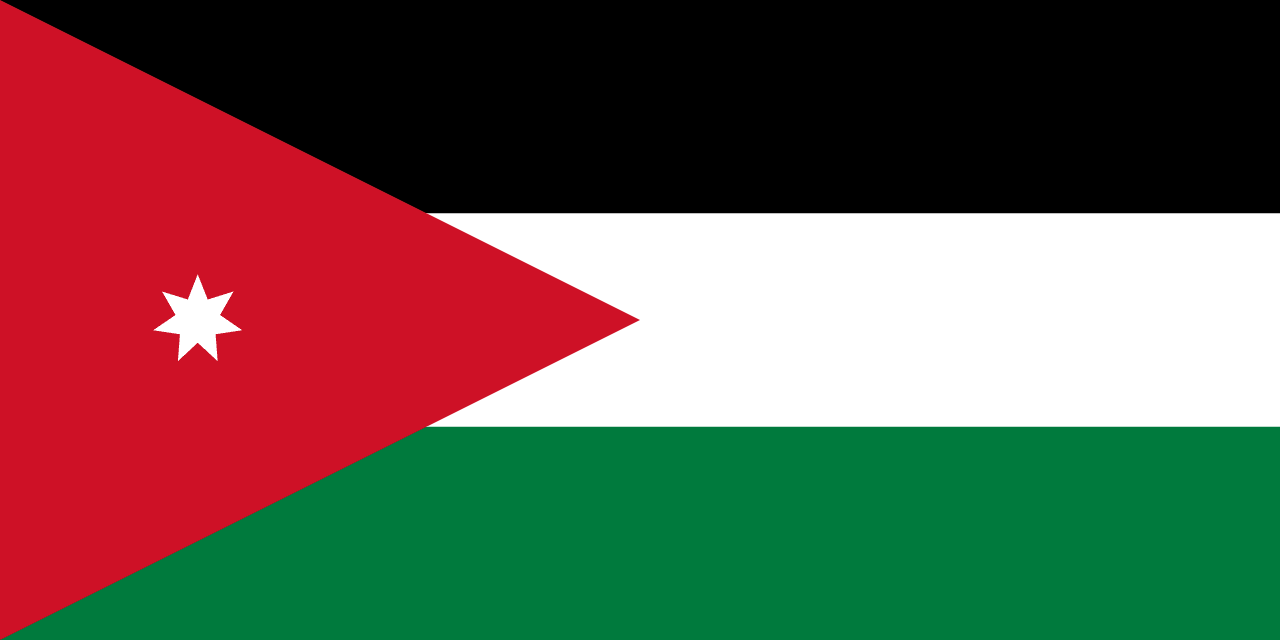
Few flags in the Middle East carry their history as openly as the flag of Jordan. At first glance it is a clean horizontal tricolor of black, white, and green, split by a crimson triangle pinned to the hoist. But every band, the triangle, and the small white star inside it point back to a single defining moment: the Arab Revolt of the First World War, when tribes and towns across the desert rallied under one banner. Adopted in 1928, the Jordanian flag is less a decorative emblem and more a compressed timeline of Arab nationhood, and it remains one of the clearest expressions of the pan-Arab idea anywhere on the map.
A Banner Born From the Arab Revolt
To understand the flag, you have to start with the rebellion that inspired it. During the 1916 Arab Revolt against Ottoman rule, the leaders of the uprising adopted a flag combining black, white, green, and red — colors meant to evoke the great Arab dynasties and unite the fragmented provinces under one cause. When the Emirate of Transjordan took shape after the war, it carried that revolutionary banner forward, formalizing its own version in 1928. The continuity was deliberate. Rather than invent a brand-new identity, the new state chose to declare itself the political heir of the revolt, and the flag became the visual proof of that lineage.
That choice is why the Jordanian flag looks so similar to several of its neighbors. They all drew from the same well, the Arab Revolt flag serving as a shared template for an entire generation of emerging states across the region.
Reading the Colors
The four colors are the classic pan-Arab palette, and each is tied to a chapter of Arab and Islamic history. Conventionally, they are read this way:
- Black recalls the Abbasid Caliphate, whose banners were black.
- White evokes the Umayyad dynasty, associated with white standards.
- Green represents the Fatimid Caliphate and is also broadly tied to Islam.
- Red — the color of the triangle — stands for the Hashemites and the blood and sacrifice of the Arab Revolt itself.
What makes the scheme so durable is that it is simultaneously historical and forward-looking. The same four colors that honored medieval caliphates were repurposed to signal a modern, unified Arab future. On the Jordanian flag they are not abstract decoration; they are a roll-call of dynasties stacked into bands of cloth.
The Design, Band by Band
Structurally, the flag is a horizontal triband of three equal stripes — black on top, white in the middle, green at the bottom. Overlaid at the hoist is a red isosceles triangle that reaches roughly to the center of the field, its point aimed toward the fly. The arrangement gives the flag a sense of motion, as if the red wedge is pressing outward into the three horizontal bars.
Set inside the triangle is a small white seven-pointed star. This star is the detail that most distinguishes Jordan from flags built on the same color scheme. Its seven points are usually explained as a reference to the seven verses of the opening chapter of the Quran, Al-Fatiha — a quiet religious anchor inside an otherwise political design. Some interpretations also link the star to the unity of the Arab peoples, a reading that fits neatly with the flag's revolutionary roots. Either way, that single white star turns a generic regional palette into something unmistakably Jordanian.
How It Compares to Look-Alike Flags
Because the Arab Revolt banner was so influential, the flags of Jordan, Palestine, Sudan, and the historical flags of several other Arab states all share the black-white-green stripes with a red triangle at the hoist. To an outsider they can blur together. The differences, though, are precise and meaningful.
The flag of Palestine is the closest match: identical colors and layout, but with a plain red triangle and no star. Sudan reorders the stripes (red, white, black) and likewise omits a star. The old flag of the Ba'athist regimes and various Gulf-era banners played further variations on the same theme. Jordan's signature is the white seven-pointed star floating in the red triangle — a feature no other current national flag in the family carries in exactly the same form. So the rule of thumb is simple: same four colors plus a seven-pointed star equals Jordan. If you are exploring the wider region, the jordan country guide puts this geography in context.
A Symbol of Hashemite Identity
For Jordanians, the flag is bound up with the Hashemite monarchy that has governed the country since its founding. The red triangle's association with the Hashemite family ties the dynasty directly into the national emblem, reinforcing the link between the ruling house and the legacy of the Arab Revolt led by Sharif Hussein of Mecca. This is not incidental symbolism; it is a core part of how the modern state narrates its own legitimacy.
The flag also does cultural work beyond politics. The Quranic reference in the star gives it a spiritual dimension, while the pan-Arab colors place Jordan inside a much larger story of Arab solidarity. It manages to say three things at once — we are Hashemite, we are Arab, we are Muslim — without a single word of text.
The Flag in Modern Jordan
Today the flag is woven into the everyday rhythm of Jordanian life. It flies over government ministries, schools, and the royal palaces in Amman, and appears at full mast during national celebrations such as Independence Day, which marks the end of the British mandate. Jordanian athletes carry it into international competitions, and it is a familiar sight at football matches and Olympic ceremonies, where the red triangle and white star stand out against the field.
The country has also embraced the flag at monumental scale. The Raghadan Flagpole in Amman, one of the tallest free-standing flagpoles in the world when it was raised, was built specifically to fly an enormous Jordanian flag visible across much of the capital — a deliberate statement of national presence on the skyline. In day-to-day civic use, the colors turn up everywhere from official seals to roadside decorations during royal occasions, keeping the design constantly in public view.
Quick Facts Worth Knowing
- The flag was officially adopted in 1928, during the era of the Emirate of Transjordan.
- Jordan sits in the Middle East, in western Asia, bordering Saudi Arabia, Iraq, Syria, the West Bank, and Israel.
- The black, white, green, and red colors are the pan-Arab colors shared across much of the region.
- The white star has seven points, commonly linked to the seven verses of Al-Fatiha, the opening chapter of the Quran.
- The design is directly descended from the flag of the Arab Revolt of 1916.
- The chief visual difference between Jordan's flag and Palestine's is that Jordan's carries a star while Palestine's triangle is plain.
Frequently Asked Questions
When was the flag of Jordan adopted?
Jordan's flag was adopted in 1928, during the period of the Emirate of Transjordan. It was carried forward into the modern Kingdom of Jordan and has remained essentially unchanged, preserving its direct connection to the Arab Revolt banner of 1916.
What do the colors of the Jordanian flag mean?
The colors are the pan-Arab palette. Black recalls the Abbasid Caliphate, white the Umayyad dynasty, and green the Fatimid Caliphate and Islam more broadly. The red triangle represents the Hashemites and the sacrifice of the Arab Revolt. The white seven-pointed star is generally read as a reference to the seven verses of Al-Fatiha and to Arab unity.
What continent is Jordan on?
Jordan is located in Asia, specifically in the Middle East region of western Asia. It shares borders with Saudi Arabia, Iraq, Syria, the West Bank, and Israel, and has a short coastline on the Gulf of Aqaba in the south.
How is Jordan's flag different from Palestine's?
The two flags use the same black, white, and green stripes with a red triangle at the hoist, so they are easy to confuse. The decisive difference is the white seven-pointed star inside Jordan's red triangle; the Palestinian flag's triangle is plain, with no star. That single element is the quickest way to tell them apart.
