

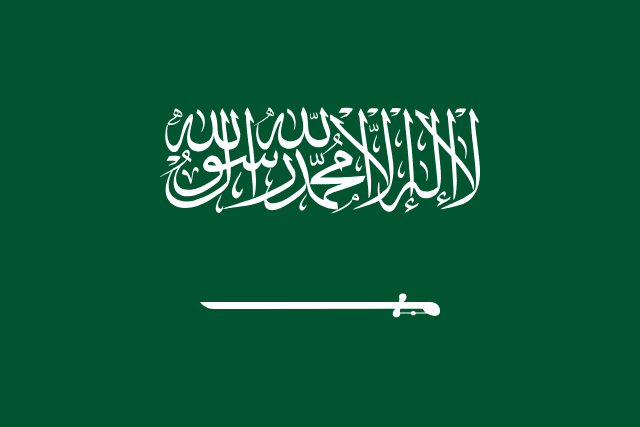
Among the world's national flags, few are as instantly recognizable, or as unusual, as the flag of Saudi Arabia. While most countries reach for abstract bands of color or geometric symbols, the Saudi flag places sacred words at its very heart. Against a deep green field runs a line of flowing Arabic script, underscored by a single horizontal sword. This is not decoration borrowed from heraldry; it is a declaration of faith, and that fact shapes everything about how the flag is designed, displayed, and protected. To understand this banner is to understand how religion, history, and national identity can be woven into a single piece of cloth.
A Flag Built Around Words
The first thing that strikes anyone seeing the Saudi flag is that its central feature is text rather than a star, crest, or stripe. The inscription is the shahada, the Islamic declaration of faith, which translates roughly as "There is no god but God, and Muhammad is the Messenger of God." This creed is the bedrock of Islam, recited by believers around the world. By emblazoning it across the national flag, Saudi Arabia ties its very statehood to its religious mission, especially its role as guardian of the two holiest cities in Islam, Mecca and Medina. Beneath the script lies a horizontal sword, its point traditionally facing the hoist, a clean and decisive line that anchors the design.
The Meaning of Green and White
The two colors of the flag, green and white, carry layered significance. Green dominates as the field of the flag, and it is far from an arbitrary choice. Green has long been associated with Islam and is regarded as a traditional Islamic color, linked in various accounts to paradise, renewal, and the Prophet Muhammad himself. Its use here signals the deeply Islamic character of the Saudi state. White appears in the lettering of the shahada and in the blade of the sword, providing crisp contrast so that the inscription remains legible and prominent. The white also lends the design a sense of clarity and purity, qualities that complement the solemn message of the script. The sword carries its own meaning, representing justice and the strength of the kingdom, a nod to the military and political resolve that helped forge the modern state.
How the Design Is Arranged
The layout of the Saudi flag is deceptively simple but governed by careful convention. The green rectangle serves as a single, unbroken field, with no border, canton, or competing emblem. Across the center flows the shahada in elegant Thuluth-style Arabic calligraphy, written from right to left as Arabic always is. Directly below the script lies the sword, drawn horizontally and aligned beneath the words rather than crossing them. Because Arabic reads right to left, the script is always oriented so that it can be read correctly from the viewer's side. This creates a practical challenge: on a flag, the reverse side would normally show the inscription mirrored. To solve this, the Saudi flag is typically manufactured as two layers sewn together, so that the shahada reads correctly whether you are looking at the front or the back. Few national flags demand this kind of two-sided construction, and it is a direct consequence of the design's reverence for the words it carries.
From the House of Saud to the Modern Banner
The Saudi flag did not appear overnight. Its lineage traces back to banners used by the House of Saud and to the broader tradition of green flags bearing the shahada that were flown across the Arabian Peninsula. The dynasty that founded the kingdom carried such standards for generations, and the modern flag is a refinement of these earlier designs rather than an invention from scratch. Over the decades the proportions, the style of the calligraphy, and the precise rendering of the sword were standardized to produce the version recognized today. The flag in its current official form was adopted in 1973, fixing the details that earlier banners had treated more loosely. That continuity, from the early standards of the ruling family to the codified national flag, gives the design a sense of unbroken heritage that many newer national flags lack. Those interested in the wider story of the nation can explore our saudi arabia country guide for more context on how the kingdom took shape.
How It Compares to Related Flags
Several flags in the Islamic world share elements with Saudi Arabia's, yet the combination remains unique. Green fields appear on a number of flags from Muslim-majority nations, and a few others incorporate the shahada into their designs. The Taliban-associated banners of Afghanistan, for example, have used white fields bearing the shahada, an inversion of the Saudi color scheme. The flag of Iraq carries the phrase "God is the greatest" in script, drawing on the same calligraphic tradition without reproducing the full creed. What sets Saudi Arabia apart is the specific pairing: a solid green field, the complete shahada in white Thuluth script, and the single horizontal sword beneath it. No other national flag combines all three in this way. The presence of the sword in particular distinguishes it from purely text-based religious banners, adding a martial and judicial dimension that reflects the kingdom's founding. Where some look-alike flags emphasize the script alone, Saudi Arabia balances faith with the symbol of earthly justice.
A Flag Treated as Sacred
Because the flag bears the name of God and the holy creed, it occupies a status closer to a sacred object than an ordinary national emblem. This has very real consequences for how it is handled. The most striking is that the Saudi flag is never flown at half-mast, even during national mourning. Lowering a flag is a gesture of grief in most countries, but here it is considered unacceptable because doing so would be seen as lowering the sacred inscription it carries. The flag is also treated with great care in everyday use, and its reproduction on commercial goods, especially items that might be discarded, walked on, or worn below the waist, has historically been discouraged out of respect for the holy text. This reverence underscores how, for Saudi Arabia, the flag is not merely a marker of the state but an extension of religious devotion. Located on the continent of Asia, in the heart of the Arabian Peninsula, the kingdom has made this banner a constant visual reminder of the faith that defines it.
Interesting Facts About the Flag
- The flag is never lowered to half-mast because doing so would dishonor the sacred shahada inscribed on it.
- It is one of only a small number of national flags whose central element is written text rather than a symbol or stripe.
- Quality flags are made double-sided so the Arabic script reads correctly from both the front and the back.
- The green color is tied to traditional Islamic symbolism rather than to any landscape or geographic feature.
- The sword beneath the creed stands for justice and the strength of the state.
- The current standardized design was officially adopted in 1973, building on banners long used by the House of Saud.
Frequently Asked Questions
When was the flag of Saudi Arabia adopted?
The current official version of the Saudi Arabian flag was adopted in 1973. While green flags bearing the shahada had been used in the region and by the House of Saud long before that date, the 1973 standardization fixed the proportions, calligraphy, and placement of the sword into the form recognized today.
What do the colors of the Saudi flag mean?
The flag uses green and white. Green is a traditional Islamic color associated with the faith and forms the field of the flag. White appears in the shahada inscription and the sword, providing contrast and a sense of clarity. The sword itself symbolizes justice and the strength of the kingdom.
Who designed the Saudi Arabian flag?
The flag is not credited to a single named designer. Instead, it evolved from banners long carried by the House of Saud and from the wider Arabian tradition of green flags bearing the Islamic creed. The modern flag is a standardized refinement of these earlier designs rather than the creation of one individual.
What continent is Saudi Arabia on, and how does its flag compare to similar ones?
Saudi Arabia is located in Asia, on the Arabian Peninsula. Its flag shares a green palette and religious script with several other flags from the Muslim world, but its specific combination of a green field, the full shahada in white Thuluth calligraphy, and a single horizontal sword is unique among national flags.
