
Introduction
Mount Tambora is a stratovolcano on the island of Sumbawa in Indonesia. Its eruption in April 1815 was the most powerful volcanic eruption in recorded human history, with a Volcanic Explosivity Index (VEI) of 7. It ejected approximately 160 km³ of material and reduced the mountain's height by nearly 1,500 meters.
The eruption killed over 70,000 people directly and through subsequent famine and disease. Its injection of massive amounts of sulfur dioxide into the stratosphere caused global climate disruption, leading to 1816 being known as the "Year Without a Summer," with crop failures from New England to China.
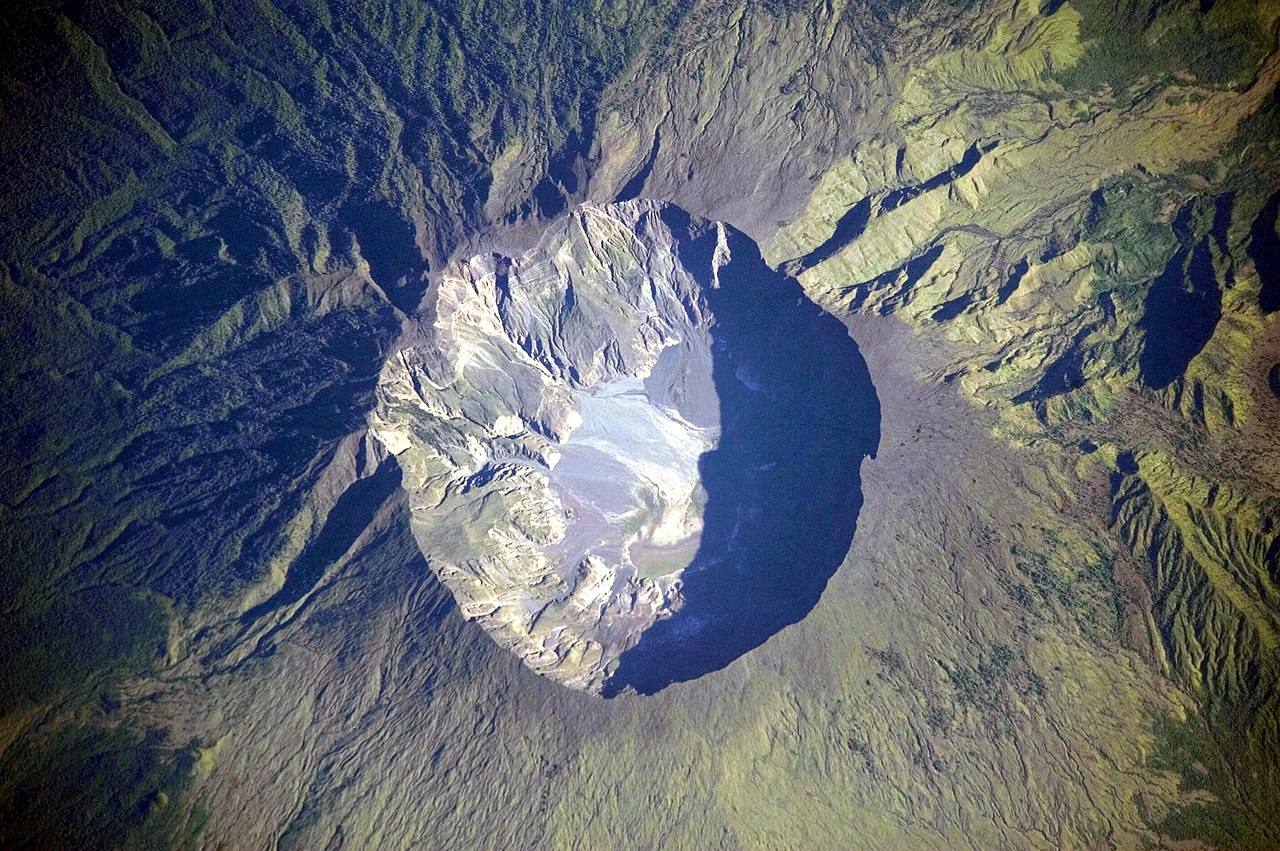
Geology & Pre-Eruption State
- Type: Stratovolcano
- Pre-eruption Height: ~4,300 m
- Post-eruption Height: 2,850 m
- Caldera: 6 km wide, 1,100 m deep
Before 1815, Mount Tambora stood approximately 4,300 meters tall, making it one of the tallest peaks in the Indonesian archipelago. The volcano sits above the subduction zone where the Indo-Australian Plate dives beneath the Eurasian Plate.
The eruption removed the upper 1,450 meters of the mountain, leaving a massive caldera 6 kilometers in diameter and 1,100 meters deep. This caldera is now partially filled by a seasonal lake.
The April 1815 Eruption
- VEI: 7 (second highest on scale)
- Material Ejected: ~160 km³
- Ash Column: 43 km high
- Sound: Heard 2,600 km away
The eruption began on April 5, 1815, with moderate explosions and escalated to its climax on April 10-11. The explosive phase ejected approximately 160 cubic kilometers of material, the largest volume of any eruption in at least 1,300 years.
Pyroclastic flows swept down all sides of the mountain, reaching the sea and destroying everything in their path. The eruption column reached 43 kilometers into the atmosphere. Darkness from the ash cloud persisted for two days up to 600 kilometers from the volcano. The explosions were heard on Sumatra, over 2,600 km away.
Year Without a Summer (1816)
- Temperature Drop: 0.4-0.7°C globally
- Frost: June snowfall in New England
- Crop Failures: Europe, North America, Asia
- Famine Deaths: Estimated 100,000+ worldwide
The massive injection of sulfur dioxide into the stratosphere created a global aerosol veil that blocked sunlight. In 1816, the northeastern United States experienced frost in every month, including snow in June. Crop failures were widespread across Europe and North America.
The resulting famine contributed to typhus epidemics in Europe and prompted mass migration. In Switzerland, the dismal weather drove Mary Shelley, Lord Byron, and others indoors, where Shelley wrote "Frankenstein," one of the most famous novels in English literature.
Discovery of the Lost Kingdom
- Kingdom: Tambora culture/civilization
- Discovered: 2004 by archaeologists
- Comparison: Called "Pompeii of the East"
- Artifacts: Bronze, ceramics, houses preserved
In 2004, archaeologists discovered the remains of a village buried by the 1815 eruption, preserved under pyroclastic deposits much like Pompeii. The site revealed a previously unknown culture with advanced metalworking and trade connections across Southeast Asia.
The discovery showed that the eruption destroyed not just lives but an entire culture. Artifacts including bronze tools, Chinese ceramics, and the remains of wooden houses were found buried under meters of volcanic debris.
Key Facts
- The 1815 eruption was the largest in recorded history with a VEI of 7.
- It ejected approximately 160 km³ of material, reducing the mountain by 1,450 meters.
- Over 70,000 people died directly from the eruption and its immediate aftermath.
- The "Year Without a Summer" in 1816 caused widespread crop failures globally.
- A lost civilization was discovered buried under Tambora's deposits in 2004.
Fun Facts
- Mary Shelley wrote "Frankenstein" during the gloomy summer of 1816 caused by Tambora's eruption.
- The eruption was roughly 100 times more powerful than Mount St. Helens in 1980.
- Tambora's ash cloud was so thick that it caused complete darkness for two days up to 600 km from the volcano.
- The global famine following the eruption may have contributed to the invention of the bicycle, as horses became too expensive to feed.
Final Thoughts
Mount Tambora's 1815 eruption stands as the most powerful volcanic event in recorded history. Its global climate impact demonstrated that a single volcanic eruption can disrupt food systems and societies across entire continents, while the recent discovery of a buried civilization adds archaeological significance to its geological importance.
