
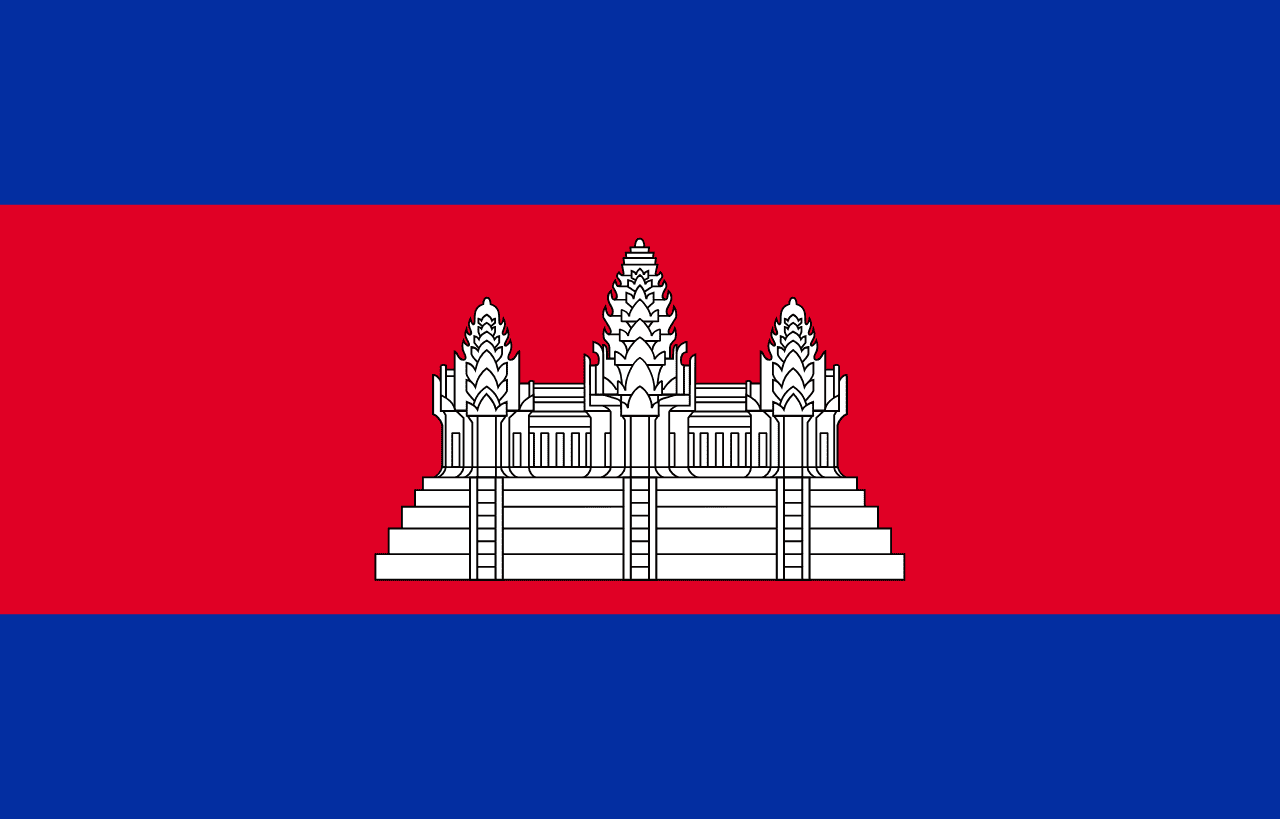
Among the roughly two hundred national flags in use around the world, Cambodia's stands alone in one remarkable respect: it is the only one that depicts an actual building. At its center rises the silhouette of Angkor Wat, the colossal twelfth-century temple complex that has become shorthand for Khmer civilization itself. Set against a horizontal arrangement of blue and red bands, this white temple gives the flag an instantly recognizable identity that no other nation can claim. Adopted in its current form in 1993, the design ties a modern constitutional monarchy directly to one of the greatest architectural achievements of the ancient world.
A Flag Anchored by a Temple
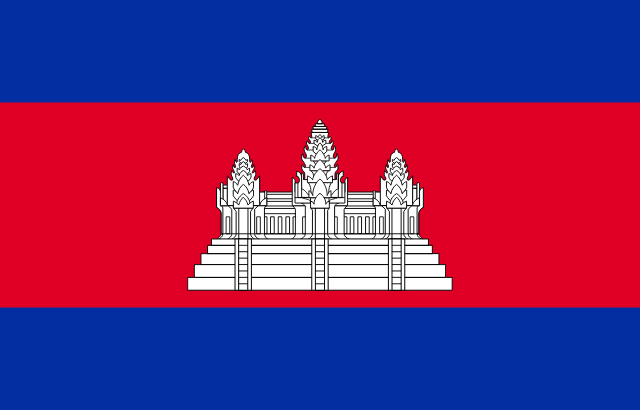
The Cambodian flag is, at first glance, a straightforward horizontal triband. Two narrow blue bands frame a wider red band that occupies the center of the field. But the feature that defines the flag is the white image of Angkor Wat stamped in the middle of that red band. The temple is rendered in a stylized, frontal form, showing its distinctive towers rising in tiered ranks. This simplified outline captures the essence of the monument without attempting photographic detail, making it readable even at a distance or on a small printed badge.
The proportions of the design place visual weight squarely on the temple. The central red band is broader than the two blue stripes that border it, ensuring the white silhouette has room to breathe and remains the dominant element. The result is a banner that functions simultaneously as a flag and as a national emblem, since the temple effectively serves as the country's coat of arms in graphic form.
What the Colors and Symbols Mean
Each element of the flag carries a specific meaning drawn from Cambodian tradition. The blue bands stand for royalty, reflecting the country's monarchy and the enduring role of the crown in national life. The red field represents the nation and its people. The white of Angkor Wat is read as a symbol of religion and of purity, an appropriate association for a structure originally built as a Hindu temple and later embraced as a Buddhist site.
Taken together, the three colors echo a familiar civic shorthand of monarchy, nation, and faith. Yet what elevates the Cambodian flag beyond simple color symbolism is the temple itself. Angkor Wat is not merely decoration; it stands for the heritage, antiquity, and cultural achievement of the Khmer people. Placing it at the heart of the flag declares that Cambodian identity is inseparable from the civilization that raised those towers more than eight centuries ago.
How the Design Evolved
The blue-red-and-temple motif is older than the present flag and has appeared on Cambodian banners in various forms across the twentieth century. The country, however, passed through extraordinary political upheaval in the decades after independence, and its flag changed repeatedly to match each new regime. Periods of monarchy, republic, revolutionary rule, and foreign-backed government each brought distinct banners, several of which discarded the familiar palette or replaced the Angkor Wat image with a differently styled temple of three or five towers.
The version flown today was restored in 1993, the year a new constitution reestablished the kingdom following the end of Vietnamese occupation and a United Nations–supervised transition. Returning to the older design was a deliberate act of continuity, reconnecting the modern state with the symbols Cambodians had long associated with their nation rather than with any single short-lived government. Readers who want the fuller political story can explore our cambodia country guide for context on how the kingdom rebuilt itself in the 1990s.
Comparisons With Other Flags
Cambodia's banner is fundamentally a triband, a layout shared by dozens of national flags, from Austria to the Netherlands. What sets it apart from those simpler designs is, of course, the central charge. While many flags place an emblem in the middle of a band, those emblems are typically abstract devices: stars, suns, crests, or geometric figures. Cambodia is the only country to use a recognizable, real-world piece of architecture as its centerpiece.
That distinction is worth dwelling on. Spain, Portugal, and Mexico all carry elaborate coats of arms, and Sri Lanka features a lion, but none depict a standing structure. A few flags include towers or castles within heraldic shields, yet Cambodia presents the temple directly on the open field rather than tucked inside a crest. The blue-and-red color scheme, meanwhile, invites comparison with other Asian and European tricolors, but the moment Angkor Wat appears there is no chance of confusion. The flag's silhouette is so specific that it reads as Cambodia and nothing else.
Cultural Weight and National Identity
Angkor Wat occupies a place in the Cambodian imagination that few national symbols anywhere can match. The temple appears not only on the flag but throughout daily life: on currency, official seals, the logos of businesses and sports teams, and countless souvenirs. Its presence on the flag therefore feels less like a chosen design and more like a recognition of something already central to who Cambodians understand themselves to be.
This continuity is meaningful in a country whose recent history was marked by trauma and rupture. By keeping Angkor Wat at the center of the flag through regime after regime, Cambodians have asserted that the deeper thread of their identity runs back to the medieval Khmer Empire, long before the conflicts of the twentieth century. The temple becomes a reminder of endurance, a link to a golden age that no political crisis could erase.
The Flag in Modern Life
Today the flag flies over government buildings, schools, and embassies across the Southeast Asian kingdom, which sits on the mainland of the continent of Asia. It is raised on national holidays, displayed during royal ceremonies, and waved by supporters at international sporting events where Cambodian athletes compete. Tourists arriving to visit the Angkor complex near Siem Reap encounter a neat coincidence: the very monument pictured on the flag overhead is the one they have traveled to see in person.
The flag also turns up in everyday and commercial settings, from festival decorations to product packaging, precisely because its central image doubles as a beloved cultural icon. Few national banners blur the line between state symbol and popular emblem so completely.
A handful of details make the flag especially memorable:
- It is the only national flag in the world to feature a building, the temple of Angkor Wat.
- The current design was restored in 1993 after the United Nations–supervised transition.
- The layout is a horizontal triband with a wide red center between two narrower blue stripes.
- Blue signifies royalty, red the nation, and the white temple stands for religion and purity.
- Angkor Wat also appears on Cambodia's currency, seals, and countless commercial logos.
Frequently Asked Questions
When was the current flag of Cambodia adopted?
The present design was adopted in 1993, when a new constitution reestablished the Kingdom of Cambodia following the end of Vietnamese occupation and a United Nations–supervised transition. The blue-red-and-temple motif itself, however, had appeared on earlier Cambodian flags during the twentieth century.
What do the colors of the Cambodian flag mean?
Blue represents royalty and the monarchy, red represents the nation and its people, and the white of the Angkor Wat image symbolizes religion and purity. Together they bind together the three pillars of Cambodian civic identity: crown, country, and faith.
Why is Angkor Wat on the flag?
Angkor Wat is the most famous monument of the medieval Khmer Empire and the enduring emblem of Cambodian heritage. Placing it at the center of the flag connects the modern kingdom to its ancient cultural achievements, and it makes Cambodia the only nation whose flag depicts an actual building.
What continent is Cambodia on, and how does its flag compare to others?
Cambodia is located in Southeast Asia, on the mainland of the continent of Asia. While its triband layout resembles many other flags, the realistic image of Angkor Wat makes it unmistakable, since no other country uses a real architectural structure as its central emblem.