
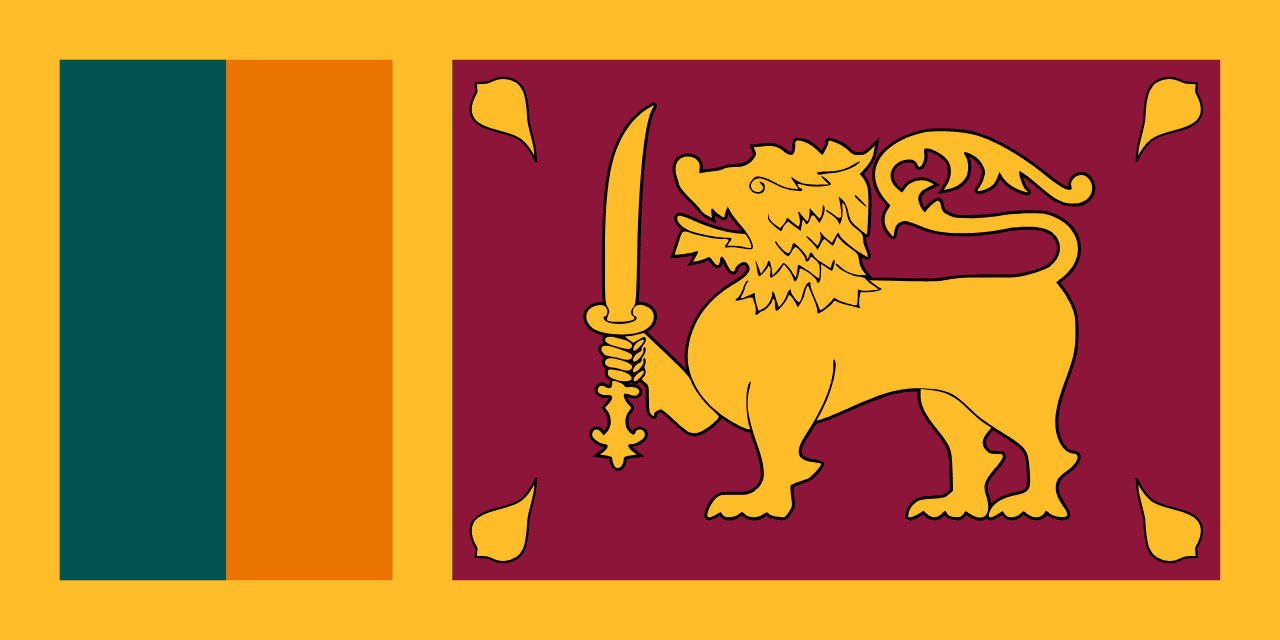
Few national flags pack as much detail into a single piece of cloth as the flag of Sri Lanka. Often called the Lion Flag, it shows a golden lion gripping a sword on a deep maroon field, framed by a band of saffron and flanked by two vertical stripes of green and orange. It is busy, unmistakable, and deeply rooted in the island's long history. Where many flags reduce a nation to a few abstract bars of color, Sri Lanka's chooses instead to tell a layered story about kingship, faith, and the many communities that share this teardrop-shaped island in the Indian Ocean.
A First Look at the Lion Flag
The overall composition divides into two main parts. On the hoist side (the edge nearest the flagpole) sit two narrow vertical stripes, one green and one orange. The larger remaining portion is a maroon rectangle bordered in yellow, and inside it a stylized golden lion stands upright, holding a sword aloft in its right forepaw. A yellow bo leaf sits in each of the four corners of the maroon panel. The whole design is then enclosed by a golden-yellow border that ties the separate elements together into one balanced banner. It is among the most intricate flags flown by any country, and that complexity is entirely intentional.
What the Colors Mean
The palette of maroon, orange, green, and yellow is not decorative chance; each color carries a defined meaning. The maroon background, together with the lion, represents the Sinhalese people, the island's majority community. The two stripes speak directly to Sri Lanka's minorities: the orange stripe represents the Tamil community, while the green stripe represents the Muslim, or Moor, community. The yellow border and the gold of the lion and leaves bind these groups together, symbolizing the unity of the nation as a whole.
This deliberate assignment of color to community is one of the flag's defining features. Rather than gloss over the island's diversity, the design makes room for it on the cloth itself, so that the banner is meant to belong to everyone who calls Sri Lanka home.
Design and Layout in Detail
The centerpiece is the lion, an emblem with centuries of royal association on the island. It stands on its hind legs in a posture known as passant or rampant in heraldic terms, with the sword raised in a gesture of vigilance and strength. The sword itself is sometimes read as a symbol of sovereignty and the authority of the state.
The four yellow leaves in the corners are leaves of the sacred bo tree (a species of fig closely linked to the Buddha's enlightenment). They stand for four core Buddhist virtues often rendered as loving-kindness, compassion, sympathetic joy, and equanimity. By placing these leaves at the four corners, the flag frames the lion and stripes within a moral and spiritual outlook, reflecting the central place of Buddhism in Sinhalese culture without excluding the other communities named by the stripes.
From the Kings of Kandy to a Modern Republic
The lion motif did not appear out of nowhere. The flag draws directly on the banner of the last King of Kandy, the inland kingdom that remained independent on the island until the early nineteenth century, when it fell under British control. The lion-on-maroon emblem of that royal standard survived in memory long after the kingdom itself was absorbed into colonial rule.
When Sri Lanka, then called Ceylon, moved toward independence, reformers revived the old lion banner as a national symbol. In the years that followed, the design was thoughtfully adjusted: the green and orange stripes were added so that the Tamil and Muslim communities would be represented alongside the Sinhalese lion, and the bo leaves were refined into their present form. The flag in essentially the version recognized today was adopted in 1972, the same period in which the country took the name Sri Lanka and became a republic. If you want broader context on the island's regions, peoples, and landmarks, the sri lanka country guide is a good companion read.
How It Compares to Other Lion Flags
Lions are popular in heraldry, but a lion actually wielding a sword is rare on a national flag. Sri Lanka shares this distinction with very few others; it is widely cited as one of only two national flags in the world to feature a lion holding a sword. That detail alone sets it apart from the more common heraldic lions that simply stand or walk.
Compared with flags that use similar warm tones, the differences are stark. Many flags pair maroon or orange with simple geometric bands and no central emblem at all. Sri Lanka's flag instead anchors its warm palette around a detailed figural device, making it far closer in spirit to a coat of arms than to the clean tricolors of much of the world. Its nearest visual relatives are not other national flags so much as historical royal standards from South and Southeast Asia, where elaborate creatures and ornamental borders were common. The result is a flag that is almost impossible to confuse with any other.
Cultural Meaning and Everyday Life
For Sri Lankans, the Lion Flag is woven into civic life. It is raised on Independence Day celebrations, displayed at government buildings, and carried by supporters at international cricket matches, where the national team has given the country some of its proudest moments on the world stage. The lion, in particular, has become a shorthand for Sri Lankan identity that appears well beyond the flag itself, from emblems to sporting crests.
Because the design encodes the country's major communities, the flag also serves as a reminder of the ideal of national unity. Sri Lanka sits in South Asia, on the continent of Asia, just off the southeastern tip of the Indian subcontinent, and its flag reflects the layered cultures that meet on the island. Flying it is both an everyday act and a quiet statement about the many threads that make up one nation.
Interesting Facts About the Flag
- It is one of only two national flags in the world that show a lion holding a sword.
- The modern design was formally adopted in 1972, alongside the country's shift to a republic and the name Sri Lanka.
- The lion and maroon field descend directly from the royal banner of the last King of Kandy.
- The orange and green stripes were added specifically to represent the Tamil and Muslim communities.
- The four corner leaves come from the sacred bo tree and stand for four Buddhist virtues.
- It is often nicknamed the Lion Flag, or Sinha Kodiya in Sinhala.
Frequently Asked Questions
When was the flag of Sri Lanka adopted?
The flag in its current form was adopted in 1972, the year the country became a republic and changed its name from Ceylon to Sri Lanka. Earlier versions of the lion banner had been in use around independence, with the colored stripes and bo leaves refined over the preceding decades.
What do the colors of the Sri Lankan flag mean?
The maroon field and golden lion represent the Sinhalese majority. The orange stripe represents the Tamil community and the green stripe represents the Muslim community. The yellow border symbolizes the unity that binds these groups together, while the corner bo leaves represent four Buddhist virtues.
Who designed the Sri Lankan flag?
The flag is based on the historic standard of the last King of Kandy rather than the work of a single inventor. As Ceylon approached and gained independence, a committee revived and modified that royal lion banner, adding the stripes for minority communities, so the modern flag is best understood as a community effort rooted in older royal heraldry.
What continent is Sri Lanka on, and how does its flag compare to similar ones?
Sri Lanka is an island nation in South Asia, on the continent of Asia, located in the Indian Ocean off the southeastern coast of India. Its flag stands apart from most national flags because of the detailed sword-bearing lion; it is widely described as one of only two national flags featuring a lion holding a sword, which makes it far more ornate than the simple tricolors common elsewhere.