
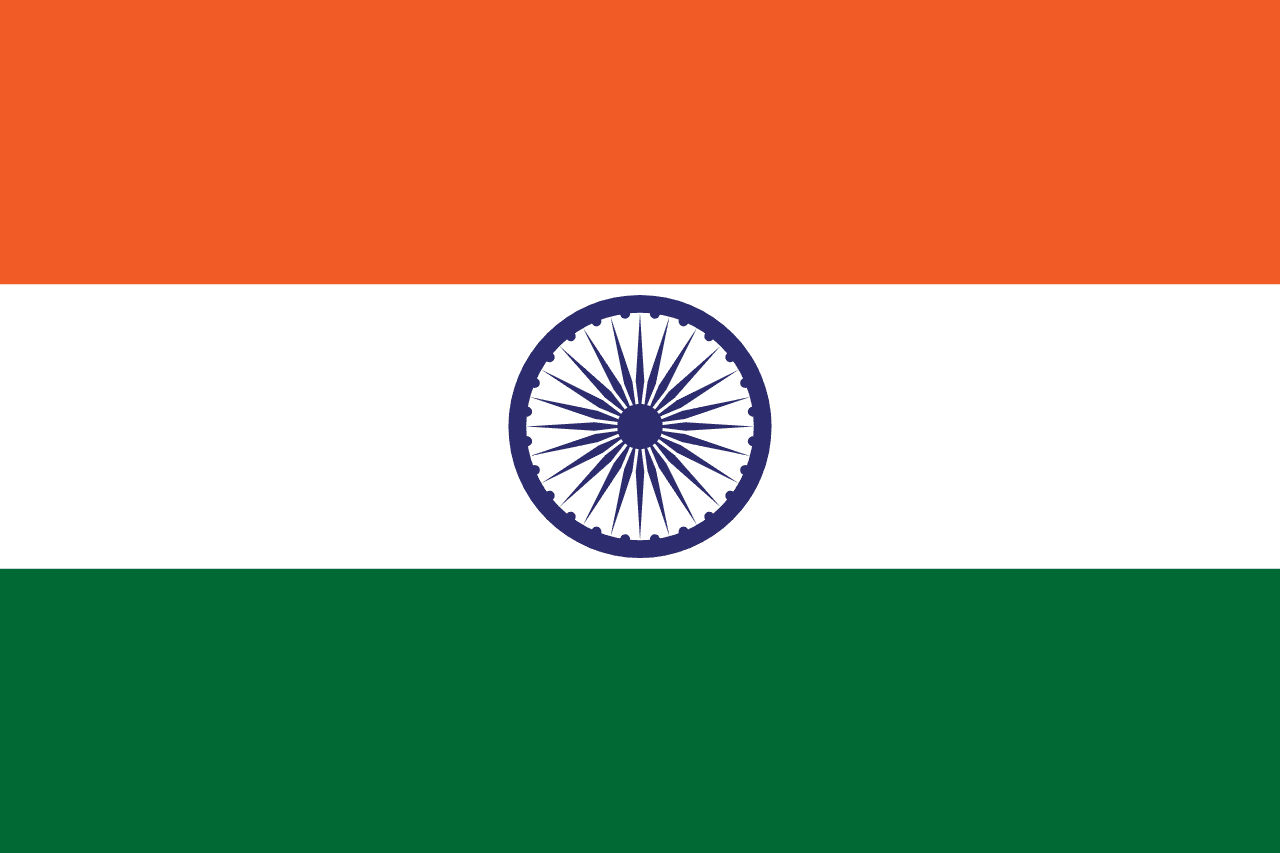
Few national emblems carry their meaning as openly as the Indian Tiranga, the "tricolour" that snaps to attention above schools, parliaments, and crowded city streets each January and August. Three bands of saffron, white, and green frame a deep navy-blue wheel at the center, and together they tell a story of a freedom movement, a philosophy of law, and a young republic determined to define itself on its own terms. Adopted on the eve of independence, the flag has become one of the most instantly recognizable banners in Asia, distinguished not only by its colours but by a rule found nowhere else in the world.
A Tricolour Read From Top to Bottom
The flag is built from three horizontal stripes of equal width. Saffron, the warm orange-gold band, sits at the top and stands for courage and sacrifice, recalling the renunciation of self-interest in service of the nation. The white band in the middle represents truth and peace, and it provides the bright field on which the central wheel rests. Green, anchored at the bottom, signals faith, fertility, and the prosperity of the land. Reading the flag from top to bottom, you move from sacrifice through honesty to the living abundance of the country itself.
What gives the design its character is the navy-blue Ashoka Chakra, the 24-spoke wheel placed precisely in the center of the white band. The Chakra is described as the eternal wheel of law, or dharma, and its presence turns an otherwise simple tricolour into something distinctly Indian. The choice of a wheel was deliberate: a wheel must keep turning to stay upright, and the symbolism points toward constant motion, reform, and progress rather than stagnation.
The Geometry of the Tiranga
Indian flag law is unusually precise about proportions. The flag follows a 2:3 ratio, meaning its width is two-thirds of its length, and the three colour bands are arranged in equal horizontal proportions so no single colour dominates. The Ashoka Chakra is centred exactly in the white stripe, its diameter sized to match the width of that band, and it appears in navy blue against the white field.
The most remarkable design rule, though, is about material rather than measurement. According to the Flag Code of India, the flag must be made from khadi, the hand-spun and hand-woven cloth that became a symbol of self-reliance during the independence struggle. This requirement makes the Indian flag the only national flag in the world with a mandated fabric, tying the physical object directly back to the movement that produced it.
From the Charkha to the Chakra
The Tiranga did not appear fully formed. Its lineage runs through the flag of the Indian National Congress, and the design owes its core concept to Pingali Venkayya, who developed an early version of the tricolour. The Congress flag had featured a spinning wheel, the charkha, at its center, an emblem strongly associated with Gandhi's call for home-spun cloth and economic independence.
As the country prepared for statehood, the design was refined so it could represent an entire diverse nation rather than a single political party. The spinning wheel was replaced by the Ashoka Chakra, drawn from the Lion Capital of Ashoka at Sarnath, an ancient sculpture that gave the flag a symbol rooted in India's deep history rather than in one organization. The redesigned flag was formally adopted on July 22, 1947, just weeks before independence was declared on August 15. Readers who want the broader national context can explore our india country guide for more on the country's geography and history.
Cousins on the World's Flag Wall
India's tricolour shares a family resemblance with several other flags, but the differences are easy to spot once you know what to look for. Ireland uses the same kind of vertical three-band layout in green, white, and orange, and the palette overlaps closely with India's saffron-white-green. The key distinctions are orientation and detail: the Irish stripes run vertically and carry no central emblem, while India's run horizontally and are crowned by the blue wheel.
Niger's flag is an even closer look-alike in structure, with horizontal orange, white, and green bands. Yet Niger places a plain orange disc in the center of its white stripe, whereas India's centerpiece is the intricate 24-spoke navy Chakra. That wheel is the single feature that makes the Indian flag unmistakable from a distance: no other widely flown national flag pairs a saffron-white-green horizontal field with a finely spoked blue wheel.
A Symbol of a Secular, Democratic Republic
For Indians, the Tiranga is far more than a decorative banner. It stands as a profound symbol of independence and sovereignty, a reminder of the long struggle for freedom and of the secular, democratic values the republic chose for itself. Because of that weight, the flag is treated with deliberate care, and its handling is governed in detail by the Flag Code of India.
The protocol is strict. There are formal rules for how the flag is hoisted and lowered, and long-standing customs hold that it must never touch the ground or water, nor be used as ordinary drapery. These conventions are not bureaucratic fussiness; they reflect a national consensus that the object itself carries the dignity of the people it represents. The story of designer Pingali Venkayya reinforces that spirit: he is remembered for offering his design in service of the country rather than seeking credit or compensation for himself.
The Flag in Everyday Modern Life
Three days in the calendar belong especially to the Tiranga. It is hoisted on Republic Day on January 26, on Independence Day on August 15, and on Gandhi Jayanti on October 2, when the country marks the birth of Mahatma Gandhi. On these occasions the flag appears everywhere from the ramparts of historic forts to the smallest village schools.
For decades, everyday display by ordinary citizens was tightly restricted, but a 2002 amendment changed that, allowing Indians to fly the flag on any day so long as it is shown with dignity. Today the Tiranga flies over government buildings, educational institutions, sporting venues, and private homes, and it is a constant presence at international cricket matches and Olympic ceremonies where Indian athletes compete. That blend of formal civic ritual and spontaneous personal pride is what keeps the flag woven into daily life.
A handful of details make the design even more memorable:
- The 24 spokes of the Ashoka Chakra are often linked to the 24 hours of the day, a reminder of ceaseless forward motion and progress.
- By law, the flag must be made of hand-spun khadi cloth, the only such fabric requirement among the world's national flags.
- Pingali Venkayya, who created the initial concept, never sought personal reward for his work.
- Detailed protocol governs every stage of hoisting and lowering the flag.
- The flag may never touch the ground or water, nor be used as drapery or decoration.
Frequently Asked Questions
When was the Indian flag adopted?
The flag was formally adopted on July 22, 1947, just weeks before India became independent on August 15, 1947. Its design evolved from the earlier flag of the Indian National Congress.
What do the colours of the Indian flag mean?
Saffron represents courage and sacrifice, white stands for truth and peace, and green signifies faith, fertility, and prosperity. The navy-blue Ashoka Chakra in the center represents the eternal wheel of law, or dharma.
Who designed the Indian flag?
The core concept of the tricolour is credited to Pingali Venkayya, whose design shaped the Indian National Congress flag. When the national flag was finalized, the earlier spinning wheel was replaced by the Ashoka Chakra to make the emblem more universal.
What continent is India on, and which flags are similar?
India is located in Asia. Its flag shares a saffron-white-green palette with Ireland and a closely related horizontal layout with Niger, but the 24-spoke navy Ashoka Chakra in the center makes the Indian flag unique among them.