
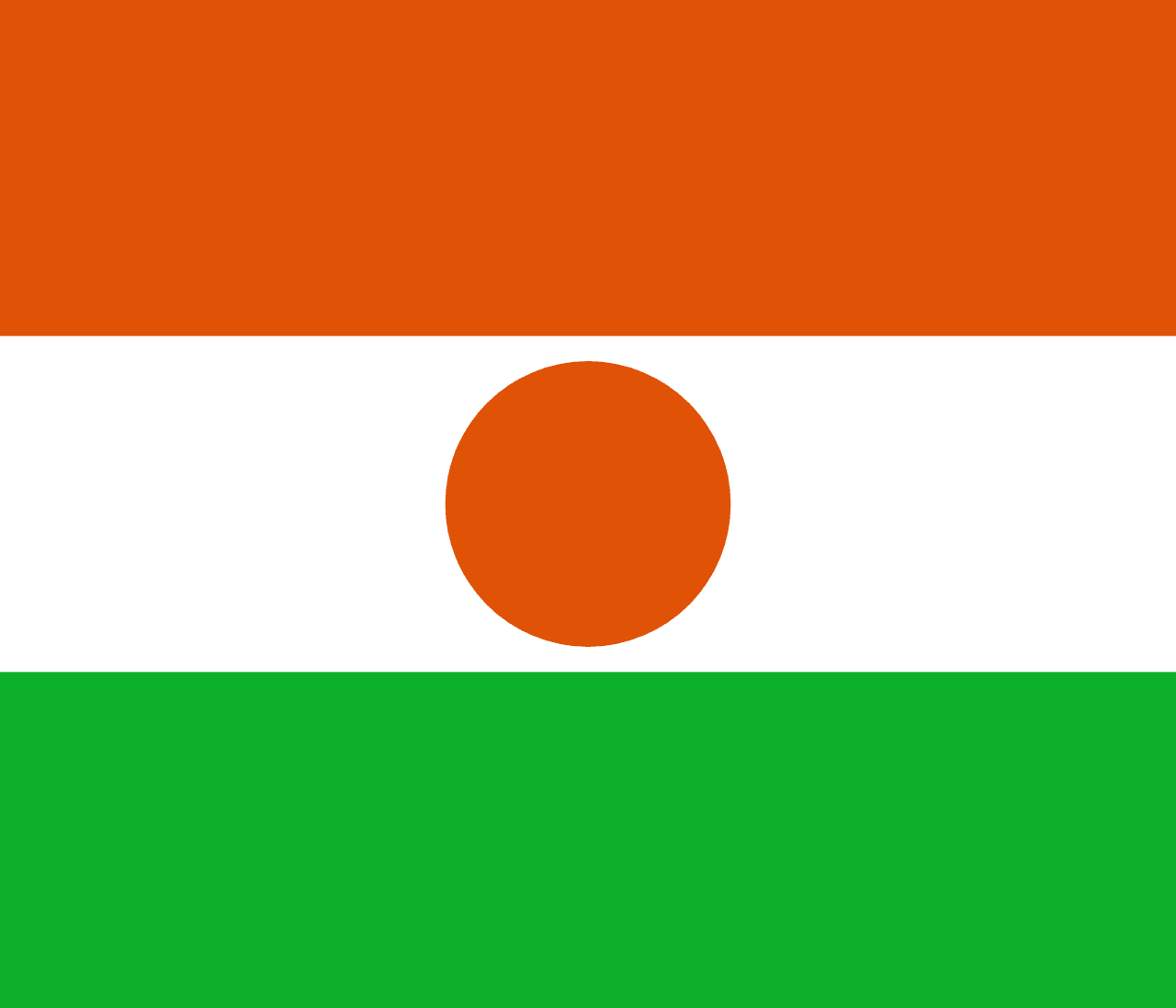
Few flags capture the geography of their homeland as plainly as the flag of Niger. A landlocked nation straddling the southern edge of the Sahara, Niger flies a banner of three horizontal bands with a single bright orange circle at its heart. Adopted in 1959, the year before independence from France, the flag reads almost like a map: sand above, river below, and the burning sun pinned in the middle. It is a quiet, confident design that lets color and a single shape carry the entire story of a people and their land.
Reading the Three Bands and the Disc
The flag is a horizontal tricolor, divided into three equal stripes. From top to bottom, the colors run orange, white, and green. Centered within the white band sits a solid orange circle, the flag's most distinctive feature and the element that sets it apart from the many other tricolors flown worldwide.
This layout belongs to a broad family of tricolors, but Niger's horizontal arrangement crowned with a disc gives it a balance that feels deliberate and grounded. The orange of the disc echoes the orange of the upper band, tying the design together so the sun appears to rise out of the desert itself. The circle sits within the white band without touching the stripes, leaving a clear margin so it reads as a sun suspended in a clear sky.
Niger's official proportions are unusual too: the flag is historically rendered in a near-square ratio close to 6:7, far more compact than the 2:3 or 1:2 ratios common elsewhere. That squarish format gives the banner a sturdy, emblematic look on a pole and is one of the details flag enthusiasts use to tell Niger's tricolor apart from its relatives.
What the Colors Stand For
Each element of the flag carries a meaning rooted in the country's environment and aspirations. The symbolism is direct, and that directness is part of its strength.
- Orange stands for the Sahara Desert, the vast expanse of sand and rock that covers much of the country's north.
- White represents purity and innocence, the central band offering a clean, calm field at the flag's core.
- Green signifies hope, calling to mind the fertile lands and the greener south where most of the population lives and farms.
- The orange disc represents the sun, and by extension the spirit of independence the young nation embraced as it stepped out from colonial rule.
Read together, the bands trace a vertical journey through the country itself, from the sun-baked desert in the north, through a band of purity, down to the green of cultivated earth. The order is not arbitrary: orange at the top mirrors the way the desert dominates the northern reaches on a map, while green at the base anchors the design in the inhabited, watered south. It is rare for a flag's color sequence to double so neatly as a geographic cross-section.
A Flag Born Just Before Independence
Niger adopted its flag in 1959, while still a territory within the French Community and on the threshold of sovereignty. Full independence followed in 1960, and the flag chosen in that hopeful interval has flown unchanged ever since. That continuity is notable. Many African nations redesigned or replaced their flags after independence, sometimes more than once, as governments and ideologies shifted. Niger kept its original banner, and the orange disc that once symbolized the coming of independence has carried that meaning forward.
Choosing the design before the formal break with France was itself a statement, allowing Niger to enter independence already in possession of its own emblem. Leaning on landscape and natural imagery, rather than political party colors or borrowed European heraldry, gave the flag a timelessness that has helped it endure. Even as Niger weathered coups, constitutional rewrites, and shifting alliances, the tricolor remained a fixed point too widely accepted to be worth replacing.
Comparing Niger's Flag to Its Relatives
Niger's banner sits within a global crowd of three-stripe flags, and part of appreciating it means understanding what it is not. The most cited look-alike is the flag of India, which also runs orange (saffron), white, and green in horizontal bands with a circular device in the center. The differences are decisive: India's central element is the navy-blue Ashoka Chakra, a 24-spoked wheel, where Niger uses a plain solid orange disc.
Niger also shares a green-white-orange palette with its neighbor Ivory Coast, though that flag arranges the colors as vertical bands and omits any central emblem. Unlike Mali, Senegal, Ghana, or Guinea, Niger does not draw on the Pan-African red-gold-green scheme associated with Ethiopia and the continent's independence movements. Its quieter choice keeps the focus on national geography rather than continental solidarity, giving the flag an identity distinct from the Pan-African family it might otherwise be grouped with.
The Desert, the River, and a Sense of Place
What makes Niger's flag resonate is how tightly it binds national identity to physical geography. The Sahara is not an abstraction here; it dominates the country's landmass and shapes daily life. The green band points toward the Niger River and the agricultural belt of the south, the lifeline along which cities, farms, and communities cluster. For a place defined by its extremes of climate, a flag that honors both the desert and the fertile land speaks to the resilience of its people.
The central sun completes the picture. In a country where the sun is an inescapable daily presence, placing it at the literal center of the flag is both honest and poetic. Readers curious about the landscapes and travel context behind the banner can explore more in our niger country guide.
The Flag in Everyday and Civic Life
Like any national flag, Niger's banner appears at the moments that knit a nation together. It is raised over government buildings, flown at schools, and carried during national celebrations. Niger marks its Republic Day on 18 December and its independence anniversary in August, and the tricolor is everywhere during these observances, draped from balconies and stitched into the regalia of marching bands. Athletes representing Niger at international competitions march beneath it, and it accompanies the country in diplomatic settings, from embassies abroad to pan-African and global organizations.
Because the design has remained stable for so long, generations of Niger's citizens have grown up with the same emblem. That permanence reinforces its role as a shared point of reference, recognized instantly whether it appears on a sports jersey, a passport, or a flagpole in a remote village. The simplicity that makes it easy to draw also makes it easy to remember.
Interesting Facts Worth Knowing
- The flag was adopted in 1959, before Niger achieved full independence in 1960.
- It has never been redesigned, making it one of the more enduring flags on the African continent.
- The orange central disc is widely read as both the sun and a symbol of independence.
- The orange-white-green arrangement is sometimes compared to India's flag, which uses a navy wheel rather than an orange disc at its center.
- Niger's flag is unusually close to square in its official proportions, unlike most of the world's more elongated tricolors.
- Every color choice ties back to the land: the orange desert above, the green fertile south below, and white purity between them.
Frequently Asked Questions
When was the flag of Niger adopted?
The flag was adopted in 1959, when Niger was a self-governing territory within the French Community. It remained the national flag after full independence in 1960 and has stayed unchanged ever since.
What do the colors of the Niger flag mean?
The orange band represents the Sahara Desert, the white band stands for purity, and the green band symbolizes hope and the country's fertile lands. The orange circle represents the sun and the spirit of independence.
What continent is Niger on, and where is it located?
Niger is a landlocked country in West Africa, with the Sahara Desert covering much of its northern reaches and the greener, more populated agricultural regions concentrated in the south near the Niger River.
How is the Niger flag different from similar tricolors?
Niger's flag uses orange, white, and green in horizontal bands with a solid orange disc at the center. While its color scheme invites comparison to India's flag, the defining difference is the orange sun-disc, which sets Niger's banner apart from tricolors that use stripes alone or a different central emblem.
Why does the orange circle sit in the middle of the flag?
The orange disc is centered in the white band to represent the sun, a constant and powerful presence in Niger's climate. Its placement is symbolic too, linking the desert above and the fertile south below while standing in for independence.