

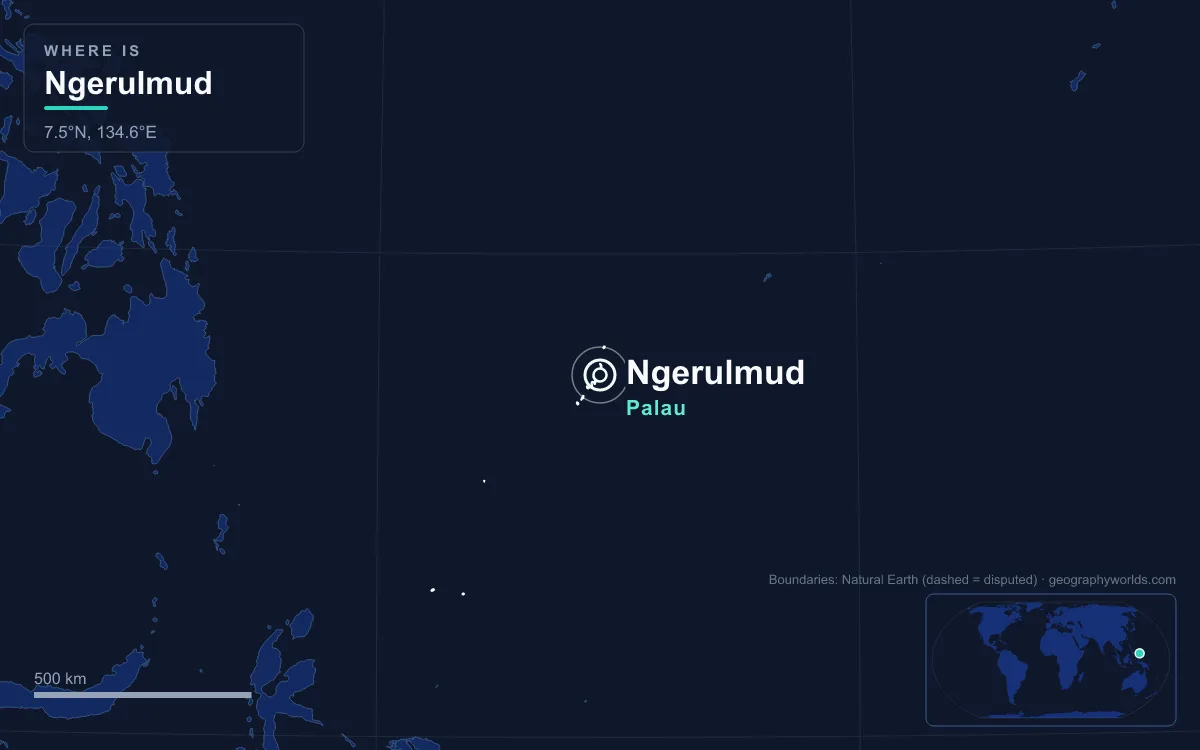
Ngerulmud is the capital of Palau. It is the seat of government built on a hilltop in Melekeok State on Babeldaob, the country's largest island, about 20 kilometres northeast of Koror, which it replaced as capital in October 2006. Ngerulmud has no permanent residents, because it consists only of the national capitol complex, so it is usually called the least populous national capital in the world. At the 2020 census the whole of Melekeok State had just 318 people. Palau ended up with a capital in its countryside because its 1981 constitution required one. The country then took 25 years, an American architecture firm and a loan from Taiwan to build it.
Koror, the Mandate Town Palau Was Told to Leave
For most of the 20th century, the obvious capital of the Palau islands was Koror. Japan took the islands during the First World War and governed them as part of the League of Nations South Seas Mandate. In 1921 Japan moved the mandate's Civil Affairs Bureau from Truk to Koror. Under Japanese rule Koror was developed to look like a small town in Japan, with cinemas, restaurants and beauty parlours, and it grew from a village of a few hundred people in 1920 to more than 2,000 by the 1930s. In November 1940 the Nan'yō Shrine, the highest-ranking Shinto shrine of the mandate, was consecrated there. After 1947, when the islands became part of the United States–run Trust Territory of the Pacific Islands, Koror stayed on as Palau's provisional capital.
Koror is also home to the clan of the Ibedul, a high chief of Palau, and today it holds most of the country's people. At the 2020 census Koror State counted 11,199 residents, about 64 per cent of all Palauans. The state is made up of several islands, including Koror, Ngerekebesang and Malakal, along with most of the Rock Islands, the uplifted limestone islets in the southern lagoon. Koror Island itself has very little flat land left, and most of it has been cleared for houses and businesses.
Babeldaob, just to the north, is the opposite. At 331 square kilometres it covers more than 70 per cent of Palau's land area, yet only about 6,000 people live there. Ten of Palau's sixteen states lie on the island, which rises to 242 metres at Mount Ngerchelchuus and has forested ridges, rivers and mangrove coasts. When Palau voted in 1978 to stay out of the Federated States of Micronesia and go its own way, its constitution picked that thinly settled island as the site of the future capital.
The 1981 Constitution's Ten-Year Deadline
The Republic of Palau came into being when its constitution took effect on 1 January 1981. That constitution was the first in the world to be nuclear-free, and it banned nuclear, chemical and biological weapons unless 75 per cent of voters approved them in a referendum. It also told the National Congress to set up a permanent capital on Babeldaob within ten years of the constitution taking effect. The instruction was simply that the permanent capital had to be on Babeldaob, the big island, and not on Koror.
The deadline was missed. Planning began in 1986, when the contract for a capitol complex went to Architects Hawaii Ltd, the Hawaii-based firm that had already designed the capitol of the Federated States of Micronesia at Palikir. But the country had few engineers or architects of its own, most construction materials had to be shipped in, and money was short. The ten-year deadline passed in 1991 with the complex still unbuilt. Palau was also still tied up in its long route to full independence. The nuclear-free clause clashed with the United States' demand to be allowed to operate nuclear-powered vessels in Palauan waters, which delayed the Compact of Free Association. The compact only came into force on 1 October 1994, and Palau joined the United Nations that December.
Infrastructure was another problem. The road link between Koror and Babeldaob was a bridge opened in 1978, and in its time its main span of 240.8 metres was a world record for its type. The bridge also carried fresh water and electricity between the two islands. On 26 September 1996 it suddenly collapsed, killing two people and cutting off water and power, and the government declared a state of emergency. Japan provided emergency aid and a temporary crossing. Japanese grant aid then paid for a replacement. The Kajima Corporation built the present 413-metre cable-stayed bridge, named the Japan–Palau Friendship Bridge when it opened in January 2002.
Architects Hawaii, a Taiwanese Loan and the Opening on 7 October 2006
Construction only really got going in the early 2000s, after Palau secured a US$20 million loan from Taiwan. The loan was part of a close relationship in which Palau keeps its diplomatic recognition of Taiwan. The finished complex cost more than US$45 million. It has separate buildings for the Olbiil era Kelulau, the national congress, and for the executive and judicial branches, all connected by a central open plaza. The congress building has a portico of tall columns under a triangular pediment and a raised white dome, and low colonnades link it to the other wings.

The complex was officially opened on 7 October 2006, and more than 5,000 people came to the ceremony. Government offices moved out from Koror shortly afterwards. Palau was not alone in doing this. Its neighbour the Federated States of Micronesia had already declared the purpose-built site of Palikir its capital in 1989, and Myanmar had officially moved its administrative capital to the planned city of Naypyidaw on 6 November 2005. What makes Ngerulmud unusual is its size. It has no city attached, no housing and no town plan, only the government buildings on their hill.
The Hill of Fermented Angelfish Above Melekeok
The name comes from a Palauan phrase meaning "place of fermented angelfish", which refers to the hill above the ocean where the complex now stands. The last syllable, mud, is the Palauan word for the keyhole angelfish, Centropyge tibicen. Local tradition says women once gathered on the hill to offer fermented angelfish to the gods. The site is about 2 kilometres northwest of Melekeok village, on the central east coast of Babeldaob.

Melekeok has a chiefly tradition of its own, and its traditional high chief carries the title Reklai. Melekeok adopted its own state constitution in 1983 and elects one member of the House of Delegates. It covers about 26 square kilometres, running from the east-coast lagoon inland to Rael Kedam, the ridge that forms Babeldaob's central divide. It also contains Lake Ngardok, which at 4.93 square kilometres is the largest natural freshwater lake in Micronesia and has a small population of saltwater crocodiles. Most of the land is farmed only in gardens around hamlets such as Ngerubesang and Ngermelech, with coconut, betel nut, breadfruit and taro patches in between.
Moving the national government here barely changed Melekeok's population. The state had 378 residents in June 1972 and 391 at the 2005 census, the year before the capitol opened. By 2015 it was down to 277, and in 2020 it had recovered to 318. Ngerulmud itself has no figure at all. Palau's census does not count it separately because it has no defined borders and consists only of government buildings.
Life at an Empty Capital: Mould, Debt and a Closed Post Office
Critics pointed out the costs quickly. In 2013 The Wall Street Journal reported that the capitol, which it said was unsuited to the local climate, had put Palau in debt. A fault in its ventilation system had also recently led to a mould infestation. That same April, Ngerulmud's post office closed for good. Congress had asked for it in a resolution, and it opened in December 2011 as one of only two post offices in Palau. In 16 months it spent more than US$30,000 and took in less than US$2,000, mostly from stamps.
The closure left behind one odd detail. Under the Compact of Free Association, Palau is served by the United States Postal Service, and Ngerulmud is the only place in the country with its own ZIP code, 96939. The rest of Palau uses 96940. The capital is too small to support a post office but still has a postal code of its own.
Inside the Olbiil era Kelulau: What the Capitol Still Does
Being the capital means that Ngerulmud is where the formal business of the Palauan state happens. The Palau National Congress sits in the capitol complex. Its House of Delegates has 16 members, one for each state, and since January 2025 its Senate has had 15. All of them are elected without political parties, because Palau has none. Olbiil era Kelulau is usually translated as the "House of Whispered Decisions". The Senate began with 18 seats, was cut to 14 in 1984 and to 9 in 2000, rose to 13 in 2008 and reached 15 in 2025. The complex also houses the presidency and the courts. The current president, Surangel Whipps Jr., was first inaugurated on 21 January 2021 and won a second term in November 2024 with 5,626 votes to 4,103 for his predecessor, Thomas Remengesau Jr.
International meetings also come up the hill, though they rarely stay long. Ngerulmud hosted the official opening of the 45th Pacific Islands Forum in July 2014, but most of the events were held in Koror and the leaders' retreat took place on Peleliu. In February 2016 it hosted the 16th Micronesian Presidents' Summit, attended by the presidents of Palau, the Marshall Islands and the Federated States of Micronesia. Palau's main airport is at Airai, at the southern end of Babeldaob, while the resorts, restaurants and hotels of the tourist trade are concentrated in Koror, some 20 kilometres from the capitol.
The capital move did what its authors wanted in one respect. The seat of power now stands on Babeldaob, the island that makes up most of the country, rather than on crowded Koror. Whether a town ever grows around it is still an open question. The wider story of the islands is told in our Palau country guide. Ngerulmud also invites comparison with two other purpose-built seats of government, Palikir in the Federated States of Micronesia, designed by the same Hawaii firm, and Naypyidaw in Myanmar, which became Myanmar's administrative capital less than a year before Ngerulmud opened.
Quick Facts About Ngerulmud
- Country: Palau
- Continent: Oceania
- Country population: approximately 18 thousand
- Capital city status: Ngerulmud is the capital of Palau, the seat of national government, and the location of foreign embassies, parliament, and the head of state's official residence.
Frequently Asked Questions
What is the capital of Palau?
The capital of Palau is Ngerulmud. Ngerulmud is the seat of national government, hosts most foreign embassies and consulates, and is typically where the head of state and parliament are located.
What continent is Ngerulmud in?
Ngerulmud, the capital of Palau, is located in Oceania. As Palau's capital, Ngerulmud serves as the country's primary connection to the broader Oceanian political, economic, and cultural sphere.
Why is Ngerulmud the capital of Palau?
Ngerulmud was chosen as the capital of Palau for reasons that typically combine geography, history, and politics. Capital city selections often reflect a desire for centrality (being accessible from across the country), historical importance (being a longstanding seat of government or culture), or neutrality (being acceptable to multiple regions or ethnic groups within the country). The specific reasons for Ngerulmud's designation are detailed in the city's history above.
What is Ngerulmud known for?
As the capital of Palau, Ngerulmud is best known for housing the country's central government institutions — parliament, presidential or royal residences, supreme court, and key ministries. It is also typically a major cultural and economic center within Palau, hosting national museums, embassies, and signature monuments. The introduction and history sections above provide detailed coverage of the city's specific notable institutions and landmarks.
Related Pages
- Palau Country Guide — full geography, climate, economy, and culture overview
- Flag of Palau — meaning, history, and design of Palau's national flag