
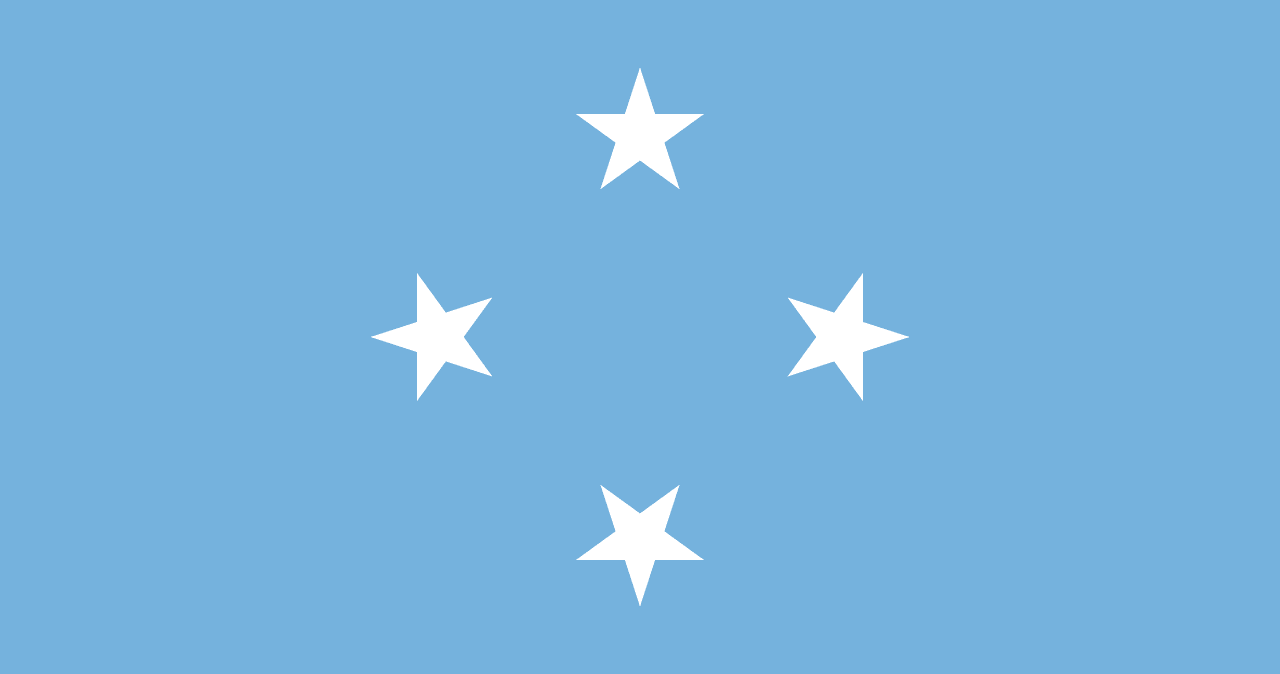
Few flags capture the geography of their homeland as literally as the banner of the Federated States of Micronesia. A calm expanse of light blue stands in for the vast Pacific Ocean, and four crisp white stars float across it like islands scattered over open water. There is no crest, no stripe, no heraldic clutter, just sky-blue and starlight. The result is one of the most serene-looking national flags anywhere on Earth, and one whose simplicity hides a thoughtful story about unity, self-determination, and a young nation finding its place among the scattered atolls of the western Pacific.
A Field of Pacific Blue
The dominant feature of the flag is its background: a single, unbroken field of light blue. This is not the deep navy of many maritime ensigns but a softer, lighter shade, deliberately chosen to evoke both the ocean and the open sky that surround the islands. Micronesia is a nation almost entirely made of water. Its land area is tiny, but its territory spreads across an enormous stretch of the Pacific, and the blue field acknowledges that reality. The sea is not merely a backdrop here; it is the connective tissue that links hundreds of islands into a single state, the highway along which Micronesians have traveled, traded, and navigated for thousands of years.
Against that blue sit four white stars. White, as so often in vexillology, suggests peace and purity, but on this flag the color also provides the high contrast that makes the design instantly legible from a distance. The interplay is intentionally minimal. Two colors, one shape repeated four times, and nothing else.
Reading the Four Stars
The four white stars are the heart of the flag's meaning. Each one represents one of the four states that make up the Federated States of Micronesia: Yap, Chuuk, Pohnpei, and Kosrae. The stars are arranged in a balanced diamond or rhomboid pattern, evenly spaced so that no single state appears more prominent than another. That balance is the whole point. A federation of widely separated island groups, each with its own languages and traditions, needed a symbol that asserted equality among its members, and a ring of identical stars does exactly that.
This star-as-state convention places Micronesia in good company. Many federations encode their constituent parts into their flags, and the visual logic is easy to grasp at a glance: count the stars, count the states. Should the federation's composition ever change, the symbolism is flexible enough to adapt, but for now the number four tells a clear and accurate story about the country's structure.
How the Flag Came to Be
The flag was adopted in 1978, during the period when Micronesia was moving toward self-governance. For much of the twentieth century, these islands were administered as part of the Trust Territory of the Pacific Islands, a United Nations trusteeship overseen by the United States after the Second World War. As the trust territory began to break apart and its districts charted separate political futures, the people of the central island groups voted to form the Federated States of Micronesia.
The choice of a pale blue field with white stars was a meaningful echo of that transitional moment. The trusteeship flag and the United Nations banner both used a similar light blue, and adopting that palette signaled continuity and a peaceful, internationally recognized path to nationhood rather than a rupture. When full self-government and later independence arrived, the flag carried forward as the emblem of a sovereign state. It is a rare case where a flag's color choice is a quiet diplomatic statement as much as an aesthetic one.
Look-Alikes and Close Relatives
Because of its light blue ground and white stars, the Micronesian flag invites comparison with a small family of similar banners. The most obvious relative is the flag of the United Nations, whose pale blue tone the designers consciously mirrored to mark the country's trust territory heritage. Casual observers sometimes confuse the two at a distance, since both rely on that same soft blue with white emblems.
Within the Pacific, several other nations also use star-studded designs to represent island groupings, which can lead to mix-ups for those unfamiliar with the region. What distinguishes Micronesia's flag is its restraint and arithmetic precision: exactly four stars, all identical, set in a tidy diamond on an otherwise empty field. There are no additional charges, no canton, no border. Where some neighboring flags layer in suns, crests, or multiple colors, Micronesia keeps the composition almost mathematically clean, which makes it one of the more minimalist national flags in the world. To distinguish it from look-alikes, you can explore more context in our micronesia country guide.
A Symbol of Island Identity
For a nation as geographically dispersed as Micronesia, a shared flag does important cultural work. The islands of Yap, Chuuk, Pohnpei, and Kosrae are separated by hundreds of miles of ocean and by deep differences in language and custom. The flag offers a single, easily recognized emblem under which all four can stand together. The diamond of stars is a visual promise that the federation is a partnership of equals rather than a hierarchy dominated by its largest island.
The blue field reinforces that sense of shared identity by celebrating the very thing the islands have most in common: the ocean. In Micronesian history, the sea was never a barrier but a network. The famed navigators of these islands crossed open water using the stars, the swells, and the flight of birds. There is a pleasing resonance, then, in a flag that pairs the blue of the sea with white stars overhead, the two great references by which generations of voyagers found their way.
The Flag in Modern Life
Today the flag appears in all the expected civic settings. It flies over government buildings across the four states, represents the country at the United Nations and other international forums, and is raised on national occasions and independence celebrations. Micronesian athletes carry it at regional and international sporting events, where the simple blue-and-white design stands out clearly in a parade of nations. Schoolchildren learn that each star is one of their states, making the flag a ready-made lesson in the country's federal structure.
Here are a few quick facts worth remembering:
- The flag was adopted in 1978 during the transition to self-governance.
- Its only two colors are light blue and white.
- The four white stars stand for the four states: Yap, Chuuk, Pohnpei, and Kosrae.
- The pale blue deliberately recalls the United Nations and trust territory flags.
- Micronesia lies in Oceania, in the western Pacific Ocean.
- The minimalist design carries no crest, stripe, or border, just the field and the stars.
Frequently Asked Questions
When was the flag of Micronesia adopted?
The flag was adopted in 1978, during the period when the Federated States of Micronesia was transitioning toward self-governance out of the former Trust Territory of the Pacific Islands. It has served as the country's emblem ever since, carrying through to full sovereignty.
What do the colors and stars mean?
The light blue field represents the surrounding Pacific Ocean, the body of water that ties the dispersed islands together. The four white stars represent the four constituent states of the federation, arranged in a balanced diamond to symbolize their equality within the union.
Why does the flag look like the United Nations flag?
The resemblance is intentional. The designers chose a light blue similar to that of the United Nations and the trust territory administration to signal Micronesia's peaceful, internationally recognized path from UN trusteeship to nationhood. The four white stars are what set it clearly apart.
What continent is Micronesia on?
Micronesia is part of Oceania, the broad region of islands in the central and western Pacific Ocean. The Federated States of Micronesia consists of four island states spread across a vast expanse of sea north of the equator, with a tiny total land area but an enormous maritime territory.
