
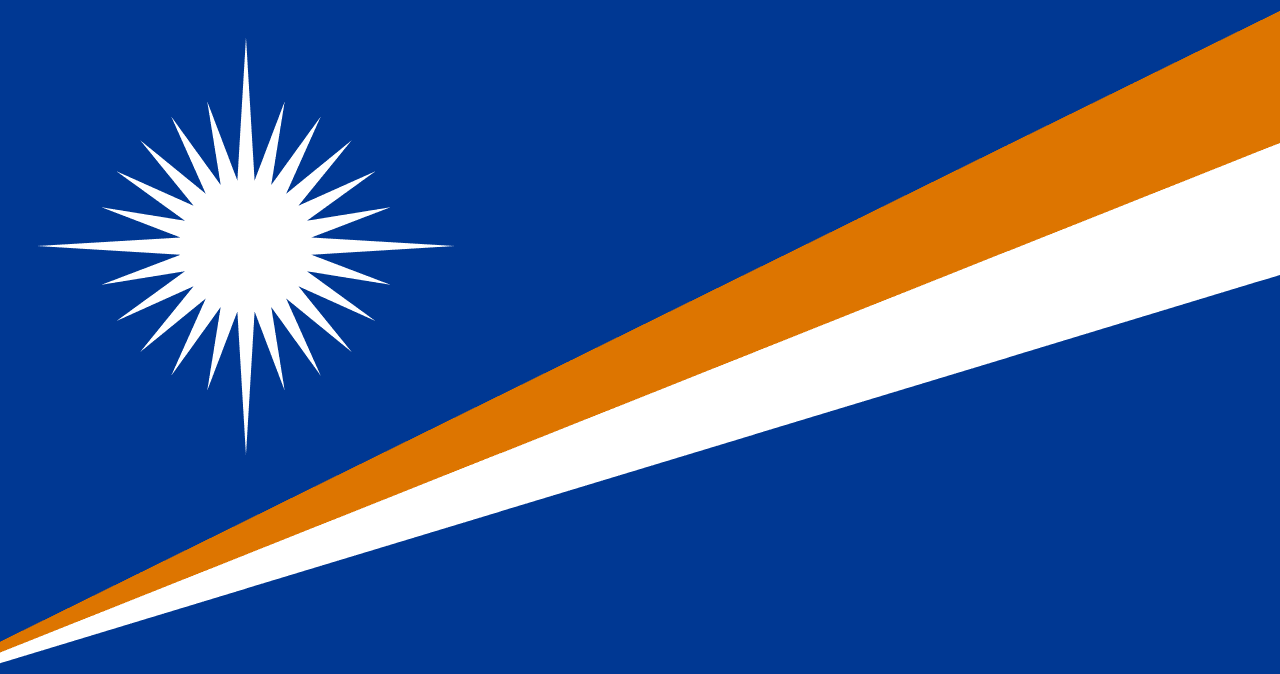
Stretched across the vast central Pacific, the Marshall Islands fly one of the most quietly inventive banners on Earth. At first glance it reads as a simple blue field, but look longer and the geometry reveals itself: two rays of orange and white widening as they climb toward a single brilliant star anchored in the upper hoist. There is nothing else quite like it. The flag turns the islanders' relationship with the ocean, the sun, and the horizon into pure design, and it has flown since 1979, the year the nation moved decisively toward self-government.
For a country made of low coral atolls scattered over hundreds of thousands of square miles of open sea, a flag has to do a lot of work. It has to say something about distance, about navigation, about a people who learned to read the swell of waves the way others read maps. The Marshallese banner manages all of that with three colors and a handful of clean lines, which is exactly why it rewards a closer look.
A Banner Born With the Nation
The flag was adopted in 1979, the same period in which the Marshall Islands established its constitution and began the path to full sovereignty that would be formalized through later compacts. Its creation was not handed to a committee of foreign heraldists; it came from within. The design is credited to Emlain Kabua, who shaped a symbol meant to feel authentically Marshallese rather than borrowed from colonial templates.
That origin matters. Many Pacific flags carry visual echoes of the powers that once administered them, but the Marshall Islands chose imagery rooted in their own geography and seafaring culture. The result is a flag that arrived fully formed and has remained unchanged ever since, a steady emblem through the country's emergence as an independent voice in the Pacific community.
Reading the Colors
The Marshallese palette is deliberate and economical. The deep blue field is the Pacific Ocean itself, the element that surrounds and connects every atoll in the country. Against it run two diagonal bands: an orange stripe and a white stripe, set side by side and rising from the lower hoist toward the fly.
Each carries meaning. Orange stands for bravery, the courage of a people whose history is bound up with long ocean voyages and survival on slender strips of land. White represents peace, a fitting value for a nation that prizes calm and community across its widely separated islands. Together the two stripes are often read as the dawn light breaking over the sea, a horizon line where the warmth of the sun meets the cool of the water.
The Geometry of Rays and Star
The design is more than decoration; it is a small map of the country. The two diagonal bands are not a flat stripe but a pair of rays that widen as they ascend, suggesting the increasing daylight of sunrise and, in a more literal reading, the way the islands lie spread across the ocean. The Marshall Islands are organized into two parallel chains, and the dual band quietly nods to that structure.
Crowning the upper hoist is the white star, and here is where the flag becomes genuinely singular. The star bears twenty-four points, one for each of the country's electoral districts, themselves corresponding to the inhabited municipalities scattered through the atolls. Four of those points are elongated, traditionally understood as marking the principal cultural and religious centers of the nation. The star sits where it does, near the rising bands, to evoke a guiding light above the sea, an apt image for a culture of master navigators.
How It Compares to Other Pacific Flags
Place the Marshallese flag beside its neighbors and its individuality stands out. Many island states in the region lean on blue fields too, since the ocean is the shared canvas of the Pacific, but the way each handles the rest of the design differs sharply. Nauru, for instance, uses a horizontal gold stripe across blue with a single white star low in the hoist, a layout meant to pinpoint the island's position near the equator. Micronesia arranges four white stars in a circle. Kiribati fills its upper field with a golden sunrise and a frigatebird above stylized waves.
What separates the Marshall Islands from all of them is the diagonal motion of its rays and, above all, that elaborate star. No other national flag carries a twenty-four-pointed star, which makes the emblem instantly identifiable once you know to count. Where other Pacific banners often read as horizontal and static, the Marshallese design pushes upward and across, giving it a sense of movement that mirrors a voyaging tradition. If you want the broader picture of the country behind the flag, the marshall islands country guide fills in the geography and culture.
Cultural Significance and National Identity
For the Marshallese, the flag is inseparable from a heritage of wayfinding. Long before satellite positioning, navigators here crossed open ocean using stick charts, lattices of palm ribs and shells that encoded the patterns of swells bending around islands. A flag whose central figure is a guiding star, rising over a sea-blue field, speaks directly to that inheritance. The star is not generic decoration; it is the kind of fixed point that brought canoes safely home.
The colors reinforce a self-image built on courage and peace, two qualities that resonate in a nation that has weathered profound challenges, from the upheavals of the twentieth century to the ongoing pressures of a changing climate on low-lying atolls. The flag gathers a dispersed population, spread across two chains and dozens of districts, into a single shared emblem. Each point of the star says, in effect, that every district counts and that the whole is built from its many islands.
The Flag in Modern Life
Today the banner appears wherever the Marshall Islands assert their identity. It is raised on national holidays, including the observances tied to the country's constitutional and sovereignty milestones, and it flies at government buildings across the atolls. On the international stage it represents the nation at the United Nations and in Pacific regional forums, where Marshallese leaders are prominent voices on ocean health and climate.
The flag also travels with the country's athletes. At the Olympic Games and at Pacific regional competitions, Marshallese teams march behind it, and the twenty-four-pointed star becomes a small ambassador, sparking curiosity among viewers who have never seen a star quite like it. Because so much of the world's commercial shipping is registered under the Marshall Islands flag of convenience, the emblem is also, improbably, one of the more widely sailed banners on the planet's oceans.
Quick Facts to Remember
- Adopted: 1979, alongside the country's move toward self-government.
- Designer: Emlain Kabua.
- Colors: blue ocean field, orange ray for bravery, white ray for peace.
- The star: twenty-four points for the electoral districts, with four elongated points for major centers.
- Unique trait: the only national flag with a twenty-four-pointed star.
- Region: Oceania, in the central Pacific Ocean.
- Symbolic reading: rising rays evoke the sunrise and the two island chains.
Frequently Asked Questions
When was the flag of the Marshall Islands adopted?
The flag was adopted in 1979, during the period in which the Marshall Islands adopted its constitution and advanced toward self-government. It has remained unchanged since then, making it one of the steady, enduring symbols of the young nation.
What do the colors of the Marshall Islands flag mean?
The blue field represents the Pacific Ocean that surrounds the atolls. The orange diagonal stripe stands for bravery, and the white stripe stands for peace. Read together, the two rays are often seen as the light of dawn rising over the sea.
Who designed the Marshall Islands flag?
The flag is credited to Emlain Kabua. Rather than adapting a colonial pattern, the design draws on Marshallese geography and seafaring tradition, using the rising rays and the star to reflect the country's own identity.
What continent is the Marshall Islands on, and how does its flag compare to similar ones?
The Marshall Islands lie in Oceania, in the central Pacific Ocean. Like several Pacific neighbors such as Nauru, Micronesia, and Kiribati, it uses a blue, ocean-themed field, but its diagonal rising rays and uniquely twenty-four-pointed star set it apart from every other national flag in the world.