
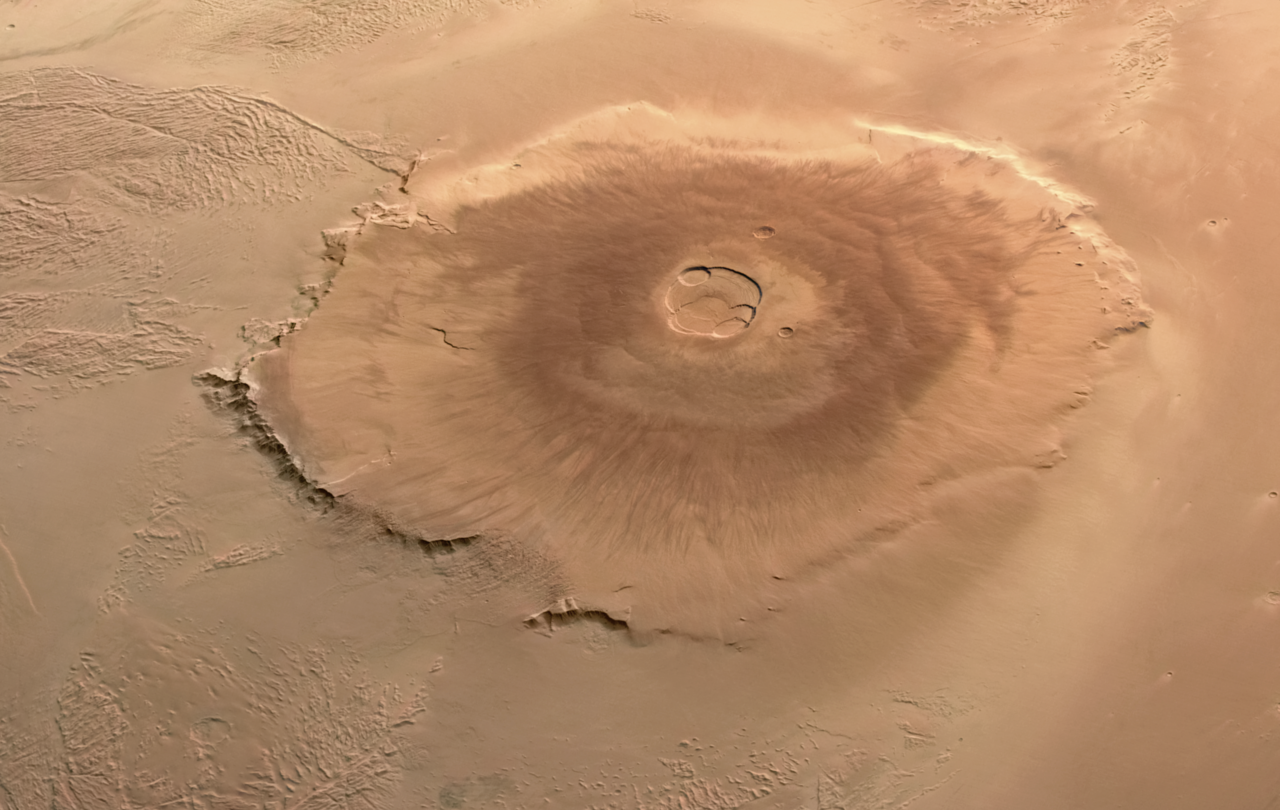
Olympus Mons is a shield volcano on Mars and the largest known volcano in the solar system. Rising approximately 21.9 km (72,000 ft) above the surrounding Tharsis plains, it is nearly three times the height of Mount Everest and roughly 2.5 times the height of Mauna Kea measured from its oceanic base.
Introduction
The volcano covers an area of approximately 300,000 km² — roughly the size of the state of Arizona or the entire country of Italy. Its caldera complex at the summit measures 80 km × 60 km, large enough to contain the entire Greater London area. Olympus Mons is the most extreme example of volcanism known anywhere in the solar system.
Geography & Location
- Location: Tharsis region, Mars (18.65°N, 226.2°E)
- Height: 21.9 km (72,000 ft) above datum
- Base Diameter: ~600 km
Olympus Mons sits in the Tharsis volcanic province on the western hemisphere of Mars, a massive volcanic plateau that hosts three other large shield volcanoes (Ascraeus Mons, Pavonis Mons, and Arsia Mons) in a roughly linear chain.
The volcano is surrounded by a steep escarpment (cliff) up to 8 km high around much of its perimeter — a feature unique to Olympus Mons and believed to result from the interaction of lava flows with an ancient ice-rich substrate or gravitational spreading of the volcanic edifice.
Volcanic Activity
- Type: Shield volcano (basaltic)
- Last Activity: Estimated 25-115 million years ago
- Status: Likely dormant, not extinct
Olympus Mons was built primarily from extremely fluid basaltic lava flows over billions of years. The gentle 2-5 degree slope angles are typical of shield volcanoes and result from the low viscosity of basaltic magma flowing great distances from the summit vents.
Analysis of crater counts on the youngest lava flows suggests the most recent volcanic activity occurred as recently as 25 million years ago — very young by geological standards. Some planetary scientists believe Olympus Mons could erupt again, making it potentially dormant rather than extinct.
Eruption History
- Formation Period: ~3.5 billion years to ~25 million years ago
- Growth Duration: Billions of years of accumulation
- Caldera Formation: Multiple collapse events
Unlike Earth's volcanoes, which are limited in size by plate tectonics that moves the crust away from magma sources, Mars has no plate tectonics. The Tharsis hotspot has remained stationary beneath Olympus Mons for billions of years, allowing lava to pile up in one location to extraordinary heights.
The summit caldera complex consists of six overlapping collapse craters formed at different times, recording multiple episodes of magma chamber draining. The youngest caldera is estimated at 150 million years old, while the oldest may be 2+ billion years old.
Surrounding Ecosystem
- Aureole: Massive landslide deposits extending 750+ km
- Lava Tubes: Likely exists, potentially habitable for future missions
- Dust: Extensive wind-deposited dust and sand features
Surrounding Olympus Mons are the "aureole" deposits — vast lobes of chaotic terrain extending up to 750 km from the base. These are interpreted as massive landslide or gravity-driven flow deposits from the collapse of the volcano's flanks, making them among the largest mass movements known in the solar system.
Scientists have identified possible lava tube entrances (skylights) on the flanks of Olympus Mons and other Martian volcanoes. These tubes could provide shelter from radiation and temperature extremes, making them potential sites for future human habitation on Mars.
Cultural Significance
- Discovery: First observed as bright feature by telescopes in the 1800s
- Named: After Mount Olympus in Greek mythology
- Mars Exploration: Key target for future missions
Olympus Mons was first observed as a bright spot by early telescopic observers, who called it "Nix Olympica" (Snows of Olympus), assuming it was a snow-capped mountain. The Mariner 9 orbiter in 1971 revealed its true volcanic nature and staggering scale for the first time.
The volcano has become an icon of planetary science and a symbol of the extreme geological features possible beyond Earth. It is frequently discussed as a long-term target for human exploration, though its high altitude means the thin Martian atmosphere provides almost no aerodynamic braking for landing spacecraft.
Key Facts
- Olympus Mons is the largest volcano in the solar system at 21.9 km tall and ~600 km across.
- It covers approximately 300,000 km² — the size of Arizona or Italy.
- The summit caldera is 80 × 60 km, large enough to contain Greater London.
- Mars lacks plate tectonics, allowing the volcano to grow over a single hotspot for billions of years.
- The most recent lava flows may be only 25 million years old, making it potentially dormant.
Fun Facts
- Olympus Mons is so large that an observer standing on its summit could not see the base — it would extend beyond the horizon.
- The atmospheric pressure at the summit is only about 2% of the already-thin Martian surface average.
- If placed on Earth, the volcano's base would span from New York City to roughly Pittsburgh.
- Early astronomers thought the bright spot was a snow-covered peak, naming it "Nix Olympica" — Snows of Olympus.
Final Thoughts
Olympus Mons is a monument to what volcanism can achieve without the constraints of plate tectonics. Over billions of years, a single hotspot built a structure that dwarfs everything on Earth, reaching the edge of space on a planet with far less gravity. It is the ultimate expression of volcanic power in our solar system.
Test Your Volcano Knowledge!
Think you know the world's most powerful volcanoes? Try our interactive quiz!
Play Geographic Features Quiz →