
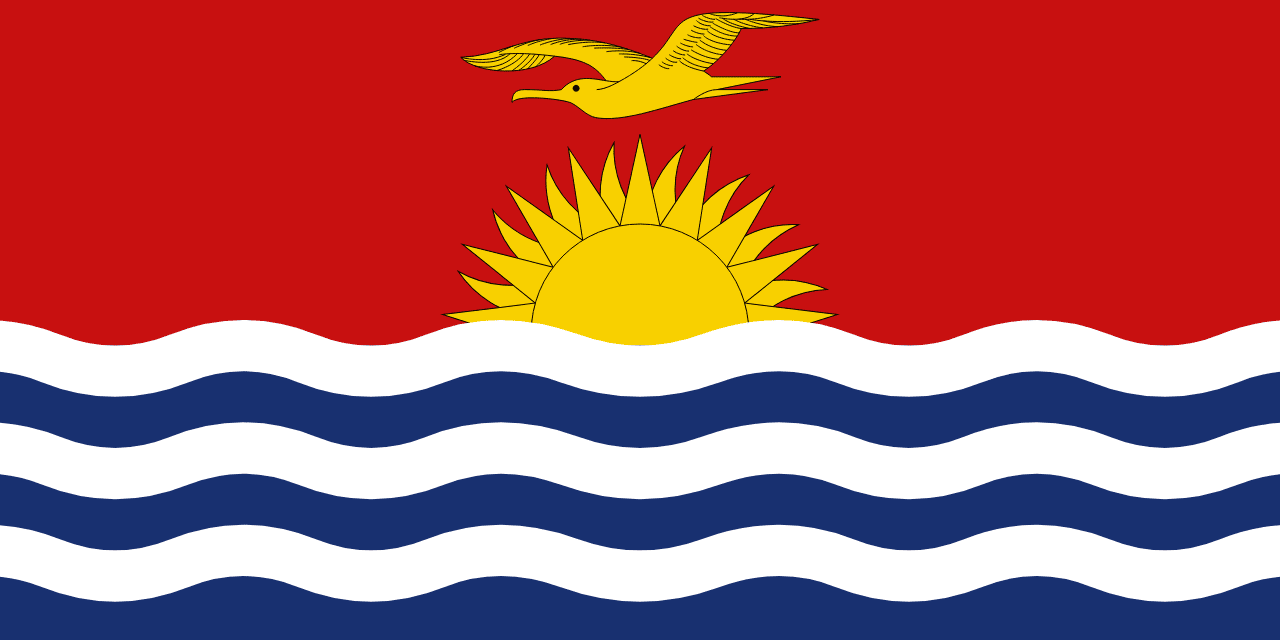
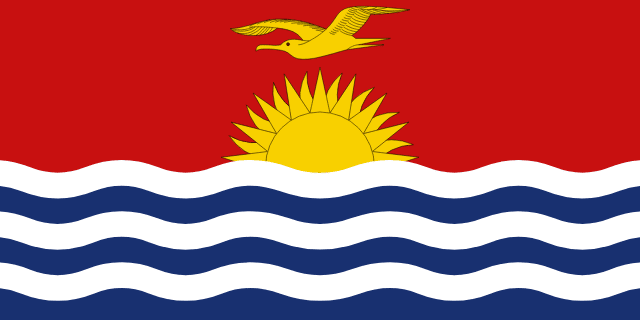
Few flags capture the essence of their homeland as vividly as the banner of Kiribati. Stretched across a tiny scattering of coral islands straddling the equator in the central Pacific, this flag tells a story you can read at a glance: a golden sun lifting above ocean waves, with a seabird soaring overhead. Adopted in 1979, the year Kiribati gained independence, it is one of the more pictorial national flags in the world, trading abstract stripes for a small painted scene that feels almost like a window onto the islands themselves.
A Window Onto the Pacific
The flag of Kiribati is a heraldic banner divided horizontally into two halves. The upper portion is a deep red field on which a yellow frigate bird flies across a rising yellow sun. The lower portion is made of blue and white wavy bands that represent the waters of the Pacific Ocean. Rather than the flat geometric blocks favoured by most countries, Kiribati chose imagery drawn directly from its environment, the sun, the sea, and a native bird, so that the design reads instantly as a maritime nation living close to the water.
This pictorial quality sets it apart. Many flags ask you to learn a code of meanings; the Kiribati flag simply shows you the place. The composition is balanced and unmistakable, and even at a distance the silhouette of the bird against the sun makes it easy to identify.
The Colors and What They Carry
The four colors of the flag each pull their weight. The yellow sun is the most pointed reference of all: Kiribati sits almost exactly on the equator, and the sun rising over the horizon speaks to that equatorial position and the daily rhythm of light over the islands. Some interpretations also count the rays of the sun as a nod to the groups of islands that make up the nation.
The red upper field gives the bird and sun a warm, dramatic backdrop, evoking the colors of a tropical sky. The blue and white waves below are the clearest symbol of all, the surrounding Pacific that defines life in an island state, alternating bands of deep water and pale foam. Together the palette ties land, sky, and sea into a single image.
The Frigate Bird and the Idea of Freedom
The golden bird arcing across the sun is a frigate bird, a large seabird native to the region and a familiar sight wheeling above the lagoons. On the flag it stands for command of the sea and the freedom of the open Pacific, the soaring, untethered spirit of a people whose world is mostly ocean. Because the frigate bird is a genuinely local species rather than a borrowed heraldic creature like a lion or eagle, it grounds the flag in the real wildlife of the islands and reinforces the sense of a distinctly Pacific identity.
The pairing of bird and sun is the heart of the design. Where the waves speak of the environment that surrounds the people, the bird in flight speaks of aspiration, of movement, voyaging, and independence.
From Colonial Arms to Independent Banner
The flag did not spring from nowhere in 1979. Its imagery comes directly from a coat of arms granted in 1937, during the era when the islands were administered as part of the Gilbert and Ellice Islands colony. That coat of arms already carried the frigate bird, the rising sun, and the wavy sea, the same elements that would later fill the national flag.
When Kiribati became independent, the choice was made to translate the heraldic shield more or less directly into a flag, expanding the arms to fill the whole banner. This is why the flag has such a detailed, illustrative look compared with the simpler tricolors and crosses of many other nations. The early proposal reportedly placed the design on a smaller shield within a plain field, but the final version enlarged the picture so that the sun, bird, and waves stretch across the entire surface. The result keeps a direct visual link to the islands' early-twentieth-century emblem while marking the birth of the new state in 1979.
How It Compares to Other Flags
Pictorial flags are relatively rare, and Kiribati belongs to a small club of nations that depict full scenes rather than abstract shapes. It shares this approach with flags that show landscapes or wildlife in detail, and within the Pacific it sits naturally alongside neighbours whose banners also reach for sun and sea imagery.
- Rising-sun motifs: Several Pacific and Asian flags feature a sun, but Kiribati's sun rises out of ocean waves rather than standing alone, which is unusual.
- Bird emblems: Flags such as those bearing eagles or birds of paradise use national birds too, yet the frigate bird gives Kiribati a uniquely maritime, seafaring character.
- Wave bands: The blue-and-white waves recall heraldic representations of the sea seen on coastal and island emblems, but few national flags render moving water so prominently across the lower half.
What distinguishes the Kiribati flag is the combination: a red sky, a golden equatorial sun, a native seabird, and the Pacific itself, all assembled into one coherent picture that no other country shares.
National Identity and Everyday Life
For the people of Kiribati, known as I-Kiribati, the flag is a compact statement of who they are: islanders of the equator, bound to the ocean. It appears on government buildings, at schools, and during national celebrations, most prominently around independence festivities each July, when the rising sun on the cloth echoes the sun overhead. The flag also flies at international sporting events, including the Olympic and Commonwealth Games, where a small nation announces itself on a world stage with an image as warm and direct as the islands it represents. If you want a fuller picture of the country behind the banner, the kiribati country guide sets the flag in the context of its geography, culture, and history.
Because the design is so legible, it travels well, recognisable on a lapel pin, a ship's ensign, or a stadium scoreboard. That immediacy helps a nation of widely scattered atolls project a single, shared identity.
Interesting Facts at a Glance
- The flag was adopted in 1979, the same year Kiribati became an independent nation.
- Its design comes from a coat of arms granted in 1937, decades before independence.
- The frigate bird shown on the flag is a real local species, not an invented heraldic creature.
- The rising sun directly references Kiribati's position straddling the equator.
- It is one of the relatively few national flags to depict a complete scene rather than abstract stripes or symbols.
- The blue and white wavy bands represent the surrounding waters of the Pacific Ocean.
Frequently Asked Questions
When was the flag of Kiribati adopted?
The flag was adopted in 1979, the year Kiribati gained its independence. Its imagery, however, is older, drawn from a coat of arms granted back in 1937 during the colonial period.
What do the colors and symbols mean?
The yellow sun marks Kiribati's location on the equator, the golden frigate bird represents freedom and command of the sea, and the blue and white wavy bands stand for the waters of the Pacific Ocean. The red field gives the bird and sun a vivid sky behind them.
Who designed the flag of Kiribati?
The flag was based on the coat of arms granted in 1937, so its core imagery predates independence rather than being invented from scratch in 1979. The national flag essentially enlarges that earlier heraldic design to fill the whole banner, which is why no single modern designer is usually credited with the concept.
What continent is Kiribati on?
Kiribati is an island nation in Oceania, spread across the central Pacific Ocean and straddling the equator. Its scattered atolls and reef islands make it one of the most ocean-dominated countries on Earth, a fact the flag's prominent waves reflect.