
Mohenjo-daro, meaning "Mound of the Dead" in Sindhi, was one of the largest and most sophisticated cities of the Indus Valley Civilization, also known as the Harappan civilization. Located on the west bank of the Indus River in present-day Sindh Province, Pakistan, the city was built around 2500 BCE and flourished for approximately 700 years before being gradually abandoned around 1900 BCE.
Introduction
The city's advanced urban planning — including a grid street layout, multi-story brick houses with indoor wells and toilets connected to a citywide drainage system, and public buildings including the famous Great Bath — was not equaled in the subcontinent for thousands of years. Mohenjo-daro, along with its sister city Harappa 680 kilometers to the north, represents one of the cradles of human urban civilization alongside Mesopotamia and ancient Egypt.
Geographic Setting
- Location: Larkana District, Sindh, Pakistan
- Elevation: Approximately 60 meters above sea level
- River: West bank of the Indus River
- Climate: Hot desert, 100mm annual rainfall
Mohenjo-daro lies in the flat alluvial plain of the lower Indus River valley, a region that today receives less than 100 millimeters of rain per year but was somewhat wetter during the 3rd millennium BCE. The Indus River and its seasonal flooding cycles were the lifeblood of the civilization, depositing fertile silt across the floodplain that enabled intensive agriculture of wheat, barley, and cotton.
The city was strategically located at a natural crossroads where the Indus River was navigable for trade and the surrounding plain provided productive farmland. The Indus Valley Civilization's territory extended from the Arabian Sea coast to the foothills of the Himalayas, and Mohenjo-daro appears to have served as a major administrative or ceremonial center for the southern portion of this vast network, which covered an area larger than ancient Egypt and Mesopotamia combined.
Architecture & Engineering
- City Area: Approximately 250 hectares (2.5 km²)
- Population: Estimated 30,000–40,000
- Great Bath: 12 × 7 meters, 2.4 meters deep
- Drainage: Citywide covered brick drains
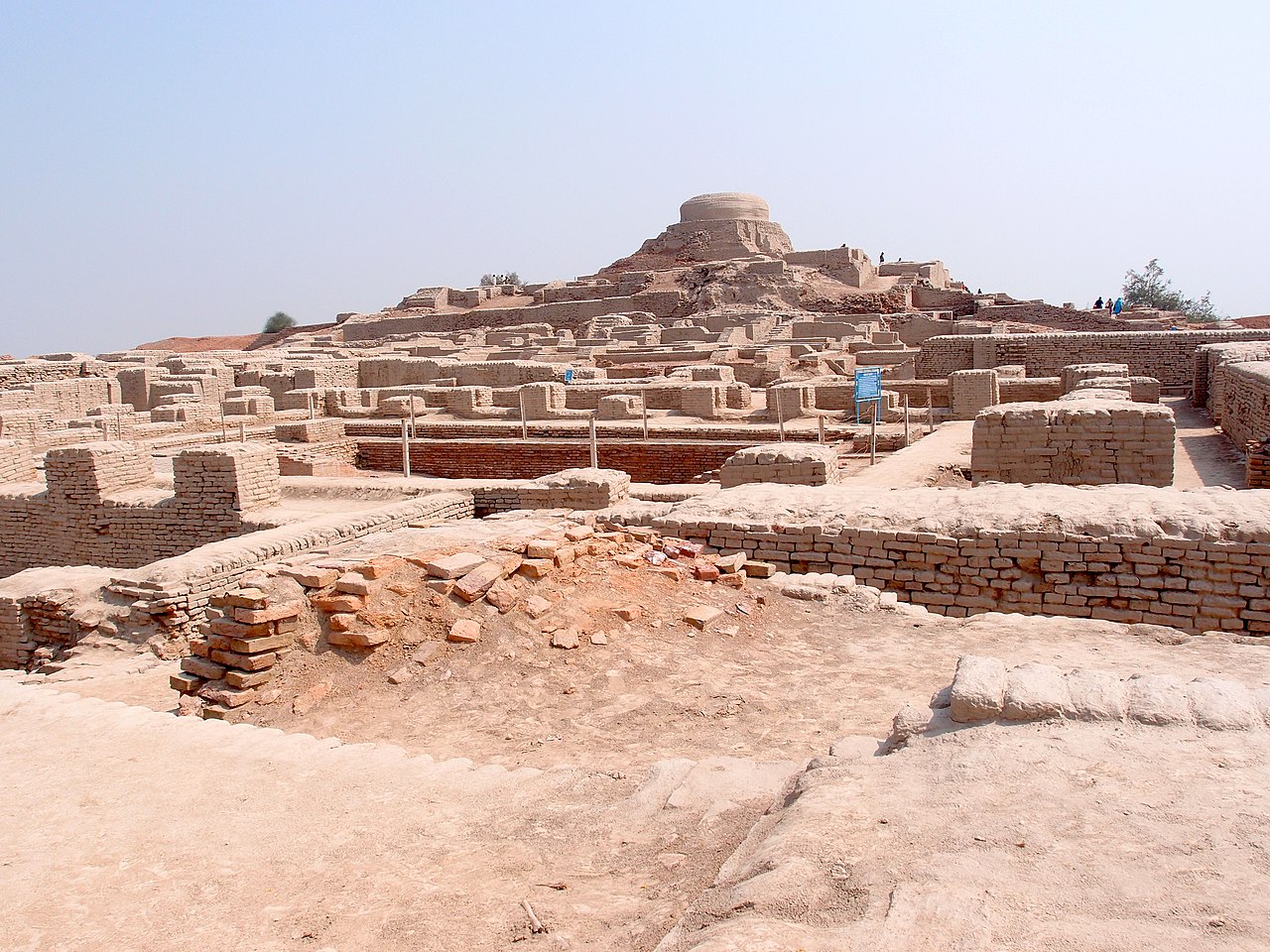
Mohenjo-daro was laid out on a precise grid of streets oriented roughly north-south and east-west, with major avenues up to 10 meters wide and narrower lanes dividing residential blocks. The city was organized into two main sectors: a raised "Citadel" mound to the west containing public buildings, and a larger "Lower City" to the east with residential and commercial areas.
The Great Bath, located on the Citadel mound, is the earliest known public water tank in the ancient world. Measuring 12 by 7 meters and 2.4 meters deep, it was made watertight using closely fitted bricks sealed with gypsum mortar and a layer of natural bitumen. Nearly every house in the city had a private well and bathing area connected to the municipal drainage system — covered brick channels that ran beneath the streets, with inspection holes for maintenance. This level of sanitation infrastructure was not matched in Europe until the Roman era.
Historical Significance
- Built: c. 2500 BCE
- Civilization Peak: c. 2600–1900 BCE
- Abandoned: c. 1900 BCE
- UNESCO Status: World Heritage Site since 1980
The Indus Valley Civilization was one of the three earliest urban civilizations, contemporary with ancient Egypt and Mesopotamia. At its peak, it encompassed over 1,500 known settlements across an area of 1.25 million square kilometers. Unlike its contemporaries, the Indus civilization shows remarkably little evidence of monumental royal architecture, massive military fortifications, or obvious social hierarchy, leading scholars to debate whether it was governed by a class of merchants, priests, or a more egalitarian system.
Mohenjo-daro's script, found on thousands of small seal stones, remains undeciphered despite a century of effort. Without readable texts, the civilization's political structure, religious beliefs, and even its proper name are unknown. The city was gradually abandoned around 1900 BCE, possibly due to shifting river courses, climate change reducing monsoon rainfall, or a combination of environmental and social factors. The site was rediscovered in 1922 by R.D. Banerji of the Archaeological Survey of India.
Conservation & Tourism
- Annual Visitors: ~100,000
- Critical Threats: Saline groundwater, erosion, flooding
- Management: Government of Pakistan with UNESCO support
- Access: 28 km from Larkana city, domestic flights available
Mohenjo-daro faces severe conservation challenges. Rising saline groundwater, driven by irrigation canals in the surrounding farmland, is wicking up through the ancient bricks and depositing salt crystals that cause the structures to crumble. UNESCO has identified Mohenjo-daro as one of the most endangered major archaeological sites in the world, and emergency conservation measures have been ongoing since the 1970s.
Seasonal flooding from the Indus River periodically inundates lower portions of the site. The 2010 and 2022 floods in Sindh caused significant damage and highlighted the vulnerability of the exposed brick structures. Despite these challenges, the Pakistani government has invested in a site museum, walkways, and protective measures. The remoteness of the site in rural Sindh means visitor numbers remain relatively modest compared to other World Heritage Sites, but those who make the journey encounter one of the most important archaeological sites of the ancient world.
Key Facts
- Mohenjo-daro was built around 2500 BCE as a major city of the Indus Valley Civilization.
- The city had an estimated population of 30,000 to 40,000 people at its peak.
- Its drainage system and indoor plumbing were the most advanced of any ancient civilization.
- The Great Bath is the earliest known public water tank in the ancient world.
- Mohenjo-daro was designated a UNESCO World Heritage Site in 1980.
Fun Facts
- The Indus Valley script found at Mohenjo-daro remains undeciphered despite over 100 years of scholarly effort.
- Nearly every house in the city had its own private well and a bathroom connected to the public sewer system.
- The civilization that built Mohenjo-daro covered a larger area than ancient Egypt and Mesopotamia combined.
Final Thoughts
Mohenjo-daro stands as extraordinary evidence that sophisticated urban civilization emerged independently in the Indus Valley around the same time as in Mesopotamia and Egypt. Its grid streets, indoor plumbing, and public drainage system demonstrate a level of civic planning and concern for public welfare that was unmatched in the ancient world and remains impressive by any standard.
Test Your Knowledge!
Think you know the world's ancient ruins and archaeological sites? Try our geography quiz games!
Play Geography Games →