
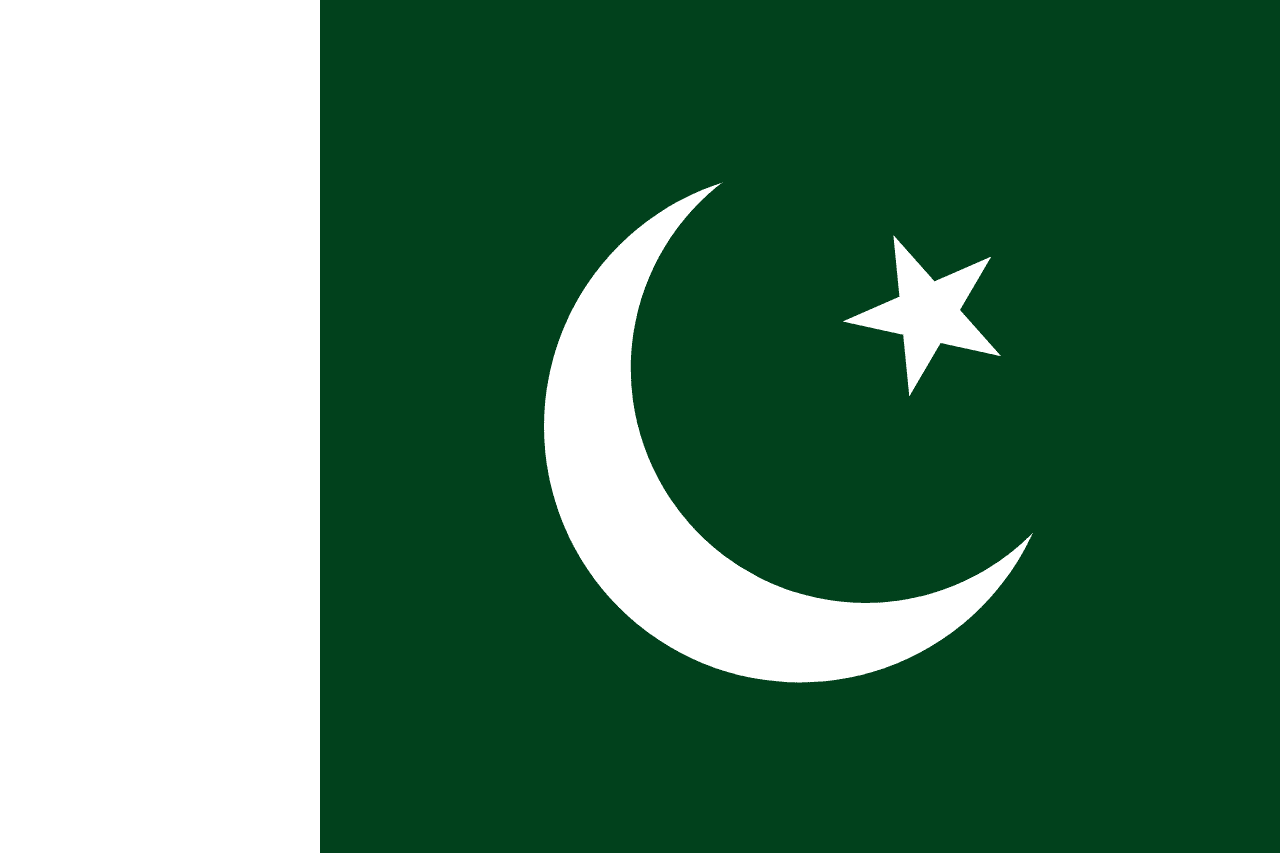

Few national flags carry their meaning quite so plainly on the surface as the flag of Pakistan. A deep green field, a white crescent and star at its heart, and a slim white band running down the side near the staff: each element was chosen to say something specific about the country that adopted it in 1947, the same year Pakistan emerged as an independent state. It is a banner that manages to be both instantly recognizable and quietly thoughtful, packing a layered statement about faith, community, and aspiration into a handful of shapes and two colors.
Below, we unpack what the green and white actually stand for, how the crescent and star are arranged, where the design came from, how it relates to other flags built on similar themes, and why Pakistanis raise it with such feeling on holidays, at sporting events, and in everyday civic life.
What the Green and White Represent
Pakistan's flag uses just two colors, and each is given a clear job. The dominant green field stands for the country's Muslim majority, tying the flag to the faith that shaped the movement for an independent homeland. Green has long been associated with Islam, which makes it a natural choice for a state founded as a home for the Muslims of the former British India.
The white is just as deliberate. The vertical white stripe set against the staff represents the country's religious minorities, the non-Muslim communities whose place in the new nation the founders wanted the flag itself to acknowledge. That single design choice turns the banner into a statement of inclusion rather than a symbol of one community alone. It is a detail many people overlook at first glance, yet it is among the most quietly meaningful features of the entire design.
Within the white symbols at the center, the meaning continues. The crescent is read as a sign of progress, and the star as light and knowledge. Together they frame the country's ambitions in terms that look forward rather than backward.
Reading the Design and Layout
The flag's geometry is simple enough to sketch from memory, which is part of its strength. The field is green, and a white vertical band sits at the hoist, the edge closest to the flagpole. The proportion between the white stripe and the green field is fixed, so the white never overwhelms the green nor shrinks into a sliver; the two areas hold a deliberate balance.
Centered on the green portion are the white crescent and a five-pointed star. The crescent opens upward and toward the fly end of the flag, with the star tucked into the space between its points. Because the crescent and star sit only on the green section, they read clearly against that darker background, while the white stripe stands apart on its own. The result is a composition that is uncluttered and legible from a distance, whether it is flying on a government building or printed on a lapel pin.
Where the Flag Came From
The flag did not appear from nowhere in 1947. Its lineage runs back to the banner of the All-India Muslim League, the political movement that campaigned for a separate Muslim-majority state in the years before partition. The League's flag was built on the same green-and-crescent-and-star palette, so the national flag of the new country was, in a real sense, the movement's own emblem carried forward into statehood.
The most significant change from that earlier banner was the addition of the white vertical stripe at the hoist. By adding it, the designers broadened the flag's message: where the League's flag spoke primarily to and for the Muslim majority, the national flag was meant to represent every citizen, minorities included. The flag was adopted right around the moment of independence, and it has flown essentially unchanged ever since, a rare example of a national symbol that has needed no redesign across the decades.
How It Compares to Similar Flags
The crescent and star are a widely shared motif, especially among nations with significant Muslim populations, so Pakistan's flag belongs to a recognizable visual family. Turkey's flag, for instance, also pairs a crescent and star with a single bold field, though it uses red rather than green and centers its emblem on the whole flag. Several other flags across North Africa and the Middle East draw on the same symbols, which can make a quick glance deceiving.
What sets Pakistan's flag apart within that family is the white vertical stripe at the hoist. No other crescent-and-star flag uses exactly this layout, with a separate white band carrying its own distinct meaning alongside the emblem. That stripe is the single most reliable feature for telling Pakistan's flag apart from look-alikes. The specific shade of green, often a rich dark green, and the placement of the crescent solely on the green field rather than across the entire banner also help distinguish it. So while the building blocks are shared, the arrangement is unmistakably Pakistan's own.
Cultural Significance and National Identity
For Pakistanis, the flag is far more than an official insignia. It is woven into the national story of independence and into a shared sense of belonging that crosses regional and linguistic lines. Schoolchildren learn the meaning of its colors early, and the explanation, that green is for the majority and white for the minorities, is part of how the country narrates its own founding values.
The flag's color scheme even spills over into national identity more broadly: green and white turn up in everything from cricket jerseys to festival decorations, so that the palette itself reads as shorthand for the country. If you want to explore the land, people, and culture behind the banner in more depth, the pakistan country guide offers a fuller picture of the nation that flies it.
The Flag in Modern Life
You will see Pakistan's flag at its most prominent on Independence Day in mid-August, when buildings, streets, vehicles, and homes are decked out in green and white, and miniature flags appear in countless hands. It flies over government offices, embassies, and military installations as a matter of routine, and it is hoisted with ceremony at the start of the day and lowered at dusk.
Sport gives the flag another stage. When the national cricket team takes the field, stadiums fill with green-and-white banners, and the colors become a wall of support behind the players. Beyond the stadium and the holiday, the flag turns up in civic ceremonies, at international gatherings where Pakistan is represented, and anywhere the country wants to plant a clear marker of its presence. In each of these settings the same two colors do their quiet work, signaling both faith and inclusion at once.
Interesting Facts at a Glance
- The flag was adopted in 1947, the year Pakistan became independent.
- The white vertical stripe represents the country's religious minorities, a deliberate gesture of inclusion built into the design.
- The design grew directly out of the All-India Muslim League flag, with the white stripe added to broaden its meaning.
- The crescent stands for progress and the star for light and knowledge.
- Pakistan sits in Asia, in the South Asian region of the continent.
- The crescent and star appear only on the green field, never on the white stripe.
Frequently Asked Questions
When was the flag of Pakistan adopted?
The flag was adopted in 1947, the same year Pakistan gained independence. It has remained essentially unchanged since then, making it one of the more stable national flags in terms of design.
What do the colors of the Pakistani flag mean?
The green field represents the country's Muslim majority, while the white vertical stripe stands for its religious minorities. The white crescent is a symbol of progress and the white star represents light and knowledge.
Where did the flag's design come from?
The flag is based on the banner of the All-India Muslim League, the movement that campaigned for an independent Muslim-majority state. The national flag kept that green field with its crescent and star and added the white stripe at the hoist to represent minorities.
What continent is Pakistan on, and how does its flag compare to similar ones?
Pakistan is in Asia, in the South Asian region. Its flag shares the crescent-and-star motif with flags such as Turkey's, but the distinctive white vertical stripe at the hoist, with its own meaning, sets Pakistan's flag clearly apart from other crescent-and-star designs.