
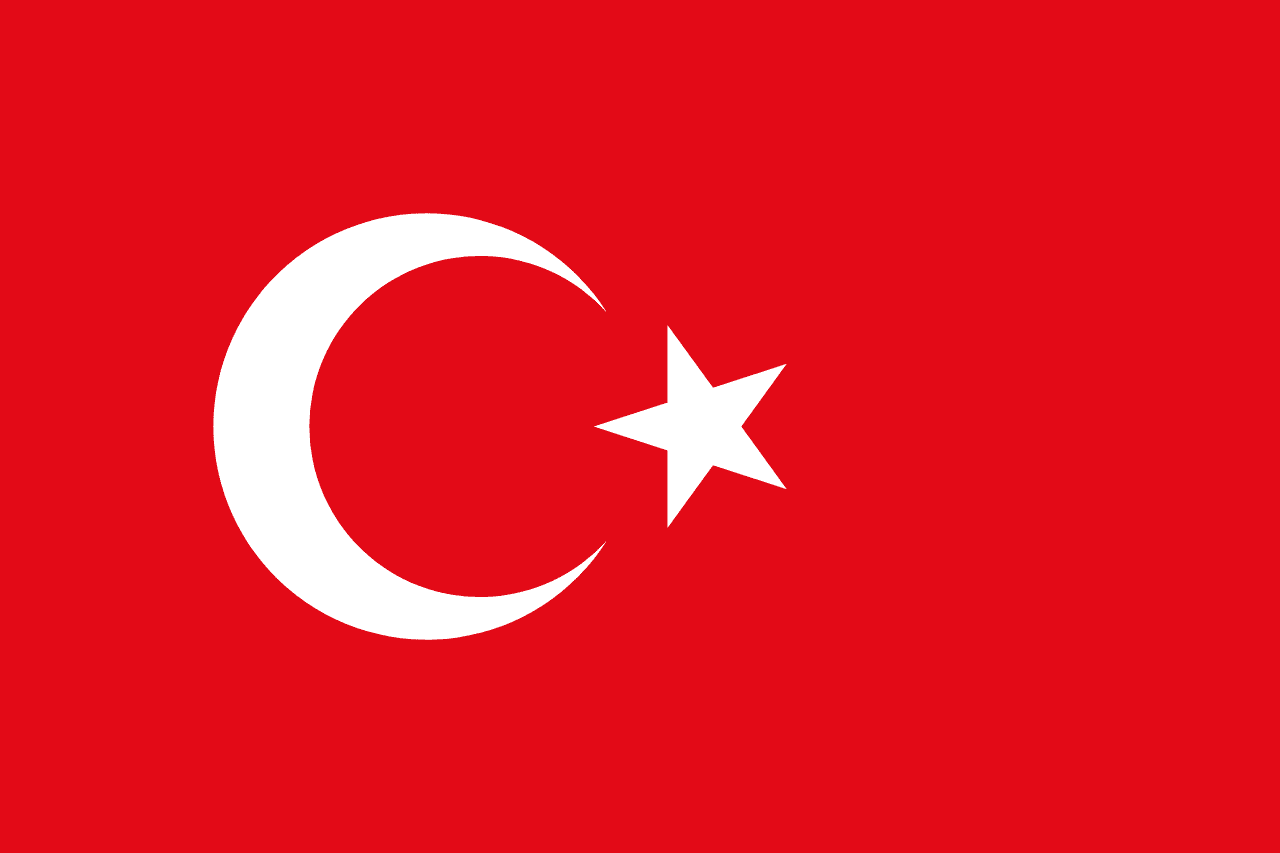
Few national emblems are as instantly recognizable as the Turkish flag: a deep crimson field broken only by a crisp white crescent moon cradling a single five-pointed star. There is a confident simplicity to it. No stripes, no coat of arms, no cluttered heraldry, just two colors and two ancient shapes that have been carried into battle, draped over coffins, and waved from stadium terraces for generations. The Turks call it al bayrak, "the red flag," or affectionately ay yıldız, "the crescent and star." Behind that economy of design lies a story that stretches back through the Ottoman centuries to a battlefield legend and forward into the modern republic founded by Mustafa Kemal Atatürk.
A Field of Red and a Crescent of White
The Turkish flag uses only two colors, and each carries weight. The red is not a casual choice of hue; it is officially Turkish Red, specified as Pantone 186 C, a warm and slightly cool-leaning scarlet that reads as both regal and martial. Tradition holds that this red stands for the blood of Turkish martyrs, those who died defending the homeland across its long history. The crescent and star sit in white, a clean contrast that lets the symbols float above the field without competing with it.
The white shapes carry their own meanings. The crescent moon is widely read as a symbol of progress and forward motion, while the five-pointed star represents independence. Together they form an emblem that long predates the modern state. Although the crescent and star are now strongly associated with Islam, their roots in Turkic and broader Near Eastern culture reach back into antiquity, well before the faith arrived. That layered history is part of why the symbol feels so settled and self-assured.
Reading the Design Up Close
The flag follows a 2:3 ratio, meaning it is half again as wide as it is tall, and its geometry is anything but improvised. Turkish law lays out the precise placement and size of every element. The white crescent sits slightly left of the flag's center, with its opening facing the fly, the edge that flutters away from the pole. Nestled in the gap between the crescent's two horns is the five-pointed star, positioned so that it appears to be held within the moon's embrace rather than overlapping it.
This careful arrangement is what gives the flag its balanced, almost calligraphic quality. The crescent is fairly thick and full, not a thin sliver, and the star is sized to nest comfortably between the points. Because the rules are codified in law, a Turkish flag made in one workshop looks essentially identical to one made anywhere else, a uniformity that reinforces its role as a shared national standard rather than an artistic interpretation.
From Ottoman Battlefields to the Republic
The flag's lineage runs through the Ottoman Empire, where the crescent and star gradually became the dominant imperial symbols. One enduring legend ties the design to the Battle of Kosovo in 1389: after the fighting, Sultan Murad I is said to have seen the reflection of a crescent moon and a star shimmering in a pool of blood on the battlefield, an image so striking it was adopted as an emblem. Whether history or folklore, the tale captures the somber blend of sacrifice and celestial imagery that defines the flag.
The crescent and star were formalized as official Ottoman symbols in 1793, and the red-and-white banner endured through the empire's final centuries. When the Ottoman state gave way to the Republic of Turkey, the new nation kept the beloved emblem rather than inventing a fresh one. In 1936, under the modernizing reforms of the Atatürk era, the design was standardized by law, fixing the proportions and placements that govern it to this day. That continuity makes it one of the oldest flag designs still in active use anywhere in the world.
Cousins and Look-Alikes Across the Map
The Turkish flag sits at the head of a large visual family. Its red field with white crescent and star inspired or paralleled the flags of several other nations, and telling them apart is a satisfying exercise for any flag enthusiast. Tunisia's flag, for instance, also pairs red and white but encloses its crescent and star inside a white circle in the center, a clear distinguishing feature. Algeria splits its field into green and white halves with a red crescent and star, inverting the palette entirely.
Pakistan's flag shares the crescent-and-star motif but sets it on a dark green field with a vertical white stripe at the hoist, signaling its own distinct identity. What makes the Turkish version unmistakable is its purity: an unbroken sweep of red, a generously curved crescent set off-center, and the star tucked between its points, with no border, circle, or secondary color to dilute the effect. Once you learn to spot that off-center crescent on solid red, you will never confuse it with its relatives again.
A Symbol Woven Into National Life
In Turkey the flag is more than decoration; it is a deeply felt expression of identity, independence, and sacrifice. It became a cornerstone of the modern republic during Atatürk's reforms, and that reverence is backed by law. Desecrating or burning the flag is a criminal offense, a measure of how seriously its dignity is guarded. You will see it flying from apartment balconies, painted on hillsides, and printed on everything from lapel pins to enormous building-sized banners.
The flag comes out in force during national holidays, above all Republic Day on October 29, which marks the founding of the republic, and Victory Day on August 30. It snaps over military ceremonies and government buildings, and it floods football stadiums whenever clubs like Galatasaray and Fenerbahçe play or the national team takes the field. For travelers curious about the country behind the banner, our turkey country guide offers a deeper look at its regions, culture, and history.
Quick Facts Worth Knowing
- Legend says the design was inspired by the reflection of the moon and star in blood after a great battle.
- Turkey's flag influenced many other national flags that feature a crescent and star.
- The proportions were standardized by Turkish law in 1936.
- It ranks among the oldest flag designs still in use today.
- Burning or desecrating the flag is treated as a criminal offense in Turkey.
- The official red is specified as Turkish Red, Pantone 186 C.
Frequently Asked Questions
When was the Turkish flag adopted?
The current form of the flag was adopted in 1936, when the Republic of Turkey standardized its proportions and the precise placement of the crescent and star by law. The underlying design, however, is far older, reaching back to the Ottoman Empire, where the crescent and star became official symbols in 1793.
What do the colors and symbols mean?
The red field is traditionally said to represent the blood of Turkish martyrs. The white crescent moon symbolizes progress, and the five-pointed star represents independence. The crescent and star together are ancient symbols rooted in Turkic and Near Eastern culture, predating their later association with Islam.
Who designed the Turkish flag?
No single individual is credited with designing the flag. It evolved gradually out of Ottoman imperial symbolism over centuries rather than being created by one person. Legend links its origin to Sultan Murad I, who is said to have seen a crescent and star reflected in blood after the 1389 Battle of Kosovo, but the modern design is the product of long tradition formalized into law in 1936.
What continent is Turkey on, and how does its flag compare to similar ones?
Turkey straddles the boundary between Asia and Europe, but it is classified here as part of Asia. Its flag belongs to a family of red-and-white crescent-and-star banners. It differs from Tunisia's, which centers the symbols inside a white circle, from Algeria's green-and-white field, and from Pakistan's green flag with a hoist-side stripe, thanks to its clean, unbroken red background and off-center crescent.