
Few national flags carry the weight of an armed liberation struggle quite as plainly as Algeria's. The green and white banner with its red crescent and star was not designed in a committee after independence; it was raised in defiance during a brutal war against colonial rule and waved by fighters long before it ever flew over a free capital. When Algeria finally became independent in 1962, the flag the new nation chose was already soaked in meaning. This is a banner that fought before it ruled.
A Quick Look at the Design
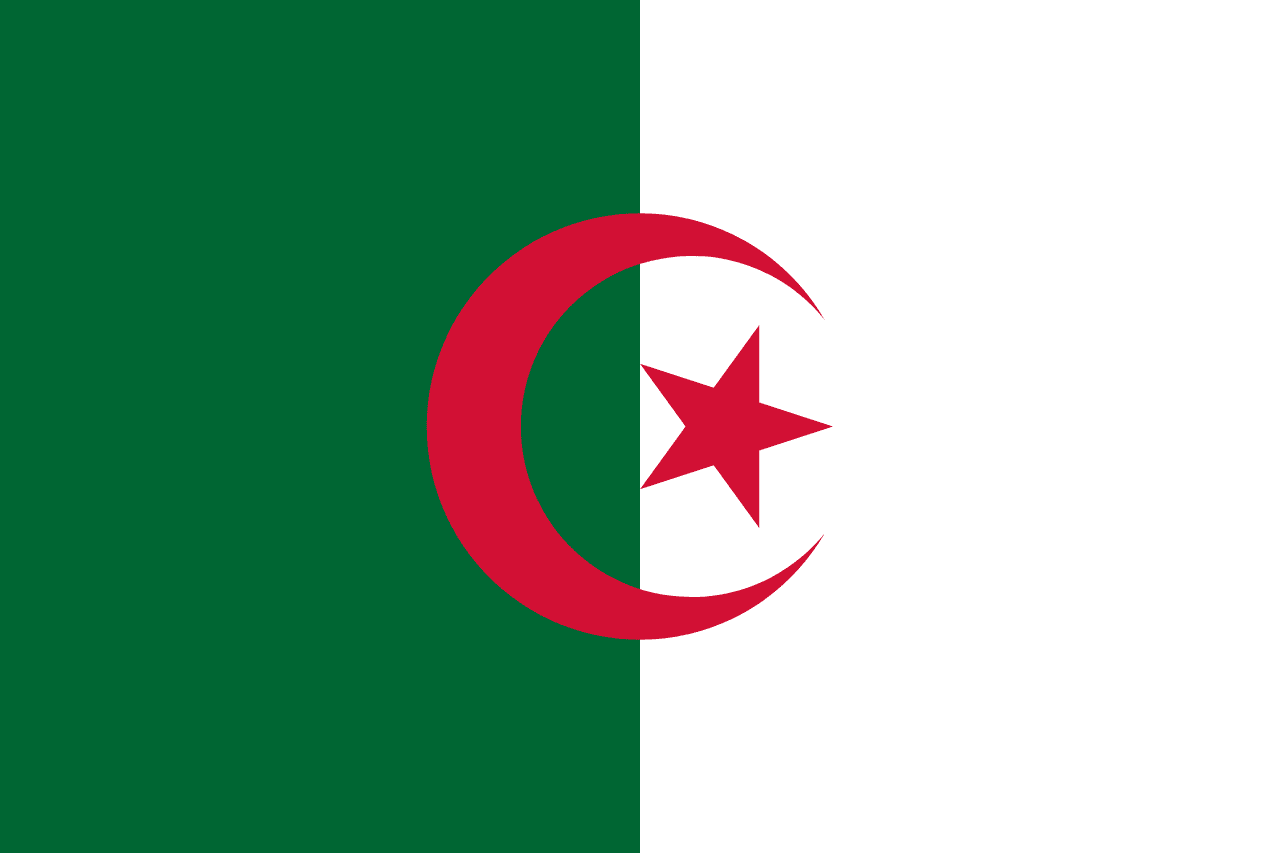
The Algerian flag is a vertical bicolor, divided into two equal halves: green on the hoist side (nearest the flagpole) and white on the fly side. Centered exactly on the dividing line, straddling both colors, sits a red crescent and a five-pointed red star. The crescent opens toward the fly, its horns curving inward, and the star nestles within its embrace. Because the emblem overlaps both fields, neither color fully owns it, a subtle visual that ties the two halves of the flag together.
It is a clean, instantly recognizable composition. There is no coat of arms, no text, no intricate heraldry. Three colors and two shapes do all the work with remarkable economy. The flag is flown at a width-to-length ratio of 2:3, a common proportion that keeps it balanced whether it hangs limp or snaps open in the wind. That meeting point of green and white is the heart of the design: the crescent and star are not decorations on a background but the visual hinge on which the whole banner turns.
What the Colors and Symbols Mean
Each element of the flag carries deliberate significance rooted in faith and national character. The green field stands for Islam, the religion of the overwhelming majority of Algerians and a unifying thread through the country's history. The white represents purity and peace, a counterweight to the green and a hope for the kind of nation that could emerge once the fighting stopped.
The red crescent and star are classic Islamic symbols, shared across much of the Muslim world, and the red here is widely understood to honor the blood of those who died in the long struggle for independence. There is a folk tradition that the crescent's horns are drawn longer than on many other flags, said to symbolize happiness, though this is more cultural lore than official decree.
What makes the symbolism resonate is how tightly it binds religious identity and national sacrifice. The green speaks to who Algerians are, the red to what they paid, and the white to what they hoped to build.
How the Flag Came to Be
The roots of this design reach back further than 1962. Algerian resistance to French colonization stretched across more than a century, and a green-and-white banner with crescent and star is associated with that older spirit of revolt, tracing to the resistance movements of the nineteenth century. It grew out of a long memory of opposition that began almost the moment French forces seized Algiers in 1830.
A version of the flag is often credited to the nationalist movement of the early twentieth century, with one popular account linking its creation to figures associated with Messali Hadj's independence movement. By the time organized armed struggle began, the green-white-and-red was already understood by Algerians as their own.
During the Algerian War of Independence, which began in 1954, the flag became the emblem of the Front de Libération Nationale (FLN), the movement that led the fight against French rule. For years it was the banner of a revolution rather than a state, carried by guerrillas in the mountains and displayed by Algerians abroad who pleaded their nation's case to the world. When the war ended and Algeria gained independence in 1962, this same flag was adopted as the official national flag with very little debate. It had already earned the role.
That continuity matters. Unlike countries that designed fresh flags upon independence, Algeria simply confirmed the banner its people had already bled for. The official flag of the new republic was, in essence, the flag of the resistance made permanent.
How It Compares to Related Flags
The crescent and star place Algeria within a wide family of flags used across the Muslim world, but several details set it apart. Turkey and Tunisia both pair a white crescent and star with a red field, the reverse of Algeria's color logic, where the crescent and star are red and the background green and white. Pakistan uses a white crescent and star on dark green with a vertical white stripe at the hoist, sharing the green-and-white palette but arranging it very differently.
Within its own region, the closest visual cousin may be Mauritania, which sets a yellow crescent and star on a green field, but that version omits the white half and uses a different palette entirely. The single most distinctive feature of Algeria's flag is that vertical green-and-white split with the emblem balanced on the seam, a layout that almost no other national flag duplicates. Once you know it, you cannot mistake it for any other.
The Flag as National Identity
For Algerians, the green-white-and-red is inseparable from the idea of la révolution, the revolution that defines the modern nation's founding story. It appears on government buildings, schools, and official documents, but its emotional charge comes from history rather than bureaucracy. To raise it is to invoke the generation that won independence at enormous cost, and that is why it stirs feeling in a way few civic symbols can.
The flag also anchors Algeria firmly within both the Arab and Islamic worlds and the broader community of African nations, a positioning that has shaped the country's diplomacy and self-image for decades. If you want to understand how that history connects to the country's geography, culture, and modern life, the algeria country guide offers a fuller picture.
The Flag in Modern Life
Today the banner turns up wherever national feeling runs high. It is most visible during sporting events, above all football, where the national team's matches transform streets and stadiums into seas of green and white. Two dates dominate the civic calendar: 1 November, which marks the 1954 outbreak of the war of independence, and 5 July, independence day itself, when the flag is draped from balconies and carried through public squares everywhere at once.
Algerian communities living abroad, particularly across Europe, are known for displaying the flag during major football victories, turning city centers into spontaneous celebrations. The same green and white that once moved quietly through resistance networks now floods boulevards in Paris, Marseille, and Lyon after a big win. In all these settings the flag is not a quiet civic emblem but a loud, joyful declaration of belonging that ties the diaspora back to the homeland.
Interesting Facts About the Algerian Flag
- The crescent and star sit directly on the boundary between the green and white fields, overlapping both colors rather than resting on one.
- The same flag served as the banner of the FLN independence movement before it became the flag of the independent state.
- Green and white as Algerian colors connect to nineteenth-century resistance, giving the design a lineage older than the modern nation.
- There is no writing of any kind on the flag, an uncommon trait among flags that use Islamic symbolism.
- The flag was adopted in 1962, the year Algeria won its independence from France.
- Its vertical green-and-white split with a centered emblem is a layout shared by virtually no other national flag.
Frequently Asked Questions
When was the Algerian flag adopted?
The flag was officially adopted in 1962, the year Algeria achieved independence. However, the design itself is much older, having served as the emblem of the FLN during the independence war and drawing on resistance symbolism that dates to the nineteenth century.
What do the colors of the Algerian flag mean?
Green represents Islam, white represents purity and peace, and the red crescent and star are Islamic symbols associated with liberty and the sacrifice of those who fought for independence. Together they express the faith and revolutionary spirit at the heart of Algeria's national identity.
What continent is Algeria on?
Algeria is in Africa, specifically North Africa along the Mediterranean coast. It is the largest country on the African continent by area and sits at a cultural crossroads between the Arab world, the Mediterranean, and sub-Saharan Africa.
How does the Algerian flag compare to other flags with a crescent and star?
Many Muslim-majority nations use a crescent and star, including Turkey, Tunisia, and Pakistan, but Algeria's flag stands apart through its distinctive green-and-white vertical split with the emblem centered on the dividing line. Where Turkey and Tunisia place a white crescent on a red field, Algeria uses a red crescent and star against green and white, making its banner easy to distinguish at a glance.
Why does the crescent and star sit on the line between the two colors?
Placing the emblem on the seam is a deliberate design choice that visually unites the green and white halves rather than letting them read as two separate blocks. It also gives the flag a single, centered focal point, so the eye is drawn to the crescent and star regardless of which color it lands on first. The effect is a banner that feels whole and balanced, with the symbol of faith and liberty literally bridging the two fields.