
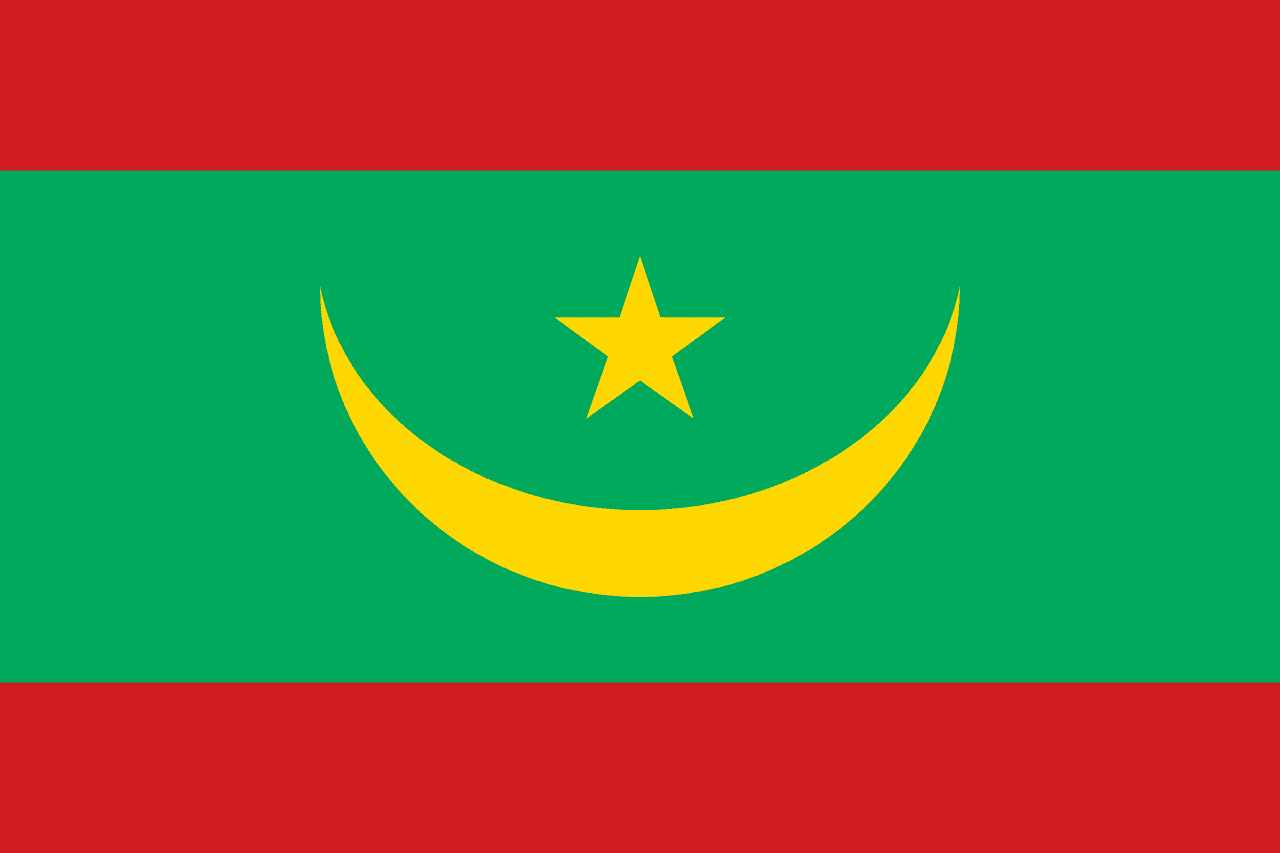

Few national flags carry the desert in their colours quite like Mauritania's. Set against a deep green field, a golden crescent and star float between two horizontal red stripes, a combination that reads instantly as Islamic, African, and proudly Sahelian. The crescent and star tie it to a wider Muslim world, while the warm gold and the unusual upturned arc of the moon give it a character all its own. What makes the flag especially interesting is not just how it looks but how it came to look this way, because the version waving over Nouakchott today is younger than many of the people living beneath it.
A Field of Green and Gold
The base of the flag is a solid green field, a colour with deep resonance across the Islamic world. Centred on that green sits a gold crescent opening upward, cradling a five-pointed gold star. Together, the green and gold are read as emblems of Islam, the faith that shapes the country's culture, law, and daily rhythm; Mauritania's full name is, after all, the Islamic Republic of Mauritania. The gold is also frequently associated with the sands of the Sahara that cover most of the territory, lending the palette a literal as well as a spiritual meaning.
The red, by contrast, speaks to sacrifice. Two red stripes run horizontally across the top and bottom edges of the flag, honouring the blood shed in the struggle for independence and sovereignty. That pairing, the serene green of faith framed by the urgent red of national struggle, gives the design an emotional arc that many Mauritanians find moving.
Reading the Design
The layout is clean and deliberate. A horizontal red band tops the flag, a matching red band closes the bottom, and the broad green field fills the space between them. The crescent and star sit in the centre of that green field, both rendered in the same gold tone so the central emblem reads as a single unified motif.
One detail vexillologists often point out is the orientation of the crescent. Rather than tilting to one side as on some Islamic flags, Mauritania's crescent opens directly upward, like a bowl, with the star nestled within its curve. It is a quietly unusual choice that helps the flag stand apart from the many other green-and-gold Islamic banners. The gold is kept deliberately bright against the darker green so the emblem stays legible at a distance, and because it sits at the exact centre the design is balanced left to right, with only the red stripes breaking the symmetry top to bottom. That restraint is part of the appeal: no clutter, no text, just three colours and two shapes arranged with confidence.
How the Flag Evolved
Mauritania first raised a green flag bearing a gold crescent and star around the time it gained independence from France in 1960, and for decades that simple green-and-gold design served as the national emblem and an expression of the country's Islamic identity. Before independence the territory had no flag of its own in the modern sense; it was administered as part of French West Africa, so the move to a distinct banner was itself a statement of the new republic's separate identity.
The flag the world knows today, however, dates only to 2017. In that year the two red stripes were added through a national referendum, framed as a way to commemorate the sacrifices made for independence and the defence of the country. The crescent, star, and green field were preserved, so the new flag felt like a continuation rather than a rupture, but the red gave the banner a new layer of meaning and a more striking visual rhythm. For a people who had grown up saluting the older design, the update mattered precisely because it built on something already beloved. The referendum bundled several constitutional questions together, and the flag change became one of its most visible outcomes. Readers curious about the wider context of the nation, its geography, peoples, and modern life, can explore our mauritania country guide for the fuller picture.
How It Compares to Related Flags
Place Mauritania's flag beside others and the resemblances are immediate. The crescent and star are among the most widespread symbols in vexillology, appearing on the flags of Turkey, Tunisia, Pakistan, Algeria, and many more, all signalling a shared Islamic heritage. The closest visual cousins are the green banners of the Muslim world, but Mauritania's gold rather than white emblem already begins to set it apart.
The colour trio of green, gold, and red also overlaps with the Pan-African palette seen from Ghana to Ethiopia, which can lead casual observers to file Mauritania alongside its sub-Saharan neighbours. Yet the meaning here is different: the colours are read primarily through an Islamic lens rather than as the Pan-African red-gold-green of liberation movements. The single most distinguishing feature remains the pairing of an upward-opening gold crescent with the two enclosing red stripes. No other national flag combines exactly these elements, which is why Mauritania's banner is almost impossible to confuse with any other.
A Symbol of National Identity
For Mauritanians, the flag is a compact statement of who they are. The green and gold announce a society organised around Islam, while the red insists that nationhood was earned, not simply granted. In a country with Moorish, Haratin, and various sub-Saharan communities within its borders, a shared flag offers a single point of reference that transcends those internal differences. The crescent and star belong to no one group; they belong to the republic as a whole, appearing on official documents, government buildings, and currency that citizens encounter from childhood onward.
The Flag in Modern Life
Today the flag turns up wherever national feeling runs high. It flies over ministries and embassies, is hoisted for the 28 November independence commemorations, and accompanies the national football team, the Mourabitounes, whose green-and-gold kit echoes the banner directly. When the Mourabitounes qualified for the Africa Cup of Nations, the flag travelled with fans across the continent, turning stadium stands into seas of green and gold. Schoolchildren learn its meaning, and the design appears on everything from postage to public murals.
Because the red stripes are so recent, many photographs and textbooks printed before 2017 still show the older stripeless version, which can confuse the unwary. Anyone wanting to display the current official flag should look for the two red bands, the mark of the post-2017 design.
Interesting Facts at a Glance
- Mauritania is one of the very few countries to have modified its national flag by direct public vote, with the 2017 referendum approving the addition of the red stripes.
- The crescent opens upward, an orientation less common than the tilted crescents on many Islamic flags.
- The green and gold are read together as symbols of Islam, while the gold also evokes the Saharan sands.
- The red stripes were absent for most of the flag's history; the green-and-gold core dates to independence in 1960.
- Mauritania straddles the cultural worlds of the Arab Maghreb and Black West Africa.
Frequently Asked Questions
When was Mauritania's current flag adopted?
The flag in its present form was adopted in 2017, when a national referendum approved adding two red horizontal stripes to the existing green field with its gold crescent and star. The green-and-gold core, however, had served as the national flag for decades before that change.
What do the colours of the Mauritanian flag mean?
Green and gold together represent Islam, the faith at the heart of the Islamic Republic of Mauritania, with the gold also commonly linked to the sands of the Sahara. The two red stripes honour the blood shed in the struggle for independence and the defence of the nation.
What continent is Mauritania on?
Mauritania is in northwestern Africa. It lies largely within the Sahara and serves as a cultural bridge between the Arab world of North Africa and the societies of West Africa to its south.
How does Mauritania's flag compare to other Islamic flags?
It shares the green field, crescent, and star common across the Muslim world, which can make it look familiar at first glance. What sets it apart is the upward-opening gold crescent and, above all, the two red stripes added in 2017, a feature unique to Mauritania among the green-and-gold Islamic banners.
Why does the Mauritanian crescent open upward instead of sideways?
The upward-opening crescent is a deliberate design choice that distinguishes Mauritania's flag from the many Islamic banners that tilt their crescents to one side. Cradling the star within an upturned arc gives the emblem a calm, centred symmetry and helps the flag stand apart, reinforcing its national identity rather than simply echoing a shared regional motif.
