
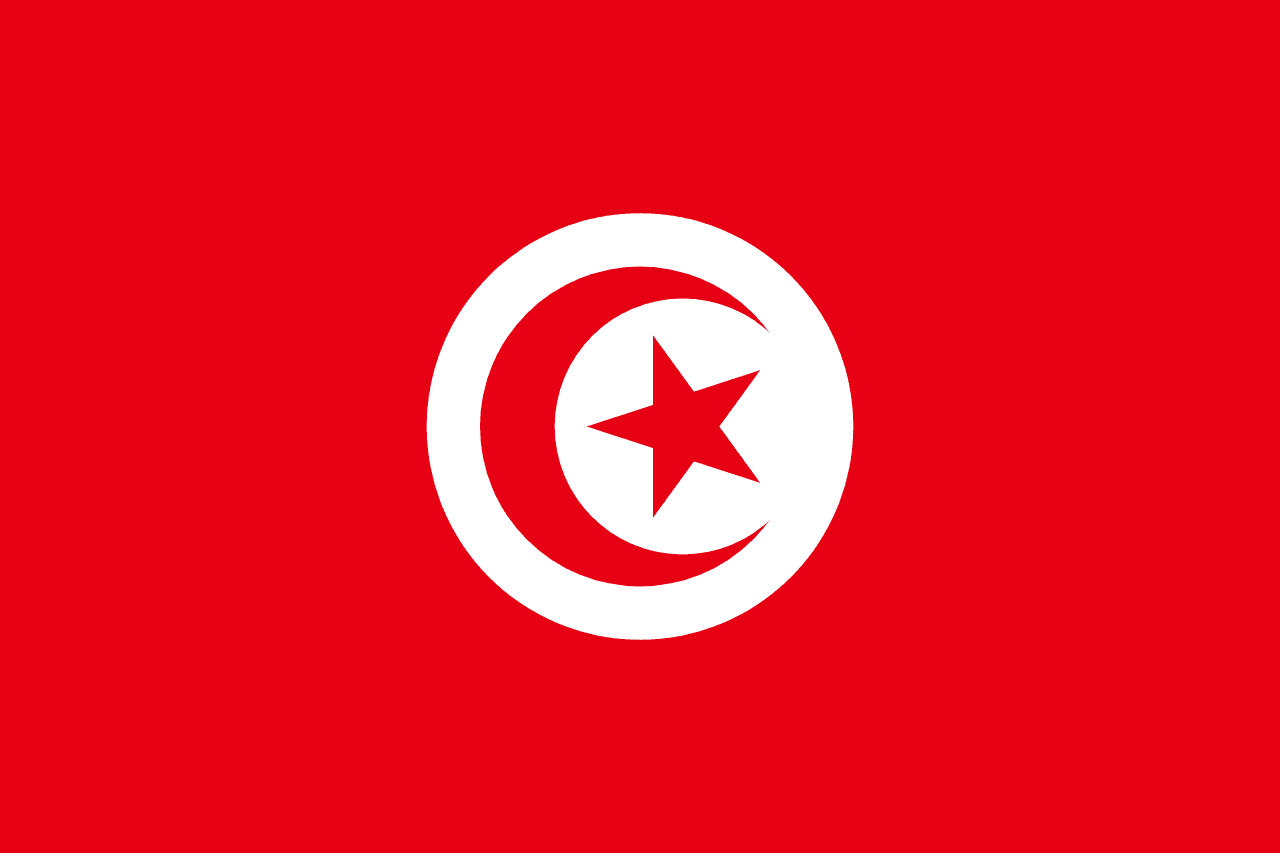
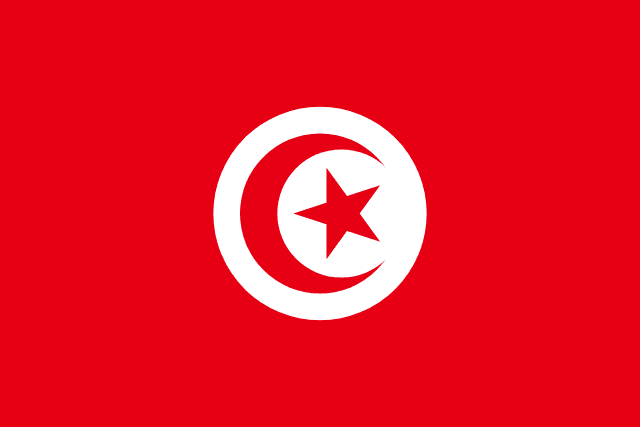
Few flags manage to feel both ancient and instantly modern, but Tunisia's does exactly that. A bold red field, a clean white disc dropped into its center, and inside that disc a slender red crescent cradling a five-pointed star. It reads clearly from a distance, photographs beautifully, and carries centuries of Mediterranean history in just two colors. For a country perched at the northern tip of Africa, looking across the sea toward Europe, the flag is a compact statement of who Tunisians are and where they have been.
Two Colors, One Message
Tunisia's flag uses only red and white, and each carries weight. The deep red of the field is traditionally read as a symbol of sacrifice, honoring those who gave their lives in the long struggle for the nation's freedom and dignity. The white disc provides contrast, but it also frames the elements that give the flag its spiritual identity. The crescent and star are recognized worldwide as Islamic symbols, reflecting the faith that shapes Tunisian culture, its calendar, and the architecture of its cities. Together, the two colors create a flag that is at once secular in political meaning and rooted in religious heritage.
Reading the Design
The layout is easy to describe and hard to forget. The entire field is red. Centered on it sits a white circle, and within it rests a red crescent opening toward the fly, its horns curving around a small five-pointed star. Because the crescent and star repeat the red of the field, the white disc acts like a window, isolating the emblem so the eye goes straight to it.
The crescent does not float freely on the red, as it does on some banners; it is deliberately enclosed inside the white disc, which gives the Tunisian flag its distinctive, medallion-like character. The proportions reinforce that effect. The modern flag uses a length-to-width ratio of 3:2, with the white disc centered and sized so the crescent and star stay legible at small scales. The crescent is a true ring shape rather than a thin sliver, and the five-pointed star nestles within its open arc. Fixed in law, these conventions keep every official flag consistent.
From the Ottoman World to an Independent Nation
Tunisia's flag did not appear out of nowhere. Its design grew out of the Ottoman-era banners that flew across the region, then was modified to suit the local rulers of Tunis. The crescent and star, the red field, and the maritime look all trace back to a period when flags needed to be readable from the decks of Mediterranean ships.
The flag in something close to its current form is usually traced to the reign of Al-Husayn II ibn Mahmud, the Husaynid bey who governed Tunis in the early nineteenth century and sought a distinct banner for his fleet rather than the general Ottoman ensign. From that point the red-and-white disc design became the recognized standard of the beylik.
The emblem stayed remarkably stable even as Tunisia's political status changed dramatically, including a long stretch under French protectorate rule that began in 1881. Unusually for a colonized territory, Tunisia kept its historic banner throughout, since the French governed in the name of the bey. When Tunisia gained independence in 1956 and the republic was declared in 1957, the historic design was carried forward rather than discarded.
The flag's specifications were formally fixed in 1959, set down in the new constitution. Rather than inventing something new, the young nation confirmed the historic banner, anchoring its identity in continuity rather than rupture. A 1999 refinement tidied the geometry of the disc, crescent, and star, but the flag a visitor sees today is unmistakably the same one that flew two centuries ago. If you want the broader story of the country behind the flag, our tunisia country guide traces its geography, cities, and culture in more detail.
How It Compares to Related Flags
The crescent and star place Tunisia inside a large family of flags, but the differences within it are revealing. The most common comparison is with Turkey, which shares the red field and the crescent-and-star inherited from the Ottoman world. Yet Turkey's emblem is white and sits directly on the red field, offset toward the hoist, while Tunisia reverses the contrast by setting a red emblem inside a white disc at the center. Side by side they are clearly cousins, never twins.
Other crescent flags diverge further still. Algeria, Tunisia's western neighbor, splits its field into green and white halves with a red crescent and star straddling the divide. What unites them is heritage and faith; what separates them is geometry. Tunisia's enclosed white medallion is its signature, the detail that lets it stand apart in any crowd of red banners.
A Symbol of National Identity
For Tunisians, the flag is more than decoration. It hung over the events that shaped the modern state and has remained a fixture through every political season since, including the 2011 revolution that opened a new democratic chapter. In a region where borders and regimes have shifted often, the steadiness of the red field and white disc has given the emblem a reassuring permanence.
The Flag in Everyday Life
Walk through Tunis or any coastal town and you will see the flag everywhere: on government buildings, school courtyards, and the prows of fishing boats. The calendar gives it its loudest moments, raised in force on Independence Day each March, on Republic Day in July, and on Martyrs' Day in April, when processions honor those the red field commemorates. In schools, the daily raising of the flag is a familiar morning ritual. When the national team they call the Eagles of Carthage plays at the World Cup or the Africa Cup of Nations, the same flag is painted on cheeks and draped over shoulders far from home.
The emblem also turns up on passports, currency, postage, and souvenirs, and its clean shape makes it a natural fit for logos. Because the design is so simple, it scales effortlessly from a tiny lapel pin to a giant flag over a stadium without losing any of its impact.
Interesting Facts at a Glance
- The flag uses just two colors, red and white, with no additional charges, text, or shading.
- The crescent and star sit inside a white disc rather than directly on the red field.
- Its modern legal specifications were established in 1959 and refined in 1999.
- The design descends from Ottoman-era flags and is linked to the bey Al-Husayn II in the early 1800s.
- It is often compared to the flag of Turkey, which shares the same colors and emblem but arranges them differently.
- The official proportions are 3:2, with the white disc centered on the field.
- Tunisia sits on the continent of Africa, at its northernmost reach along the Mediterranean coast.
Frequently Asked Questions
When was the flag of Tunisia adopted?
The flag's modern legal specifications were set in 1959. The basic design, however, is far older, descending from Ottoman-era banners that flew over the region long before that date, so 1959 marks the formal standardization rather than the birth of the design.
What do the colors and symbols mean?
The red field represents sacrifice and the struggle for freedom. The white disc provides contrast and frames the central emblem. The red crescent and star inside the disc are traditional Islamic symbols, reflecting the faith and culture of the Tunisian people.
What continent is Tunisia on, and who designed the flag?
Tunisia is in Africa, occupying the northernmost point of the continent along the Mediterranean. The flag was not the work of a single named designer; it evolved from Ottoman-era flags and the banners of the rulers of Tunis, shaped gradually over generations.
Why does the Tunisian flag look so much like Turkey's?
Both flags share a red field with a white crescent-and-star heritage drawn from the Ottoman world, which explains the strong family resemblance. The key difference is arrangement: Tunisia encloses its red crescent and star within a white disc at the center, while Turkey places a white crescent and star directly on the red field, set toward the hoist.
How big is the white disc compared with the rest of the flag?
The white disc is centered on the red field and sized generously so the crescent and star stay visible at small scales. Under the official specifications the flag uses a 3:2 ratio, with the disc, crescent, and star laid out to fixed proportions, so every official flag matches whether it is a desktop miniature or a giant banner over a public square.
