
Few flags carry the weight of history quite like Ethiopia's. The bold horizontal bands of green, yellow, and red, crowned by a luminous blue disc and golden star, are instantly recognizable across the African continent and far beyond. This is not merely a national emblem but the visual ancestor of an entire color tradition: Ethiopia's hues helped shape the Pan-African palette that countless nations adopted as they emerged from colonial rule. To understand this flag is to glimpse a story of independence, faith, and resilience.
A Tricolor With Deep Roots
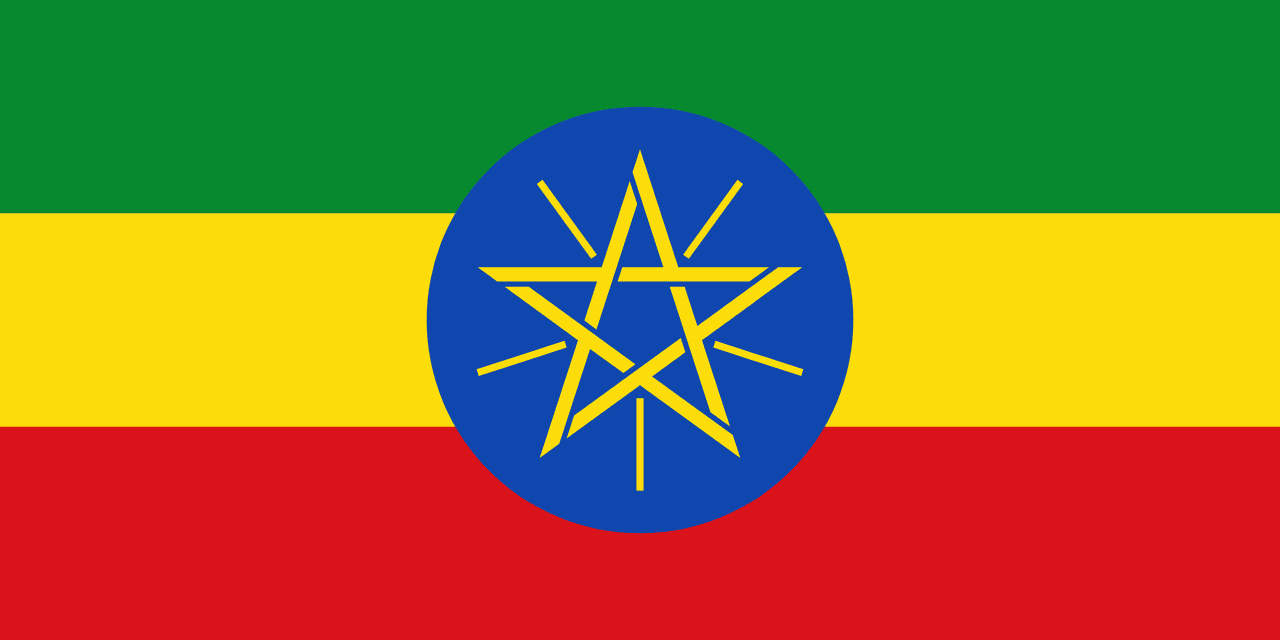
At first glance, the Ethiopian flag presents three equal horizontal stripes. Green sits at the top, yellow runs through the center, and red anchors the bottom. Layered over this triband, in the very middle, is a blue circular disc bearing a five-pointed golden pentagram with rays radiating outward. The current design, with this central emblem, was adopted in 1996, but the green-yellow-red sequence is far older, having served as Ethiopia's colors for well over a century before that.
The emblem distinguishes the modern flag from its simpler tricolor predecessors. The star and its surrounding disc were added to represent the bright future and unity of Ethiopia's many peoples, giving the banner a focal point that ties the three stripes together into a single coherent statement of nationhood.
What the Colors Mean
Each element of the flag carries a deliberate meaning rooted in the land and its people. The symbolism is straightforward yet evocative:
- Green represents the land — Ethiopia's fertile highlands, its agriculture, and the natural wealth that sustains the nation.
- Yellow stands for peace, as well as hope and the harmony sought among diverse communities.
- Red signifies strength, recalling the sacrifice and courage shown in defense of freedom.
- The golden star on its blue disc represents the unity of the country's peoples and the equality of all its nations and nationalities, with the radiating points suggesting a shared, prosperous future.
This pairing of earth, peace, and strength gives the flag a balance that feels both grounded and aspirational — a reminder of where the country comes from and where it intends to go.
How the Flag Evolved
Ethiopia possesses one of the oldest flag traditions in Africa, and its banner has passed through several forms as the nation itself transformed. For generations the green, yellow, and red appeared in different orders and were sometimes flown as three separate pennants before being combined into the rectangular tricolor familiar today. The three colors were arranged into the modern stacked form in the late nineteenth century, around the era when Ethiopia decisively defended its sovereignty against foreign invasion. During the imperial period the flag often bore the Lion of Judah at its center — a crowned lion holding a cross-topped staff — a symbol tied to the monarchy and to Ethiopia's ancient Christian heritage.
Political upheaval in the twentieth century brought repeated changes to the central emblem even as the three colors endured. When the monarchy fell in the mid-1970s, the lion lost its crown and was eventually removed altogether, and the military government that followed placed its own emblems on the field. With the establishment of the modern federal republic, the design was settled in 1996 around the blue disc and golden pentagram, an emblem chosen to express federal unity rather than dynastic or partisan loyalty. Through every transition — empire, revolution, and federation — the underlying tricolor remained the constant thread, a testament to how deeply those three colors are woven into Ethiopian identity.
The Birthplace of Pan-African Colors
Perhaps the flag's most remarkable legacy lies beyond Ethiopia's own borders. As the only African nation to successfully resist long-term European colonization, Ethiopia became a beacon of independence and Black sovereignty in the early and mid twentieth century. Its victory over a colonial army at the Battle of Adwa in 1896 echoed across the continent and the wider African diaspora, turning the green, yellow, and red into a banner of pride. When dozens of African countries won their freedom in the mid-twentieth century, many looked to Ethiopia as a model and adopted its colors as their own. These hues — now known collectively as the Pan-African colors — appear on the flags of nations across the continent and have become a shorthand for African unity and self-determination. You can read more about the country's wider story in our ethiopia country guide.
How It Compares to Similar Flags
Because so many flags share Ethiopia's palette, telling them apart is a useful exercise in distinguishing detail. The flags of Senegal, Mali, Guinea, and Cameroon all draw on the same green-yellow-red family, yet each differs in arrangement or added symbols. Guinea and Mali, for instance, use vertical bands rather than horizontal stripes, while Senegal places a green star on its central yellow stripe.
What sets the Ethiopian flag apart most reliably is its central blue disc and radiant golden star, an emblem found on no other national flag. When a green-yellow-red tricolor carries that blue circle at its heart, it is unmistakably Ethiopia. It is also worth noting that these Pan-African colors are distinct from the Pan-Arab palette of red, white, black, and green, even though green appears in both traditions.
Design Conventions and Proportions
The flag is flown in a horizontal rectangle with the three stripes of equal height, and the blue disc is sized so that it overlaps onto the green and red bands above and below the central yellow. The pentagram is rendered in the same gold tone as the central stripe, and its five rays extend toward the edge of the disc, suggesting light spreading outward. Keeping the emblem and the stripes in fixed proportion ensures the flag stays legible at any size.
The Flag in Everyday Ethiopian Life
The flag is a constant presence in Ethiopian public life. It flies over government buildings and schools, appears at national celebrations such as the Ethiopian New Year and victory commemorations, and is carried proudly by athletes — particularly the country's celebrated long-distance runners, who have draped themselves in green, yellow, and red on Olympic and world-championship podiums for decades. Flag Day and patriotic anniversaries see the colors raised in town squares and along city streets, while the palette also turns up in scarves, clothing, and everyday decoration, especially during festivals. For many Ethiopians the flag is part of the visual rhythm of national life, encountered as readily at a football match or a holiday gathering as at an official ceremony.
Interesting Facts at a Glance
- Ethiopia's flag colors helped inspire the Pan-African color scheme used by many newly independent African nations.
- The current design featuring the blue disc and golden star was adopted in 1996.
- The three colors — green, yellow, and red — predate the central emblem by more than a century.
- Ethiopia is one of Africa's oldest independent states, which gave its flag outsized symbolic influence.
- The five-pointed pentagram represents the unity and equality of the country's many peoples.
- The blue disc with its golden star is unique to Ethiopia, making the flag easy to distinguish from look-alikes.
Frequently Asked Questions
When was the current Ethiopian flag adopted?
The flag in its present form — the green, yellow, and red triband with a blue disc and golden pentagram at the center — was adopted in 1996. The three colors themselves had been used for much longer, but the central emblem was introduced to represent the unity of the modern federal state.
What do the colors of the Ethiopian flag mean?
Green represents the land and its fertility, yellow stands for peace and hope, and red symbolizes strength and sacrifice. The golden star on the blue disc represents the unity of Ethiopia's peoples and the bright future they share.
What continent is Ethiopia on?
Ethiopia is located in East Africa, in the region known as the Horn of Africa. As one of the continent's oldest independent nations, it has played an influential role in African history and symbolism.
Why do so many African flags share Ethiopia's colors?
Because Ethiopia resisted colonization and stood as a symbol of African independence, many countries adopted its green, yellow, and red when they gained their own freedom. These became known as the Pan-African colors, which is why the Ethiopian palette echoes across so many flags on the continent today.
How can you tell the Ethiopian flag apart from similar tricolors?
The surest way is the central emblem. While several flags share the green-yellow-red colors, only Ethiopia's carries a blue circular disc with a radiant golden pentagram in the middle. If you see that blue disc and star on a horizontal green-yellow-red field, you are looking at the flag of Ethiopia.