
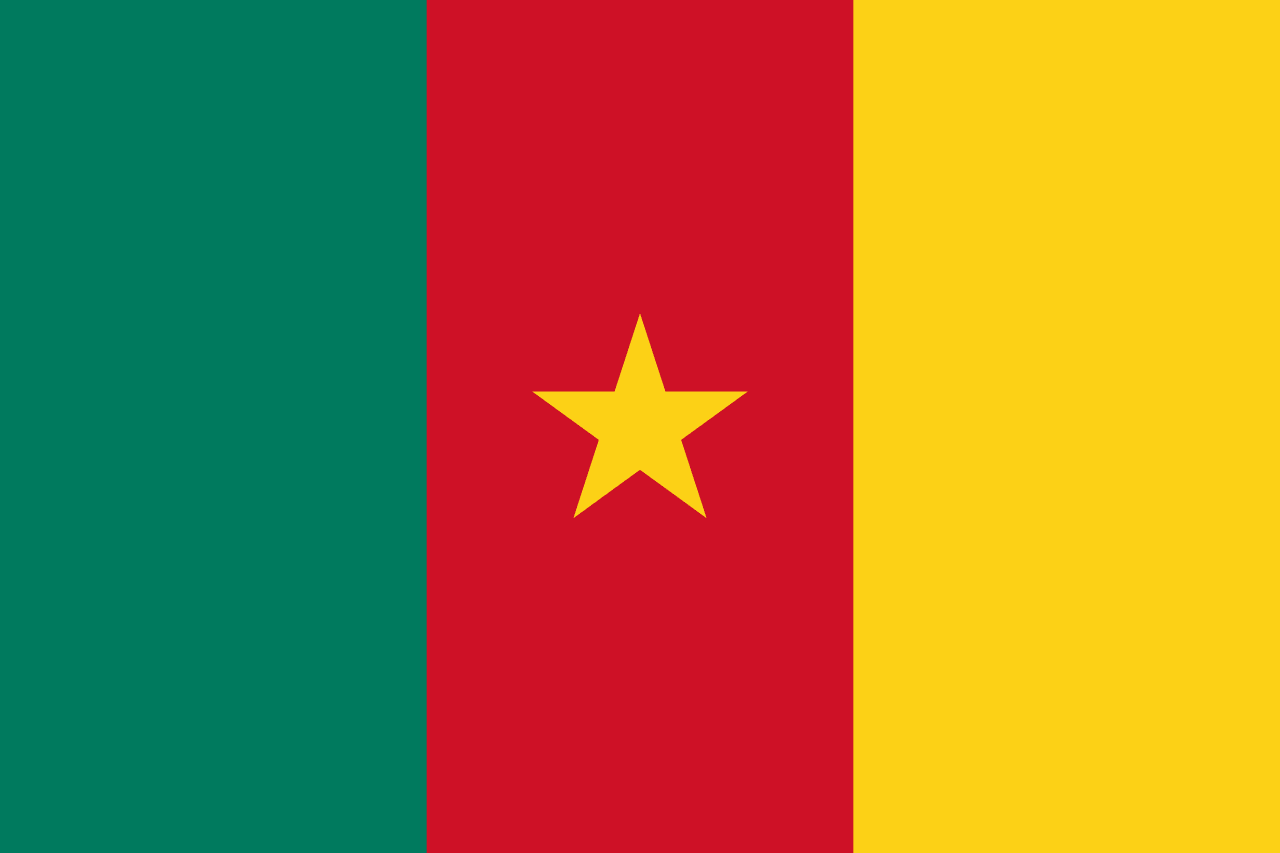
Few flags announce their continental identity as boldly as Cameroon's. Three vertical bands of green, red, and yellow stand shoulder to shoulder, and a single gold star burns in the center of the red. To anyone who has glanced across the flags of Africa, the palette feels instantly familiar, yet the arrangement and that lone star give Cameroon a signature all its own. Behind this clean design lies a story of colonial borders, hard-won independence, and the merging of two territories into one nation.
A Pan-African Tricolor at a Glance
Cameroon flies a vertical triband: green on the hoist side (nearest the pole), red in the middle, yellow on the fly side. Centered on the red band is a single five-pointed yellow star. The flag is drawn in a 2:3 ratio, with each stripe occupying an equal third of the width, so the design reads as balanced and no single color dominates, a fitting choice for a banner meant to express unity rather than hierarchy. The geometry is uncomplicated, which makes the flag legible from a distance and easy to render on everything from passports to jerseys.
The three colors belong to the Pan-African family popularized by Ethiopia, the continent's enduring symbol of independence. Green, red, and yellow recur across dozens of African flags, expressing solidarity and emancipation. Cameroon's particular touch is the centered star, which turns a generic Pan-African scheme into a distinct national emblem.
What the Colors and Star Stand For
Each element of the flag carries meaning rooted in the land and the people. The colors are commonly read this way:
- Green represents the lush forests and fertile agricultural south, a nod to the country's natural abundance and hope for the future.
- Red stands at the heart of the flag as a symbol of unity, often associated with the sacrifices made on the road to nationhood.
- Yellow evokes the sun and the savannas of the north, as well as the country's mineral and natural wealth.
The gold star, set in the central red band, is frequently called the "star of unity." It speaks to the binding together of Cameroon's diverse regions into a single state, and placing it on the unifying red stripe reinforces the message that the nation's strength comes from togetherness. Read in sequence, the colors even trace a kind of geography of the country itself, from the forested, well-watered south to the sun-baked grasslands of the far north.
How the Flag Came to Be
Cameroon's flag did not appear in its current form overnight. Its lineage traces back to the era of French Cameroon, a territory administered under a League of Nations mandate and later a United Nations trusteeship after Germany lost its colonial holdings in the First World War. As self-rule gathered momentum in the late 1950s, the territory adopted a green-red-yellow vertical tricolor, establishing the palette and orientation that survive to this day.
French Cameroon gained independence on 1 January 1960 as the Republic of Cameroon, carrying that plain tricolor forward. The defining chapter came soon after, with reunification. In 1961 the southern portion of the neighboring British Cameroons voted in a plebiscite to join the newly independent republic, and the two territories formed a federation. To mark this enlarged state, two small gold stars were added to the green stripe, one for each federated state.
The federation gave way to a single unitary state in 1972, and the flag was revised once more. The version flown today, with a single centered star replacing the earlier pair, was adopted in 1975. That move from two stars to one captured the political shift: where the federal flag had acknowledged two distinct states side by side, the new design declared them fused into one nation, the star migrating from the green hoist stripe to the very center of the red band.
That detail is worth pausing on. The star is more than decoration; it is the visual record of two territories becoming one. For a nation built on the merging of different colonial legacies and a remarkable diversity of more than two hundred languages and peoples, a single star at the center is a quietly powerful statement.
A Symbol Woven Into National Life
For Cameroonians, the flag is a daily companion to civic and emotional life. It rises over government buildings, schools, and public squares, and it appears at the ceremonies that punctuate the national calendar. Two dates in particular bring the tricolor out in force: National Day on 20 May, which commemorates the 1972 vote that created the unitary state, and Independence Day on 1 January. On National Day, military and civilian parades march beneath rows of flags, and schoolchildren in matching outfits file past officials in towns across the country.
Sport is perhaps where the flag travels furthest. Cameroon's national football team, the Indomitable Lions, has long been one of Africa's most celebrated sides, with a string of Africa Cup of Nations titles and a famous run to the quarter-finals at the 1990 World Cup. When the team plays, the flag becomes shorthand for national pride, and the green-red-yellow palette spills across stadiums far beyond the country's borders, painted on faces and draped over shoulders. If you want to understand the place this banner waves over, the landscapes that the green and yellow honor, and the regions the star unites, the cameroon country guide offers a fuller portrait.
Telling It Apart From Its Neighbors
Because so many African flags share the Pan-African colors, casual observers sometimes confuse them. The trick with Cameroon is the orientation and the star. Guinea and Mali use the same green, red, and yellow in vertical bands but carry no central emblem, while Senegal mirrors that layout with a green star in the middle stripe. Ghana, Ethiopia, and others arrange the colors horizontally, ruling them out. Cameroon's combination of vertical thirds with a single gold star centered on the red band is unique among national flags. Where some banners crowd in coats of arms or multiple symbols, Cameroon keeps things spare and symmetrical, letting that one star do the talking.
Interesting Facts About Cameroon's Flag
- The flag uses the classic Pan-African colors, linking Cameroon visually to a continent-wide tradition of independence and solidarity.
- The design is a vertical triband with a single star, distinguishing it from horizontally striped flags with similar palettes.
- An earlier federal flag carried two stars in the green stripe, one for each federated state, before the 1975 redesign reduced them to one.
- The current flag was adopted in 1975, marking the move from a federal republic to a single unitary state.
- The centered star symbolizes unity and was placed on the red band as the flag's focal point.
- Cameroon's flag is among the most internationally visible in Africa, thanks to the global success of the Indomitable Lions.
Frequently Asked Questions
When was the flag of Cameroon adopted?
The flag in its current form, featuring the single centered yellow star, was adopted in 1975. Its green-red-yellow tricolor base, however, traces back to the design of French Cameroon, so the flag represents an evolution rather than a single fresh start.
What do the colors of the Cameroon flag mean?
The three colors are Pan-African colors expressing solidarity and independence. Green is commonly linked to the country's forests and hope, red to unity, and yellow to the sun, the northern savannas, and natural wealth. The gold star on the red band stands for national unity.
Why is there a star on the Cameroon flag?
The single yellow star is often called the star of unity. It was added in connection with the reunification of the formerly French and British Cameroons, symbolizing the joining of these territories and their diverse peoples into one nation. Its placement on the central red band underscores that theme of togetherness.
Why did the flag once have two stars instead of one?
Between 1961 and 1975, Cameroon was a federal republic made up of two states, and its flag carried two gold stars in the green stripe to represent them. When the country became a single unitary state in 1972, the design was revised, and by 1975 the two stars were replaced by one star moved to the center of the red band, signaling that the two parts had fully merged.
What continent is Cameroon on, and which flags look similar?
Cameroon is in Africa. Because it uses the widely shared Pan-African green, red, and yellow, its flag can resemble those of other African nations at a glance, especially Guinea, Mali, and Senegal. The surest way to identify it is the vertical stripe arrangement combined with the single gold star centered on the red band.
