
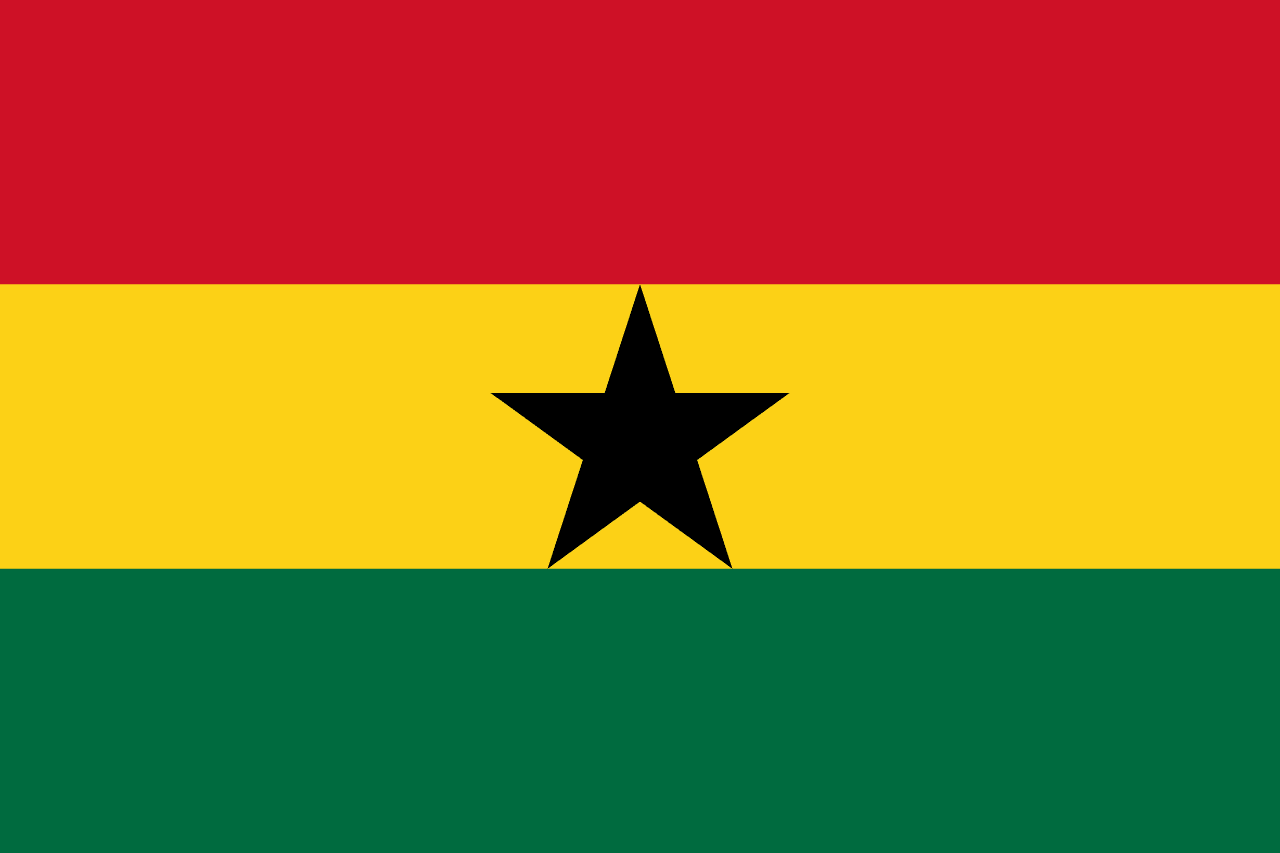
When the Gold Coast lowered the British colonial flag at midnight on 6 March 1957 and raised a new banner of red, gold, and green crowned by a single black star, it was not merely a domestic ceremony. It was a signal flare seen across an entire continent. Ghana had become the first country in sub-Saharan Africa to win independence from European rule, and the flag it chose carried a message that reached far beyond its own borders. To this day, that black star burning against a gold field remains one of the most recognizable emblems of African liberation.
The Ghanaian flag is deceptively simple: three horizontal bands of equal width, topped with a star at its heart. Yet every element was chosen with deliberate intent, and the design became a template that other newly free nations would echo in the decades that followed.
A Tricolor and a Star
The flag is a horizontal triband. From top to bottom run three stripes of equal height: red, gold, and green. Centered in the middle gold band sits a five-pointed black star. The layout is balanced and instantly legible, which is part of why it has aged so gracefully. There is no clutter, just four colors arranged with confidence.
The flag flies at a standard ratio of 2:3, a proportion shared with many former British territories. Each of the three stripes occupies exactly one third of the height, and the black star is sized so that its points reach toward, but do not touch, the edges of the gold band. That spacing keeps the star floating cleanly at the center.
That black star is the single feature that sets Ghana apart from the many other tricolors that share its palette. Without it, the red-gold-green sequence could be mistaken for several flags across the continent. With it, the banner becomes unmistakably Ghanaian.
What the Colors Mean
Each color speaks to a distinct part of the national story. The red band honors the blood of those who died in the struggle for independence, a sober acknowledgment that freedom was not freely given. The gold recalls the country's tremendous mineral wealth, a reminder of the gold deposits that earned the territory its colonial name, the Gold Coast. The green represents the rich forests and fertile land that sustains the nation.
The black star is the most resonant symbol of all. Known as the Star of African Freedom, it stands for the hopes of African emancipation and unity. It transformed a national flag into a continental statement, declaring that Ghana's independence was the beginning of something larger. The choice of black was itself meaningful: it spoke directly to the identity and dignity of African peoples, and it gave the design a focal point that no purely tricolor banner could match.
Pan-African Colors and Their Legacy
Red, gold, and green are often called the Pan-African colors, drawn from the flag of Ethiopia, the African nation that famously resisted colonization and so became a beacon of pride. By adopting this palette in 1957, Ghana made a clear ideological choice: it placed itself in solidarity with the movement for African dignity and self-rule.
Because Ghana was the first sub-Saharan country to gain independence, its flag became deeply influential. The Ghanaian banner did not just represent a country; it helped define a visual language of liberation that successor nations would adapt for their own flags.
How It Compares to Similar Flags
Set Ghana's flag beside others that use the same colors and the differences come into focus. Bolivia uses a red-yellow-green horizontal triband with nearly the same stripe order, but it carries a detailed coat of arms rather than a star, and its symbolism is rooted in South American history. Several African flags also lean on the red-gold-green family, yet they break from Ghana's layout through vertical stripes, added emblems, or different proportions.
The closest relatives are flags that consciously borrowed from Ghana itself. Guinea-Bissau pairs a red vertical band bearing a black star with horizontal yellow and green stripes, a clear nod to the same symbolism. What keeps Ghana's banner distinct is the specific recipe: equal horizontal thirds in red, gold, and green, with one solid black five-pointed star at the center. No other national flag matches that exact arrangement.
How the Flag Came to Be
The flag was adopted in 1957 to mark the birth of the independent state. Its creation is widely credited to Theodosia Okoh, a Ghanaian artist and teacher who designed a banner to represent the new nation rather than a foreign imperial power. Her choice of the three Pan-African stripes and the bold central star gave the country an identity rooted in both its natural riches and its aspirations.
The flag replaced the colonial ensign of the Gold Coast, which followed the standard British pattern of a Union Jack in the canton paired with a colonial badge. Trading that borrowed imperial design for an original African creation was a deliberate act of self-definition.
For a brief stretch in the early 1960s, the central gold band was changed to white as part of a short-lived political shift, but the original red-gold-green tricolor with the black star was restored and has remained the official design ever since. That return to the founding colors underscored how attached Ghanaians had become to the original vision, and it cemented the 1957 design as the enduring emblem of the republic.
The Flag in National Life
Few national symbols are woven as tightly into everyday identity as Ghana's black star. The country's celebrated football team is known the world over as the Black Stars, a direct tribute to the flag, and the gleaming Black Star Gate in Accra anchors the nation's biggest civic ceremonies. The star appears on currency, government insignia, and merchandise, a constant visual shorthand for the country itself.
On Independence Day each 6 March, the flag is flown across the country in a celebration of the 1957 milestone, often alongside parades and televised addresses. It is raised at schools, government buildings, and sporting fixtures, and it travels abroad with the Ghanaian diaspora as a portable piece of home. During major tournaments, supporters drape the banner over their shoulders and paint the four colors across their faces, turning stadiums into seas of red, gold, and green. For travelers curious about the land behind the banner, our ghana country guide explores the geography, culture, and history that give the flag its meaning.
Interesting Facts
- Ghana was the first country in sub-Saharan Africa to adopt the Pan-African colors of red, gold, and green.
- The black star is nicknamed the Star of African Freedom and inspired the name of the national football team, the Black Stars.
- The Pan-African palette traces back to the flag of Ethiopia, a symbol of resistance to colonization.
- The flag's three stripes are of equal width, with the star centered in the middle gold band.
- The gold band briefly became white in the early 1960s before the original design was restored.
- The design replaced the colonial Gold Coast ensign, which carried a British Union Jack in its canton.
Frequently Asked Questions
When was the flag of Ghana adopted?
The flag was adopted in 1957, the year Ghana gained independence and became the first sub-Saharan African nation to break from colonial rule. Aside from a brief change to the central band in the early 1960s, the design has remained consistent ever since.
What do the colors of the Ghanaian flag mean?
Red represents the blood of those who died in the fight for independence, gold symbolizes the country's mineral wealth, and green stands for its forests and fertile land. The black star in the center is the Star of African Freedom, representing African emancipation and unity.
Who designed the flag of Ghana?
The flag is widely attributed to Theodosia Okoh, a Ghanaian artist and educator. She designed a banner intended to capture the new nation's natural wealth, its sacrifices, and its aspirations for a free Africa.
Why is the star on Ghana's flag black?
The black color of the star was chosen to symbolize the identity, dignity, and freedom of African peoples. It became known as the Star of African Freedom and stands as the flag's defining feature, distinguishing Ghana's banner from other flags that use the same red, gold, and green colors.
What continent is Ghana on, and how does its flag compare to similar ones?
Ghana is in West Africa, on the African continent. Its flag shares the red, gold, and green Pan-African palette with several other African nations, which can make them look alike at a glance. The distinguishing feature is the single black star centered in the gold band, an element unique to Ghana's banner.