

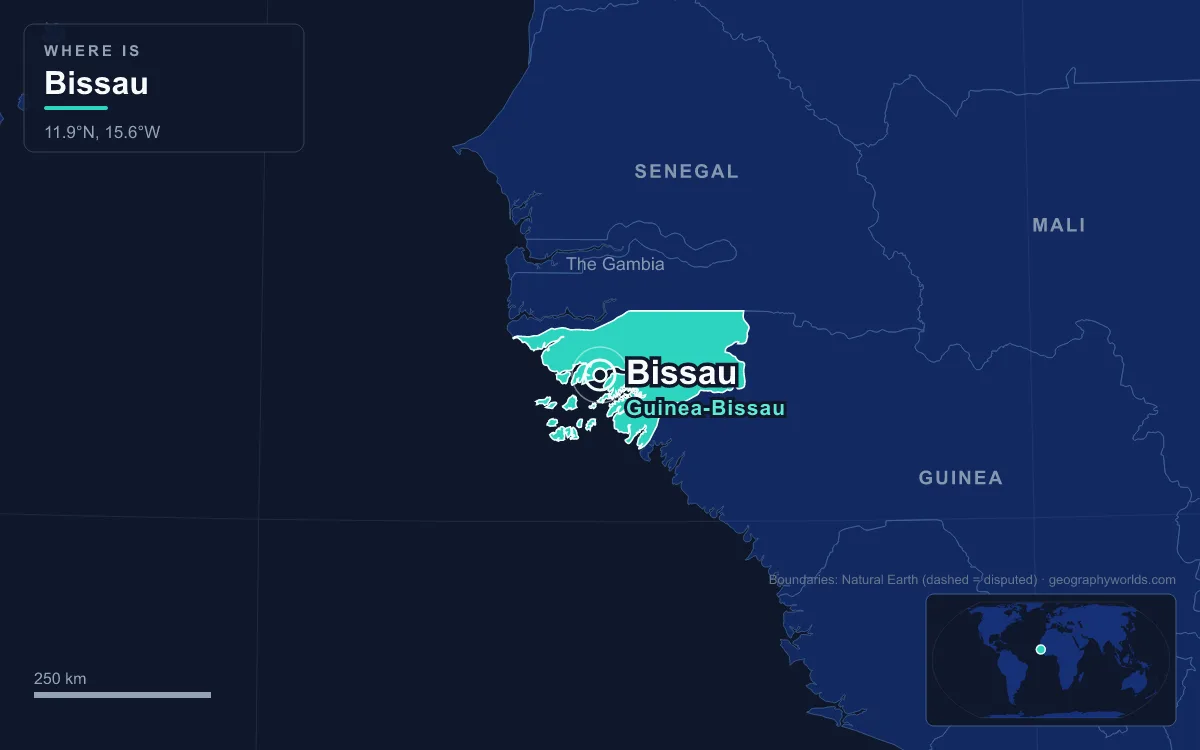
Bissau is the capital and largest city of Guinea-Bissau. It lies on the estuary of the Geba River, just in from the Atlantic, and it is the country's main port and its administrative and military centre. The 2015 census counted 492,004 people there. Bissau was not always the obvious choice for a capital. It was founded in 1687 as a Portuguese trading post in the lands of a Papel kingdom, and it had to overtake Cacheu as the main trading town. Portugal did not move its colonial government there from the island town of Bolama until 1941. In 1973 independence was declared not in Bissau but in the remote village of Madina do Boé, and Bissau became the capital of the new state only in 1974, after the Portuguese withdrew.
Cacheu, Amura and the Papel Kings of Bissau, 1687–1915
The first rival was Cacheu, on the river of the same name to the north. It was one of the earliest European settlements in sub-Saharan Africa. Portuguese and Cape Verdean traders, known as lançados, began settling there in the late sixteenth century. In 1589 they won the local king's permission to build a fort, moved into its stockade in 1591, and received a municipal charter in 1605, when the town had about 1,500 inhabitants. Cacheu became an important slave-trading point for the Portuguese in Upper Guinea and a boat-building centre. In 1676 Lisbon even launched a Company of Cacheu to try to control that trade.
Bissau started as someone else's capital. The island of Bissau was ruled by a Papel kingdom. According to oral tradition it was founded by Mecau, son of the king of Quinara, and it was organised into seven clans. The Bossassun clan held the throne, and the city's name may come from it. The kingdom was stratified and ceremonial: at a coronation the new king was bound and beaten, so that he would know what punishment felt like before he handed it out. When the Portuguese arrived in the sixteenth century, the kings of Bissau were among their most supportive local partners.
That partnership gave Bissau its start. In 1687 the French were trying to build a fort on the island. King Bacompolco refused them a fort but let them open a trading factory, from which thousands of captives were shipped. Portugal answered by creating a captaincy-general of Bissau. By 1696 the settlement had a fort, a church and a hospital, and as the main trading centre on and south of the Geba it was rivalling, and perhaps overtaking, Cacheu. It did not stay secure. When Bacompolco died in 1696, his successor Incinhate resisted Portuguese attempts to impose a trade monopoly. He surrounded the unfinished fort, and the Portuguese captain-general Pinheiro later died in Papel custody. The Portuguese abandoned the post. They came back in 1753, met determined resistance and left again two years later.
What lasted was built for the Atlantic slave trade. In 1775 the Grão Pará and Maranhão Company rebuilt the fort, to project Portuguese power and to hold more captives for shipment to Brazil. Between 1757 and 1777 more than 25,000 people were shipped from the "Rivers of Guinea", a region covering roughly Portuguese Guinea and parts of Senegal. This fort, the Fortaleza de São José da Amura, still stands. Even so, real power on the island stayed with the Papel kings for more than a century. Bissau was made a commune in 1869, but the kingdom was defeated only in 1915, after some 30 years of fighting, by Portuguese forces under Officer Teixeira Pinto and the warlord Abdul Injai.
Bolama's Water Problem and the Move of 6 December 1941
The second rival was an island to the south. Bolama was apparently uninhabited when a British philanthropic venture, the Bulama Association, landed 275 colonists there in 1792. Most of them died, and the survivors abandoned the colony in November 1793. Britain and Portugal went on disputing the island for decades. The "Bolama Question" was raised at a conference in Madrid in 1861 and settled only in 1870, when President Ulysses S. Grant of the United States, acting as arbitrator, awarded Bolama to Portugal. In 1879 Bolama became the first capital of Portuguese Guinea.

Bolama had a fatal weakness: it did not have enough fresh water, and without it the town could never become a large city. Bissau had the geography Bolama lacked. It sits on a mainland estuary, and even though the Geba carries only a modest flow, ocean-going ships can navigate the river for about 80 kilometres beyond the city. Portugal had also kept a fort there since the eighteenth century. On 6 December 1941 the colonial capital moved there. Bolama declined steadily afterwards. Its 2009 population was only 4,819, and the ruins of the Governor's Palace are now a minor tourist attraction. Many of the abandoned houses have become roosts for large colonies of fruit bats.
Pidjiguiti Quay, Madina do Boé and the Algiers Accord
Becoming the colonial capital made Bissau the target of the independence movement. The turning point came at the city's own waterfront. On 3 August 1959 dock workers at the Pidjiguiti quay, most of them employed by Casa Gouveia, a subsidiary of the Portuguese conglomerate Companhia União Fabril, went on strike for higher pay. Their manager called in PIDE, the Portuguese political police, who fired into the crowd and killed at least 25 people. The African Party for the Independence of Guinea and Cape Verde (PAIGC), led by Amílcar Cabral, drew the conclusion that peaceful protest would not work. It began an armed struggle in 1963.
The war was mostly fought in the countryside, and the guerrillas never took the capital. The PAIGC attacked Bissau in 1968 and 1971. By 1973 the war had reached a stalemate: Portuguese forces were largely confined to the major towns and fortified bases, and could not dislodge the PAIGC from its "liberated zones" in the countryside. Cabral was shot dead on 20 January 1973 at a roadblock on the way to his house in Conakry, the capital of neighbouring Guinea. In July that year the PAIGC held its second congress at Madina do Boé, in the far south-east near the Guinean border, and on 24 September 1973 it declared independence there. For about a year Boé served as the de facto capital of the self-declared state, while Portugal still held Bissau.
The capital changed hands through events in Europe rather than in West Africa. After the Carnation Revolution in Lisbon on 25 April 1974, the new Portuguese government and the PAIGC signed an accord in Algiers. Portugal agreed to withdraw all its troops by the end of October and to recognise the PAIGC-run Republic of Guinea-Bissau, and independence was formally recognised on 10 September 1974. Bissau, the colonial capital, became the national capital, and Boé went back to obscurity. The country also took the city's name. "Bissau" was added to "Guinea" to avoid confusion with the neighbouring republic of Guinea, the former French colony.
Bissau Since 1974: Civil War, Coups and a Port on the Geba
Being the capital has brought Bissau growth, but also the country's conflicts. The city had 109,214 people in 1979, and by the 2009 census it held more than a quarter of the national population. The civil war of 7 June 1998 to 10 May 1999 began with an attempted coup by Brigadier-General Ansumane Mané against President João Bernardo Vieira. Heavy fighting in Bissau destroyed much of the city's infrastructure and drove most of its people out. The Presidential Palace and the French Cultural Centre were among the buildings ruined. The cultural centre has since been rebuilt. The city recovered after peace returned, with many new and restored buildings. Several military coups have since interrupted transfers of power. The most recent came on 26 November 2025, when President Umaro Sissoco Embaló was arrested the day before election results were due and a military command under General Horta Inta-A Na Man took over. Guinea-Bissau's membership of ECOWAS and the African Union was suspended as a result.

Being the capital also means Bissau holds the state's main institutions. It has the country's only international airport, Osvaldo Vieira International. Its universities include Amílcar Cabral University, the Catholic University of Guinea-Bissau and Jean Piaget University. Its chief products are peanuts, hardwoods, copra, palm oil, milk products and rubber. Bissau is also the centre of the fishing and farming economy. The city's fragility shows too. On 17 October 2023 the Turkish electricity company Karpowership cut off power to the city over an unpaid bill of more than $15 million. The lights came back late the next day, after the government paid $6 million. The city's memorials record how it became the capital. The Amura fort, now a military barracks, holds Amílcar Cabral's mausoleum, and the Pidjiguiti Memorial marks the 1959 massacre at the docks.
The Geba estuary also sets the rhythm of the year. Bissau has a tropical savanna climate that is almost wet enough to count as monsoonal. Almost no rain falls from November to May. The WMO's 1991–2020 normals for the airport record about 1,530 millimetres a year, nearly all of it between June and October, with August alone bringing close to 470 millimetres.
Bissau won its role because of its river port and in spite of its rivals, and each of those rivals still exists as a much smaller place. For the country as a whole, see our Guinea-Bissau country guide, and for how the Geba's mix of river and sea works, read what an estuary is. The PAIGC's struggle linked Bissau to two other capitals: Conakry, where Cabral ran the movement and was killed, and Praia, capital of the Cape Verde islands that the same party led to independence.
Quick Facts About Bissau
- Country: Guinea-bissau
- Continent: Africa (West Africa)
- Country population: approximately 2.3 million
- Capital city status: Bissau is the capital of Guinea-bissau, the seat of national government, and the location of foreign embassies, parliament, and the head of state's official residence.
Frequently Asked Questions
What is the capital of Guinea-bissau?
The capital of Guinea-bissau is Bissau. Bissau is the seat of national government, hosts most foreign embassies and consulates, and is typically where the head of state and parliament are located.
What continent is Bissau in?
Bissau, the capital of Guinea-bissau, is located in Africa, in the West Africa region. As Guinea-bissau's capital, Bissau serves as the country's primary connection to the broader African political, economic, and cultural sphere.
Why is Bissau the capital of Guinea-bissau?
Bissau was chosen as the capital of Guinea-bissau for reasons that typically combine geography, history, and politics. Capital city selections often reflect a desire for centrality (being accessible from across the country), historical importance (being a longstanding seat of government or culture), or neutrality (being acceptable to multiple regions or ethnic groups within the country). The specific reasons for Bissau's designation are detailed in the city's history above.
What is Bissau known for?
As the capital of Guinea-bissau, Bissau is best known for housing the country's central government institutions — parliament, presidential or royal residences, supreme court, and key ministries. It is also typically a major cultural and economic center within Guinea-bissau, hosting national museums, embassies, and signature monuments. The introduction and history sections above provide detailed coverage of the city's specific notable institutions and landmarks.
Related Pages
- Guinea-Bissau Country Guide — full geography, climate, economy, and culture overview
- Flag of Guinea-Bissau — meaning, history, and design of Guinea-Bissau's national flag