

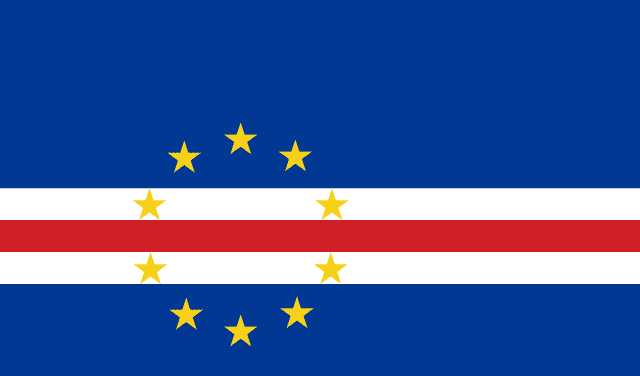
Scattered across the Atlantic some 600 kilometres off the coast of West Africa, the archipelago of Cape Verde flies one of the more distinctive flags in the region. Rather than echoing the bold green-and-red palette common to many neighbouring nations, Cape Verde chose a calm field of blue broken by a ring of ten golden stars. The design feels almost nautical, a fitting choice for a country whose identity has always been shaped by the sea and by emigration.
Adopted in 1992, the flag is a relatively young emblem, born from a deliberate decision to redefine how the nation pictured itself. To understand why it looks the way it does, it helps to look at the colours, the geometry, and the political moment that produced them.
The Colours and What They Carry
The flag draws on four colours: blue, white, red, and yellow, each chosen with intent rather than decoration.
Blue dominates the design, standing for the two elements that surround and define the islands: the ocean and the sky. For an Atlantic nation whose history, livelihood, and diaspora are inseparable from the sea, this expanse of blue is more than a backdrop. It is the medium through which Cape Verde connects to the rest of the world.
The white and red appear as horizontal stripes set low on the flag. Together they symbolise the road to progress and the effort of nation-building, the white suggesting peace and the red the determination and labour required to keep the country moving forward. The yellow belongs to the ten stars, gold against the deep blue, representing the islands and the light of guidance.
Reading the Design
The layout is unusual enough to be instantly recognisable. The blue field is interrupted in its lower portion by a band of three stripes, white, red, and white, the red sandwiched between the two lighter ones. Above and overlapping this band sits the flag's centrepiece: a circle of ten yellow five-pointed stars, slightly off-centre toward the hoist rather than dead in the middle.
That ring of stars is the heart of the composition. Each star marks one of the ten main islands, and arranging them in a closed circle carries its own message. A circle has no beginning and no end, no island placed above another. It suggests unity and equality among the islands, a single nation assembled from separate pieces of land. The off-centre placement, drawing the eye toward the hoist, gives the flag a dynamic balance rather than rigid symmetry.
The proportions follow a ratio of two to three, among the most common flag shapes worldwide, and the five-pointed stars keep the emblem legible even at small sizes.
How the Flag Came to Be
Cape Verde gained independence from Portugal in 1975, and its first flag reflected the politics of that era. That original banner used the colours of Pan-Africanism, the green, red, and yellow associated with liberation movements across the continent, and it visually tied Cape Verde to neighbouring Guinea-Bissau, with which it shared an independence party and, for a time, the aspiration of union. The two territories had been governed together under the African Party for the Independence of Guinea and Cape Verde, and the matching flags broadcast that bond to the world.
That shared future did not hold. After political shifts in the 1980s, the two countries drifted apart, and Cape Verde's first free legislative elections in 1991 brought a new government to power. The change of regime opened the door to a reimagining of national symbols, and with it the desire for a flag that spoke to Cape Verde alone rather than to a wider movement or a partnership that no longer existed. In 1992 the Pan-African design was retired and the present flag adopted in its place, steering away from the older liberation palette toward something that emphasised the islands' Atlantic character. The coat of arms and anthem were overhauled in the same period. You can read more about the islands and their story in our cape verde country guide.
How It Compares to Other Flags
Cape Verde's flag is striking partly because of the company it keeps. Most of its West African neighbours, from Senegal to Mali to Guinea, fly variations on the Pan-African green, red, and yellow. By turning toward blue, Cape Verde set itself visually apart from the mainland and aligned its imagery with the ocean that defines it. The result, at a glance, looks more like a maritime ensign than a typical African national banner.
The ring of stars also invites comparison with other circular arrangements. The European Union's circle of twelve gold stars on blue is the most familiar, though Cape Verde uses ten stars for its ten islands and breaks up its field with the striped band. What distinguishes the flag, ultimately, is that its circle is a literal census of the nation's land, not an abstract gesture.
A Symbol of Identity
For a nation as geographically fragmented as Cape Verde, a flag has real work to do. The ten islands are spread across a wide stretch of ocean, divided historically by distance. A flag that gathers all ten into a single ring of equal stars is, in effect, an argument for nationhood, a visual insistence that these scattered specks of land form one people.
That message resonates well beyond the archipelago. Cape Verde has one of the largest diasporas relative to its population of any country, with communities across Europe, the Americas, and Africa. For those abroad, the flag is a portable home, a reminder of the islands carried into kitchens, festivals, and football matches far from the Atlantic.
The Flag in Everyday Life
Today the flag appears in the expected official settings, flying over government buildings, embassies, and during celebrations such as Independence Day on the fifth of July. It also turns up wherever Cape Verdeans gather to mark their culture, from morna and funaná performances to community festivals in the diaspora. Schoolchildren learn the meaning of its ten stars, and the design is reproduced on official documents and the uniforms of national institutions.
Sport gives the flag some of its most visible moments. When Cape Verde's national football team, nicknamed the Blue Sharks, takes the field, the blue field and golden stars appear in the stands, on shirts, and painted on faces. The team's appearances at the Africa Cup of Nations have turned the flag into a familiar sight on the continental stage, a moment of visibility that means a great deal to a country of half a million people.
Interesting Facts at a Glance
- The ten stars correspond to the ten main islands of the archipelago, arranged in a circle to signify unity and equality.
- The current flag replaced an earlier Pan-African design linking Cape Verde to Guinea-Bissau.
- Blue covers most of the flag, a maritime choice reflecting the country's Atlantic setting.
- The ring of stars sits off-centre, shifted toward the hoist rather than the middle of the flag.
- The stripes run only across the lower portion, leaving the upper blue field uninterrupted.
Frequently Asked Questions
When was the flag of Cape Verde adopted?
The current flag was adopted in 1992, replacing the Pan-African flag the country had used since independence in 1975. The change coincided with Cape Verde's transition to multiparty democracy and its desire for a more distinct national symbol.
What do the colours and stars mean?
Blue represents the ocean and the sky that surround the islands. The white and red stripes stand for the road to progress and the work of building the nation. The ten yellow stars represent the ten main islands, set in a circle to express unity among them.
What continent is Cape Verde on?
Cape Verde is an island nation in the Atlantic Ocean off the coast of West Africa, and it is counted as part of Africa. The flag's strong emphasis on blue reflects its position as an Atlantic archipelago rather than a mainland country.
How does it compare to similar flags?
Its ring of stars invites comparison with other circular star arrangements, but Cape Verde's heavy blue field and low-set stripes make it distinct. It deliberately broke away from the Pan-African green, red, and yellow scheme that still links many neighbouring African flags, choosing instead a palette built around the sea.
Why are there exactly ten stars on the flag?
The ten stars stand for the ten main inhabited islands of the Cape Verde archipelago. By placing them in a single closed ring rather than a hierarchy, the design treats every island as an equal part of one nation, reinforcing the idea of unity across a country whose land is spread over a wide stretch of ocean.
