
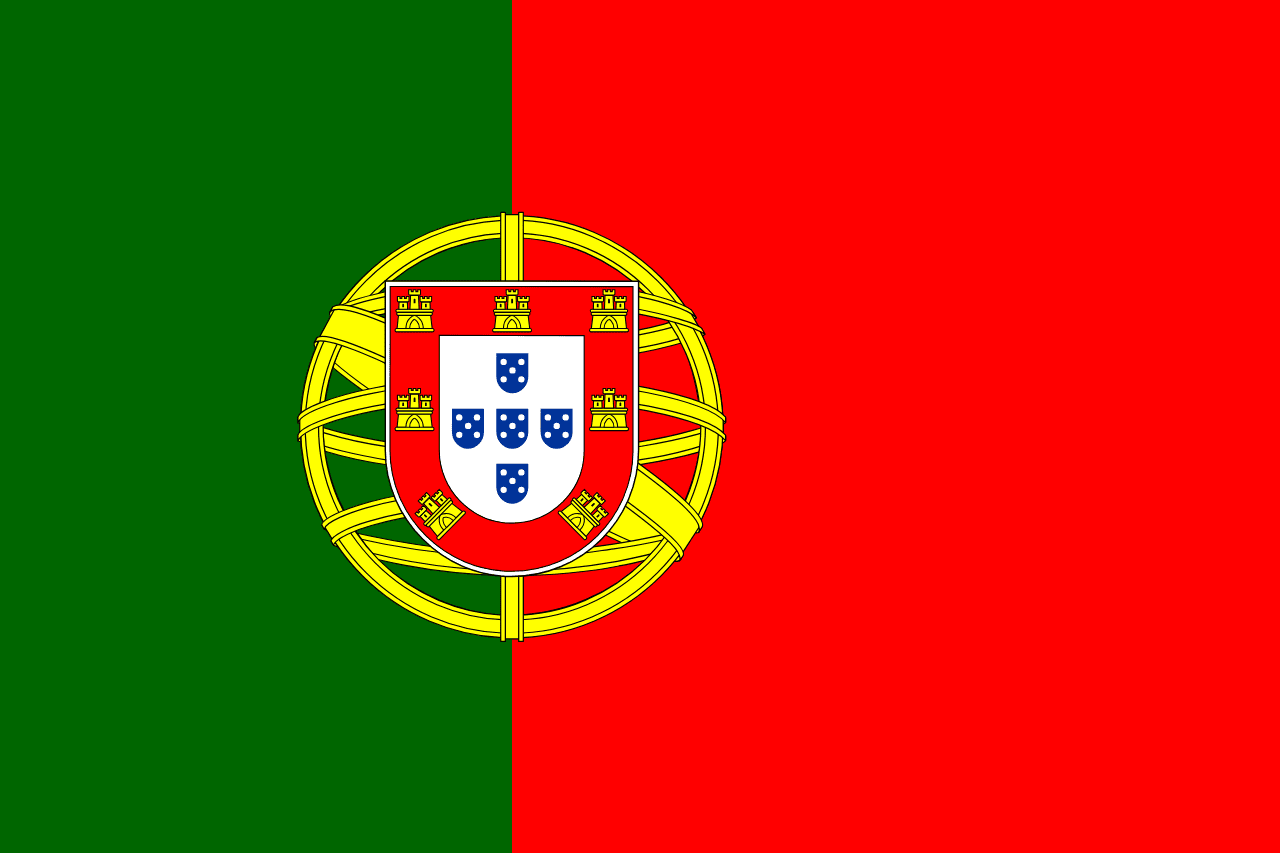

Few European flags reward a closer look quite like Portugal's. From a distance it reads as a simple two-color banner, green beside red, but step nearer and a remarkable emblem comes into focus: a golden lattice of rings cradling a small shield, a design that compresses centuries of seafaring ambition into a single point on the cloth. This is a flag that does not merely decorate a nation; it narrates one. Adopted in 1911 in the turbulent aftermath of revolution, the Portuguese flag broke decisively with the blue-and-white banners of the deposed monarchy and announced a republic eager to define itself anew.
A Republic's Statement in Green and Red
The most immediate thing about the flag is its asymmetry. Most national bicolors split their fields evenly, but Portugal's divides vertically with green occupying roughly the inner two-fifths nearest the hoist and red filling the larger fly. The boundary between the two colors sits behind the central emblem, so the coat of arms straddles the line where green meets red. The effect is deliberate and theatrical, drawing the eye to the seam and to the ornate device that overlaps it.
Those two colors were a sharp departure from tradition. For generations Portuguese royal banners had leaned on blue and white, hues tied to the House of Braganza and earlier dynasties. By choosing green and red, the architects of the new republic signaled rupture rather than continuity. The palette had circulated among republican movements and was associated with the secret societies and reformers who had agitated against the throne, so the colors themselves carried a political charge before they ever flew over a government building.
What the Colors Are Meant to Say
Official interpretation gives each color a clear role. Green stands for hope, the optimism of a young republic looking toward its future. Red represents the blood of the nation, honoring those who fought and died in the struggles that shaped Portugal, including the revolutionaries of the new era. The pairing is intended to balance aspiration with sacrifice: the bright forward-looking green tempered by the solemn weight of red.
It is worth noting that this symbolism was attached after the fact as much as it guided the choice. The colors first won favor for their republican associations, and the poetic readings of hope and sacrifice gave the public a meaning to rally around. That layering of practical politics and lofty ideals is typical of how national symbols acquire their stories, and it makes the explanation feel earned rather than arbitrary.
The Emblem at the Heart of the Flag
The centerpiece is what truly sets Portugal apart from every other flag on earth. Resting over the color boundary is an armillary sphere, a golden skeletal globe made of interlocking rings that astronomers and navigators once used to model the heavens and chart positions at sea. This instrument is not decoration; it is a direct reference to the Age of Discovery, when Portuguese caravels rounded Africa, reached India, and touched coastlines across the world. The sphere had served as a personal device of King Manuel I, under whom much of that maritime expansion flourished, and its survival on the republican flag is a rare thread of continuity tying the new state to the nation's proudest chapter.
Layered on top of the sphere sits the traditional Portuguese coat of arms: a white shield bearing five smaller blue shields arranged in a cross, each dotted with white points, all set within a red border studded with golden castles. The blue shields are popularly linked to a foundational victory of the medieval kingdom, while the castles recall territories won during the long reconquest of the Iberian Peninsula. So within the emblem alone, the flag holds both the land-bound origins of the kingdom and its later turn toward the open ocean.
From Monarchy to the Modern Banner
The flag's birth is inseparable from a single dramatic moment. In October 1910 a republican uprising toppled the Portuguese monarchy, ending centuries of royal rule. The provisional government needed a banner that would not echo the old regime, and a commission was convened to design one. After debate, including resistance from those who felt green and red were too radical a break, the new design was approved and formally adopted in 1911.
What makes the result so elegant is that it did not throw away everything old. The shield and the armillary sphere carried genuine historical pedigree, so the flag managed to look revolutionary in its colors while remaining rooted in national memory through its emblem. The core design has stayed essentially unchanged for over a century, surviving dictatorship, democratic revolution in 1974, and entry into modern Europe without alteration, a stability that few flags born of upheaval can claim.
How It Compares to Its Neighbors and Look-Alikes
Green-and-red bicolors are not unique to Portugal, and a quick glance can invite confusion. Italy and Mexico both use vertical green-white-red tricolors, but the white panel and the different emblems set them apart at once. Closer in spirit is the flag of Madeira, the Portuguese island, which shares the green-red scheme but centers a Cross of Christ rather than the armillary sphere.
The decisive distinguishing feature, however, is always the sphere. No other sovereign nation places an armillary sphere on its flag, which makes Portugal instantly identifiable once you know what to look for. Where Spain's flag opposite it across the border relies on bold red-yellow-red bands and a crowned emblem, and where many republics chose simple stripes, Portugal committed to a dense, intricate device that rewards inspection. It is one of the most detailed national flags in regular use, and that complexity is precisely what guards it against being mistaken for anything else.
The Flag in National Life Today
The banner is woven through Portuguese public life. It flies over government buildings, embassies, and schools, and appears prominently on June 10, Portugal Day, which honors the poet Luís de Camões and the broader Portuguese community at home and abroad. It is hoisted on October 5 as well, the anniversary of the republic's founding, a date that directly celebrates the regime that gave the flag its colors.
On the world stage the flag is most visible in sport. It floods stadiums whenever the national football team plays, draped over shoulders and painted on faces, and it travels with the Portuguese diaspora to celebrations across Europe, the Americas, and beyond. To understand how deeply this symbol is tied to identity, place, and history, it helps to read more in our portugal country guide, which sets the flag within the wider story of the country.
Quick Facts Worth Knowing
- Portugal is the only country whose flag features an armillary sphere, a navigational instrument symbolizing its maritime discoveries.
- The green and red fields are unequal, with green covering the smaller hoist side and red the larger fly side.
- The coat of arms includes five blue shields and golden castles, recalling medieval victories and the reconquest of Iberian territory.
- The flag was adopted in 1911, replacing the blue-and-white banners of the overthrown monarchy.
- Portugal sits on the Iberian Peninsula in southwestern Europe, bordered only by Spain on land.
Frequently Asked Questions
When was the flag of Portugal adopted?
The current flag was officially adopted in 1911, shortly after the republican revolution of October 1910 that ended the Portuguese monarchy. A government commission designed it specifically to break from the old royal banners, and its core design has remained unchanged ever since.
What do the green and red colors mean?
Green represents hope and the forward-looking spirit of the young republic, while red symbolizes the blood of the nation and the sacrifices made by those who fought for it. The colors were also closely tied to the republican movement that brought the flag into being.
Who designed the Portuguese flag and what is the sphere?
The flag was created by a commission appointed by the provisional republican government rather than a single celebrated artist. Its most striking element is the golden armillary sphere, a model of interlocking rings once used for navigation and astronomy, which honors Portugal's era of seafaring exploration.
What continent is Portugal on, and what flags resemble it?
Portugal lies in southwestern Europe, on the Iberian Peninsula alongside Spain. Other green-and-red flags such as Italy's and Mexico's can look superficially similar, but they are vertical tricolors with a white band, while Portugal's bicolor and unique armillary sphere make it impossible to confuse once you know the emblem.