

Few national banners are as instantly recognizable as the bold red and yellow of Spain. Affectionately nicknamed la Rojigualda — roughly "the red and weld-yellow" — this flag pairs two warm colors with an elaborate coat of arms that compresses centuries of Iberian history into a single emblem. It is a flag that works on two levels at once: a simple, striking horizontal tricolor that reads clearly from a distance, and a dense heraldic shield that rewards a closer look. Below, we unpack what each element means, how the design came together over more than two centuries, and why it stirs such strong feelings across the country today.
A Quick Look at the Design
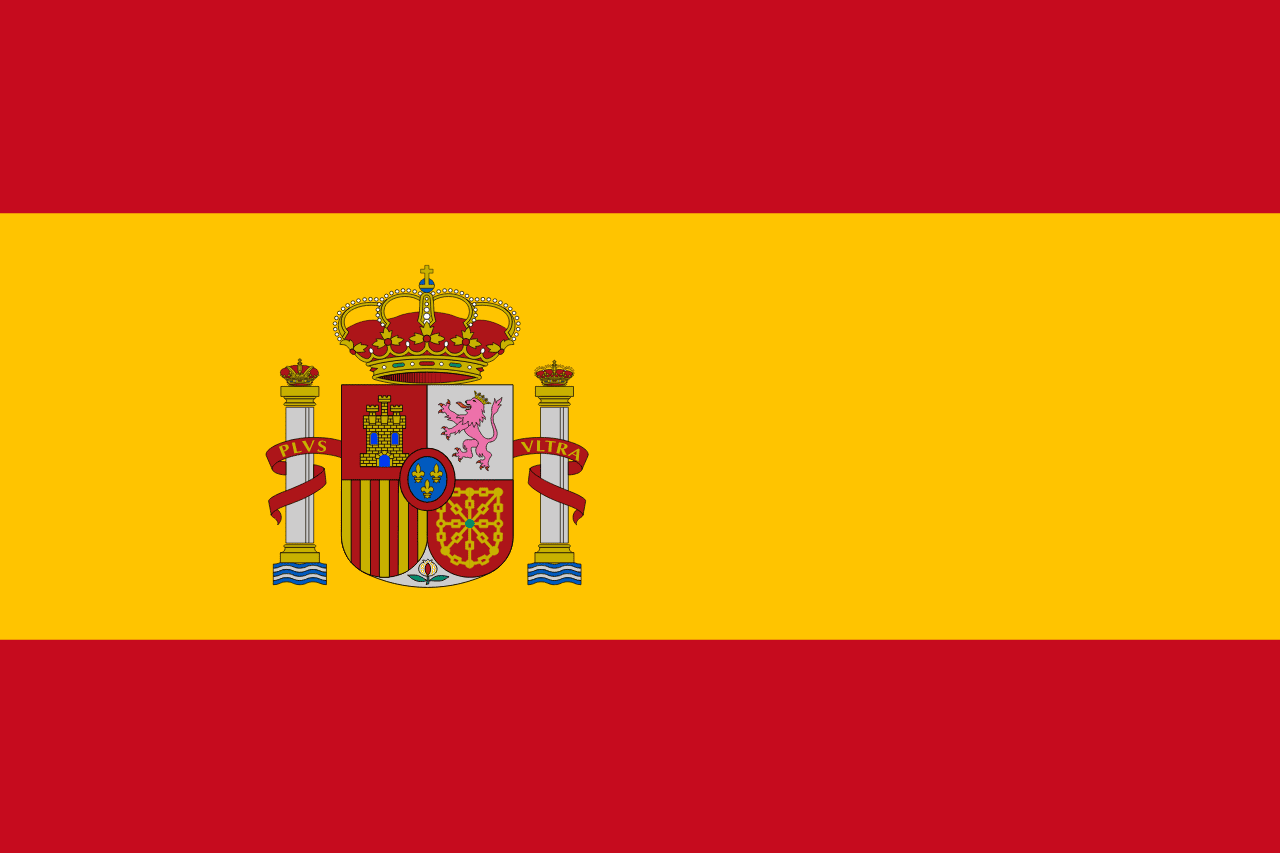
The Spanish flag uses three horizontal stripes in a striking 1:2:1 arrangement: a red band at the top, a yellow band of double width through the middle, and a red band at the bottom. The overall proportions are 2:3. Because the central yellow stripe is twice the height of either red band, yellow dominates the field and gives the flag its sunny, unmistakable character. Set slightly toward the hoist (the left side, nearest the flagpole) on that yellow band sits the national coat of arms — the detail that turns a clean two-color design into a layered statement of identity. The off-center placement is deliberate: it keeps the emblem visible even when the flag is furled or hanging close to the pole.
What the Red and Yellow Stand For
The red and yellow palette is far older than the modern state. These colors trace back to the medieval Crown of Aragon and its heraldry, which used bold gold and red bars long before Spain existed as a unified country. Rather than assigning each color a tidy modern abstraction such as "courage" or "prosperity," the Spanish tradition treats them as inherited, historic hues — a continuity with the kingdoms that eventually merged into Spain. That said, the practical reason these particular colors were chosen for the flag is just as interesting as the symbolic one. When King Charles III selected the design in 1785, he wanted a combination that stood out clearly against the sea and sky and could not be confused with the flags of other Bourbon-ruled nations, many of which leaned heavily on white. Red and yellow were vivid, high-contrast, and impossible to mistake at a distance.
Reading the Coat of Arms
The emblem on the yellow band is essentially a visual history lesson. Its central shield gathers the arms of the historical kingdoms that came together to form Spain: Castile, León, Aragon, Navarre, and Granada, the last often represented by a pomegranate at the base of the shield. Flanking the shield are the Pillars of Hercules, the twin columns of classical legend that mark the Strait of Gibraltar, where the Mediterranean meets the Atlantic. Each pillar is wrapped in a banner bearing the motto Plus Ultra, meaning "Further Beyond." That phrase was the personal motto of Charles V (Carlos I of Spain), an inversion of the older warning Non Plus Ultra ("nothing further beyond") that supposedly marked the edge of the known world. By dropping the "non," Spain turned a boundary into an invitation — a fitting emblem for a nation whose ships once sailed past the limits of the old maps.
How the Flag Evolved
The flag's journey to its present form spans more than two hundred years. Charles III introduced the red-and-yellow naval ensign in 1785, and the basic color scheme proved remarkably durable, surviving monarchies, regencies, and dictatorships while the coat of arms in the center changed to suit each regime. There was one dramatic interruption: during the Second Republic (1931–1939), the country flew a tricolor that replaced the lower red band with purple, a nod to a popular (if historically shaky) association between purple and the old Crown of Castile. After the Republic, the red-yellow-red scheme returned. The version flown today was anchored by the 1978 Constitution, which fixed the stripe arrangement, while the precise design of the modern coat of arms was finalized in 1981. That is why the flag is usually dated to 1981 even though its colors are far older.
Cousins and Look-Alikes
Red-and-yellow is a popular combination, so the Spanish flag invites comparison with several neighbors and relatives. The closest in spirit is the flag of Andorra, the small principality nestled in the Pyrenees, whose blue-yellow-red tricolor carries a central coat of arms and shares heraldic DNA with both Spain and France. Spain's western neighbor, Portugal, also pairs warm tones with a detailed shield and an armillary sphere, reflecting a parallel age of seafaring exploration — though Portugal's green-and-red field and distinctive emblem make the two impossible to confuse. The real distinguishing features of the Spanish flag are its unequal stripes (that double-width yellow band) and the unmistakable Pillars of Hercules wrapped in the Plus Ultra motto. Strip away the coat of arms entirely and you have a "civil" version of red-yellow-red that ordinary citizens often fly, which is plainer than the official state flag. For more on the country itself, see our spain country guide.
The Flag in Modern Spanish Life
Today the Rojigualda flies over government buildings, military installations, and embassies, and it takes center stage on Fiesta Nacional de España, the national holiday held each October 12 with a major military parade in Madrid. Beyond officialdom, the flag is woven into Spanish sport. You will see it draped over shoulders and painted on faces when La Roja, the national football team, plays, and it ripples through the stands during La Liga matches. It appears at bullfighting events, at Formula 1 circuits when Spanish drivers compete, and at tennis tournaments whenever a homegrown champion is on court. It is worth acknowledging that the flag carries complicated associations: because the red-yellow design continued through the Franco dictatorship, some Spaniards have a more ambivalent relationship with it than the cheerful colors might suggest. Yet for most, it remains a straightforward emblem of national unity and shared identity.
Quick Facts Worth Knowing
- The flag's nickname, la Rojigualda, blends the Spanish words for red (rojo) and a yellow dye (gualda, or weld).
- King Charles III picked the colors in 1785 partly so Spanish ships would stand out at sea and not be mistaken for other Bourbon fleets.
- The central yellow stripe is twice the width of each red stripe, giving the flag its characteristic 1:2:1 banding.
- The Pillars of Hercules represent the Strait of Gibraltar, the gateway between the Atlantic and the Mediterranean.
- Plus Ultra ("Further Beyond") began as the motto of Charles V and celebrated exploration past the edge of the known world.
- From 1931 to 1939, the Second Republic flew a flag with a purple lower stripe instead of red.
Frequently Asked Questions
When was the current Spanish flag adopted?
The red-yellow-red stripe pattern was confirmed by the Spanish Constitution of 1978, and the modern coat of arms was finalized in 1981. The flag is therefore usually dated to 1981, even though the underlying color scheme goes back to 1785 under King Charles III.
What do the red and yellow colors mean?
The colors are inherited from the medieval Crown of Aragon's heraldry rather than tied to fixed modern abstractions. They were chosen by Charles III in 1785 largely for practical visibility, so Spanish vessels would be clearly distinguishable at sea from those of other Bourbon nations.
Who designed the Spanish flag?
King Charles III is credited with selecting the red-and-yellow naval design in 1785, choosing from several submitted options. The coat of arms has been revised by successive governments since then, with the present version dating to 1981, so the flag is best understood as the work of many hands across more than two centuries.
What continent is Spain on, and what flags are similar?
Spain is located in Europe, on the Iberian Peninsula in the continent's southwest. Its red-and-yellow palette invites comparison with the flags of Andorra and Portugal, both of which combine warm colors with a detailed central emblem, though Spain's unequal stripes and its Pillars of Hercules set it apart.