
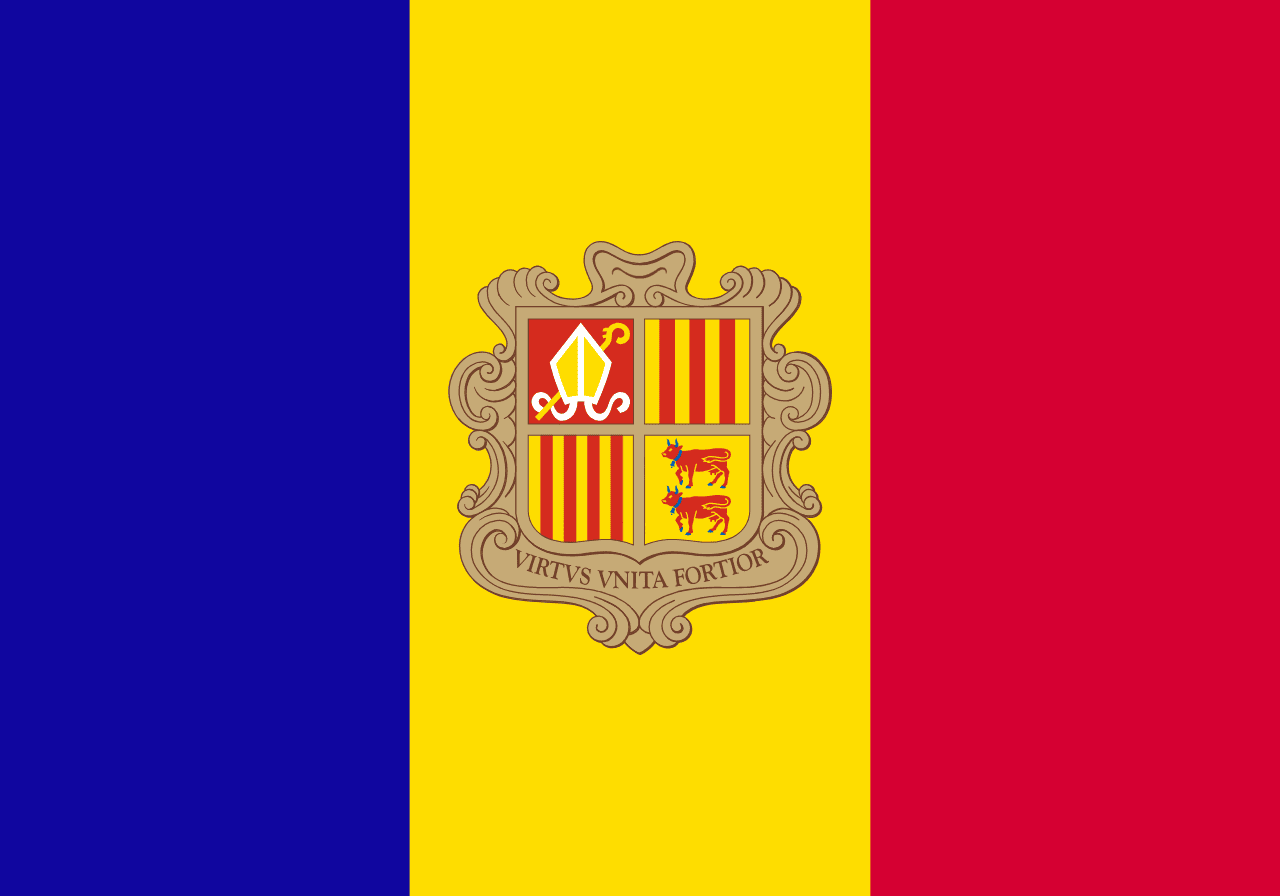
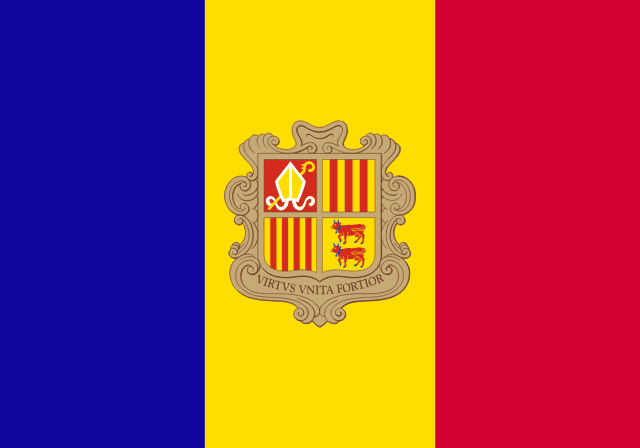
Tucked into the high valleys of the eastern Pyrenees, between two of Europe's larger nations, sits the tiny principality of Andorra. Its flag tells the story of that location almost at a glance: a vertical band of blue, a band of yellow, and a band of red, with an intricate coat of arms anchored in the center. Look at it quickly and you might mistake it for a French tricolor or a Romanian banner, but linger a moment and the differences emerge. The blue and red borrowed from France, the yellow and red echoing Spain, and an emblem stuffed with heraldic detail combine into one of Europe's most quietly distinctive national symbols. This is a flag built from compromise, history, and a fierce sense of independence.
A Tricolor Born From Two Neighbors
The most striking feature of Andorra's flag is also the simplest to explain: its colors are a deliberate blend of the flags of its two historic protectors. France contributes blue and red; Spain contributes yellow and red. By weaving these hues together, Andorra acknowledges the dual influences that have shaped its political life for centuries while still asserting a separate identity. The shared red, sitting between the French and Spanish palettes, becomes a kind of visual hinge linking the two traditions.
This blending is not accidental decoration. Andorra has long existed under an unusual arrangement of shared sovereignty, and the flag honors that reality rather than hiding it. Blue and yellow flank the central red in the standard version, producing a balanced tricolor that reads as both familiar and unique. The colors say, in effect, that Andorra belongs to the cultural worlds on either side of the mountains without belonging entirely to either one.
Reading the Design and Layout
Structurally, the flag is a vertical triband: three upright stripes of equal width in blue, yellow, and red, ordered from the hoist to the fly. At the heart of the central yellow stripe sits the national coat of arms, which is what truly sets this banner apart from look-alikes. Many countries fly plain tricolors; Andorra's emblem is detailed and unmistakable.
The arms are divided into quarters, each representing a historic authority connected to the principality. The shield combines symbols tied to Andorra's co-princes and to the neighboring regions of Catalonia and Foix, the lineages historically bound up in the country's governance. Below the shield runs a motto on a scroll. That Latin phrase, Virtus Unita Fortior, translates to "strength united is stronger," a fitting sentiment for a nation defined by the union of outside influences and internal resolve. The emblem's busy, layered character gives the flag a ceremonial weight that a bare tricolor could never carry.
Historical Background and How the Flag Took Shape
Andorra's flag did not appear fully formed. Earlier versions of the national banner used the blue, yellow, and red combination but varied in details and sometimes lacked the full coat of arms. Over the nineteenth and twentieth centuries the design gradually standardized, reflecting Andorra's slow evolution from a feudal curiosity into a recognized modern state.
The flag in its current, codified form dates to 1971, when the design with the central coat of arms was formally fixed. That date matters because it predates the country's modern constitution by a couple of decades, showing that Andorrans had settled on their flag's symbolism well before they fully modernized their institutions. The tricolor with arms thus became a thread of continuity connecting the principality's medieval roots to its contemporary identity. If you want the broader story of the country behind the banner, the andorra country guide traces its geography, governance, and culture in more depth.
How It Compares to Similar Flags
Andorra's flag belongs to a small club of European tricolors that share the blue-yellow-red or red-yellow palette, and casual observers frequently confuse it with a few of them. The closest visual cousins are the flags of Romania, Chad, and Moldova, all vertical tricolors using blue, yellow, and red in roughly the same arrangement.
- Romania and Chad use plain blue-yellow-red tricolors with no central emblem, so the presence of Andorra's detailed coat of arms is the immediate giveaway.
- Moldova also carries a central emblem on a blue-yellow-red field, making it the trickiest comparison. Moldova's crest features an eagle and is visually distinct from Andorra's quartered shield and Latin motto.
- France shares the blue and red but adds white rather than yellow, while Spain leans on red and yellow horizontally. Andorra's flag sits between them precisely because it draws from both.
The lesson is that color order alone rarely identifies a flag. For Andorra, the coat of arms and its motto are the fingerprints that separate it from a whole family of similar designs.
Cultural Significance and National Identity
For Andorrans, the flag is more than a marker on a map. In a country of fewer than a hundred thousand people, perched among mountains and historically caught between powerful neighbors, the banner is a statement of survival and self-determination. The deliberate fusion of French and Spanish colors transforms what could have looked like dependence into a confident assertion of balance: Andorra takes from both sides yet answers to its own emblem.
The motto "strength united is stronger" captures the national temperament. A small population in a rugged landscape has endured for centuries by cooperating internally and managing its relationships with larger powers diplomatically. The coat of arms, with its references to the historic co-princes and neighboring lineages, keeps that layered heritage visible every time the flag is raised, reminding citizens that their independence was built through shared arrangements rather than conquest.
The Flag in Modern Life
Today the flag flies over government buildings, schools, and public squares throughout the principality, and it appears prominently on Andorra's national day each September, when the country celebrates its patron and its identity. Travelers passing through the capital, Andorra la Vella, or the ski resorts in the surrounding valleys will see it hung alongside the banners of the parishes that make up the country's internal divisions.
In sport, the flag follows Andorra's athletes onto the international stage. The principality competes at the Olympic Games and in football and other events, where its delegations are small but proud, and the blue-yellow-red tricolor with its central arms gives a tiny nation an outsized presence in the procession of flags. The emblem also turns up on official documents, currency-adjacent branding, and tourism materials, anchoring the country's image for the millions of visitors who pass through its mountain passes each year.
Interesting Facts at a Glance
- The flag's three colors are a deliberate blend of the French and Spanish flags, symbolizing Andorra's two historic protecting powers.
- The current design with the central coat of arms was formally adopted in 1971.
- The Latin motto on the arms, Virtus Unita Fortior, means "strength united is stronger."
- Without its coat of arms, the flag would be easily confused with Romania's and Chad's plain tricolors.
- The coat of arms is divided into quarters representing historic authorities tied to the principality, including its co-princes.
- Andorra lies in Europe, high in the Pyrenees mountains between France and Spain.
Frequently Asked Questions
When was the flag of Andorra adopted?
The flag in its current standardized form, featuring the vertical blue-yellow-red tricolor with the national coat of arms in the center, was formally adopted in 1971. Earlier versions used the same colors but varied in their details before the design was fixed.
What do the colors of the Andorran flag mean?
The blue and red are drawn from the flag of France, while the yellow and red are drawn from the flag of Spain. Together they represent Andorra's two historic protecting powers and the country's position between the two nations, while still expressing a distinct identity through its central emblem.
What continent is Andorra on, and where is it located?
Andorra is in Europe. It is a small landlocked principality nestled in the eastern Pyrenees mountains, sharing borders with France to the north and Spain to the south.
How is Andorra's flag different from similar tricolors like Romania's or Moldova's?
All three use a vertical blue-yellow-red arrangement, which causes frequent confusion. The clearest distinction is the coat of arms: Andorra's central emblem features a quartered shield tied to its co-princes and the Latin motto "strength united is stronger," whereas Romania's flag has no emblem and Moldova's carries a different eagle-based crest.