

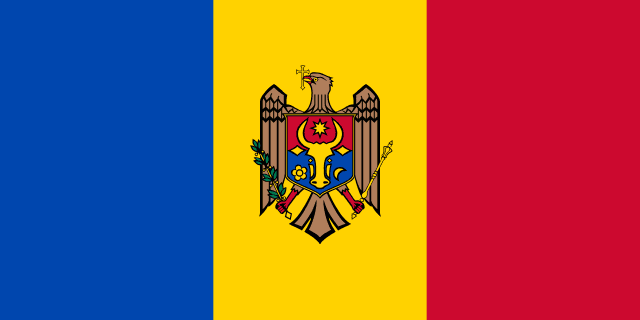
Tucked between Romania and Ukraine, Moldova flies a flag that tells a layered story in three vertical stripes of blue, yellow, and red. At a glance it looks like a close cousin of the Romanian tricolor, and that resemblance is no accident. But step closer and you find a detail that sets Moldova apart entirely: a golden coat of arms resting on the central yellow band, crowned by an eagle clutching an Orthodox cross. Adopted in 1990 as the country emerged from the Soviet Union, the flag is both a declaration of cultural kinship and a statement of sovereign identity.
A Tricolor Born From a Turning Point
The Moldovan flag was adopted in 1990, during the wave of national awakening that swept the Soviet republics in the years before the USSR formally dissolved. As an independence movement gathered momentum, Moldovans reached for symbols that reflected who they believed themselves to be rather than the imposed iconography of the Soviet era. The result was a return to the blue, yellow, and red palette long associated with the broader Romanian cultural world, paired with an emblem that grounded the flag firmly in Moldova's own land and history.
That timing matters. The flag did not arrive after decades of quiet evolution; it appeared at a decisive moment, when choosing a national banner was itself a political act. Raising the tricolor meant rejecting one identity and embracing another. For many Moldovans, the flag remains inseparable from the memory of those charged, hopeful years.
Reading the Three Colors
The blue, yellow, and red of Moldova's flag echo the colors of neighboring Romania, and that shared palette is deliberate. It represents the deep historical, linguistic, and cultural heritage the two nations have in common. Moldovans and Romanians speak closely related languages and trace overlapping roots, and the tricolor is a visible acknowledgment of that bond.
Each band carries the broad meanings that European tricolors of this family tend to evoke. Blue is widely read as a reference to the sky and to liberty, yellow to the richness of the land and the dignity of the people, and red to the courage and sacrifice that secured the nation's freedom. Rather than three isolated ideas, the colors read as a single thread of belonging: a people connected to a wider heritage while standing on their own ground.
The Design and Its Layout
Structurally, the flag is a vertical triband, sometimes described as a vertical tricolor. Three equal stripes run from top to bottom: blue at the hoist (the edge nearest the pole), yellow in the center, and red at the fly (the outer edge). Centered on the yellow stripe sits the national coat of arms, which gives the Moldovan flag its unmistakable character.
That emblem is the visual heart of the design. At its core is an eagle holding an Orthodox cross in its beak, a detail that anchors the flag in the country's spiritual traditions. The eagle also bears symbols associated with Moldova's historical heraldry, including the aurochs head that has represented the Moldavian lands for centuries. Because the coat of arms is rendered in gold tones against the yellow band, it reads as an elegant, integrated centerpiece rather than a busy add-on.
One charming consequence of placing the arms only on one side historically is that the Moldovan flag has, at times, been described differently when viewed from the front versus the reverse. Whether or not you ever notice that detail in person, it speaks to how much thought went into a banner that looks deceptively simple from a distance.
How It Compares to Similar Flags
Moldova's flag belongs to a recognizable European family of blue-yellow-red vertical tricolors, and the comparisons are unavoidable. The closest relative is Romania's flag, which uses the same three colors in the same vertical arrangement. The decisive difference is the coat of arms: Romania flies a plain tricolor, while Moldova centers its emblem on the yellow stripe. If you ever need to tell the two apart instantly, look for the eagle and cross. No emblem means Romania; the golden coat of arms means Moldova.
The blue-yellow-red combination also brings Andorra and Chad to mind, both of which use vertical tricolors in similar hues. Andorra, like Moldova, places a coat of arms on its central band, while Chad's flag is a plain tricolor with no emblem at all. What distinguishes Moldova within this group is the specific content of its arms, the eagle, the Orthodox cross, and the aurochs, which root the design in the country's own heraldic past rather than in any shared template. The palette may feel familiar, but the story painted onto the yellow stripe is uniquely Moldovan.
Cultural Significance and National Identity
For Moldovans, the flag is a careful balancing act made visible. The shared colors honor a heritage that crosses the border with Romania, while the coat of arms asserts that Moldova is its own sovereign nation with its own institutions, faith, and history. In a country whose identity has been debated and contested across generations, that dual message is meaningful rather than merely decorative.
The Orthodox cross held by the eagle reflects the central place of Christianity in Moldovan life, and the historical emblems woven into the arms connect modern citizens to the medieval principality of Moldavia. Flying the tricolor, then, is a way of saying that the nation did not begin in 1990; it simply reclaimed its right to fly its own colors. To understand how that heritage shapes daily life, language, and landscape, the moldova country guide offers a fuller picture of the nation behind the flag.
The Flag in Modern Moldovan Life
Today the tricolor appears wherever national identity is expressed. It flies over government buildings, schools, and embassies, and it is raised on public holidays and during commemorations of independence. Sporting events bring it into the hands of fans, who wave it in stadiums and along the streets when national teams compete. It also features in official ceremonies, military events, and civic gatherings, where it stands as the formal symbol of the state.
Because the flag is so closely tied to the country's emergence as an independent nation, it carries an emotional charge on occasions that recall that history. For Moldovans abroad, the tricolor is also a portable piece of home, a quick and powerful way to signal where they come from and what they share with one another.
Interesting Facts at a Glance
- The flag was adopted in 1990, as Moldova moved toward independence amid the collapse of the Soviet Union.
- The eagle in the coat of arms holds an Orthodox cross in its beak, reflecting the country's Christian traditions.
- Its blue, yellow, and red colors match those of Romania, symbolizing a shared cultural heritage.
- The decisive difference from the Romanian flag is the centered coat of arms on the yellow stripe.
- The arms include heraldic symbols tied to the historical principality of Moldavia, including an aurochs head.
- Moldova sits in Eastern Europe, landlocked between Romania and Ukraine.
Frequently Asked Questions
When was the flag of Moldova adopted?
Moldova adopted its current flag in 1990, during the independence movement that accompanied the final years of the Soviet Union. Choosing the tricolor at that moment was a deliberate break from Soviet-era symbolism and a statement about the nation Moldova intended to become.
What do the colors of the Moldovan flag mean?
The blue, yellow, and red mirror the colors of Romania and represent the shared cultural heritage between the two nations. More broadly, blue is associated with the sky and liberty, yellow with the land and its people, and red with courage and sacrifice.
What is the emblem on the Moldovan flag?
The central yellow stripe carries Moldova's coat of arms, which features an eagle holding an Orthodox cross in its beak. The arms also include historical symbols such as the aurochs head, linking the modern state to the medieval principality of Moldavia.
How is Moldova's flag different from Romania's?
Both flags use the same vertical arrangement of blue, yellow, and red, which reflects their close cultural ties. The key difference is that Moldova places its coat of arms on the central yellow band, while Romania flies a plain tricolor with no emblem. Moldova lies in Eastern Europe, bordered by Romania and Ukraine.