

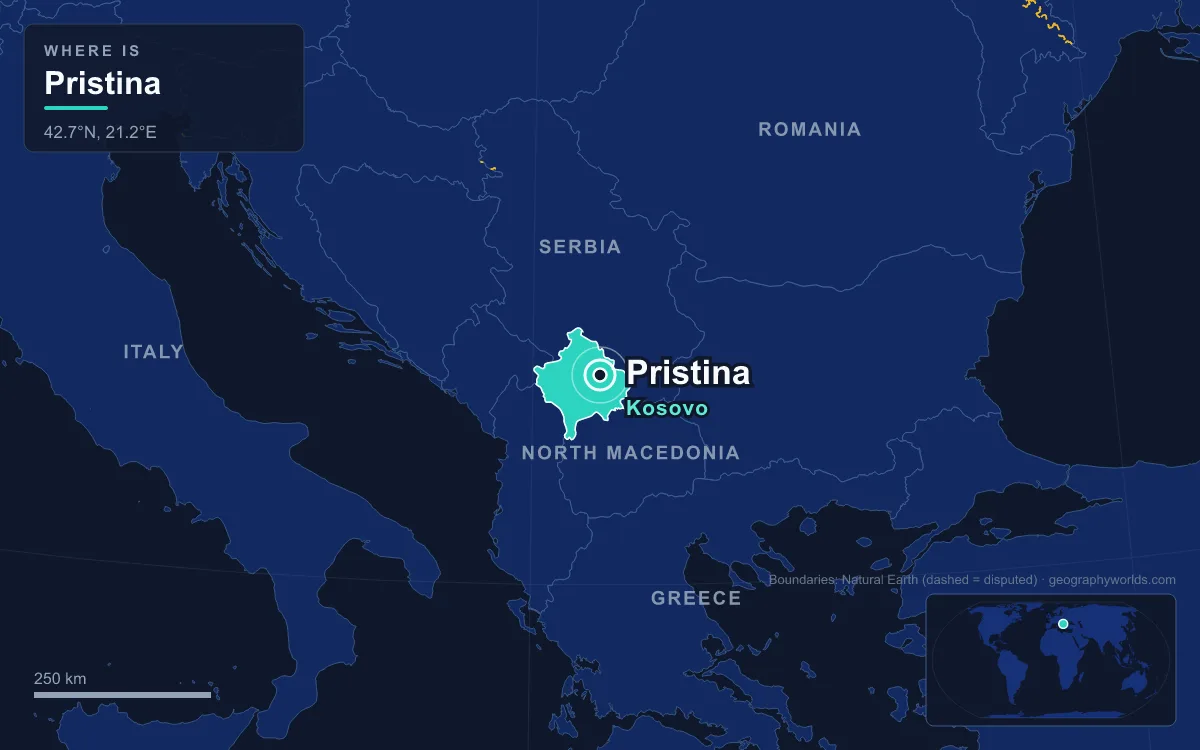
The capital of Kosovo is Pristina (Prishtina in Albanian), the country’s largest city, set on a plain in central-eastern Kosovo beside the low Gollak hills. The 2024 census counted 227,466 residents in the municipality, up 14.2 percent since 2011, and about 98 percent of them are Albanians. Pristina’s defining feature is the question hanging over the state it governs. Kosovo declared independence from Serbia on 17 February 2008 and has been recognised by at least 110 United Nations members, while Serbia does not recognise it and still claims the territory as its Autonomous Province of Kosovo and Metohija, although in the 2013 Brussels Agreement it agreed to bring its parallel institutions in northern Kosovo under Kosovo’s legal framework. Parliament, the presidency, the government and the top courts all sit in Pristina, and the city’s streets carry the marks of every regime that has ruled it.
Power on Mother Teresa Square and the Newborn Letters
Pristina has been a seat of government several times before now. After the League of Prizren in 1878, the Ottoman authorities moved the capital of the Kosovo vilayet here, probably to weaken the league’s influence by placing the capital in a more central town, and it held that role from 1879 to 1888. Those years brought the first registered state printing press and the building that now houses the Kosovo Museum. Serbian forces took the town on 22 October 1912, during the First Balkan War, and in 1948 the Yugoslav authorities made it the capital of the province of Kosovo. When Belgrade stripped the province of most of its autonomy in 1989, Albanians were purged from state jobs and institutions across Kosovo, and the city remained under Serbian and Yugoslav control until the war ended in June 1999, when NATO troops arrived and a United Nations mission took over the administration.
Today the Assembly of Kosovo meets on Mother Teresa Square, and the president and prime minister both work in the city, as do the Constitutional Court, the Supreme Court and the Court of Appeal. The city itself is run by an elected mayor and a 51-member municipal council, covering a municipality of 43 settlements with Pristina as its seat.
The best-known political symbol, though, is a piece of typography. On the day of the 2008 declaration, a sculpture spelling NEWBORN in capital block letters was unveiled in front of the Palace of Youth and Sports. Designed by the Kosovar designer Fisnik Ismaili with the agency Ogilvy Kosova and built in only ten days, it weighs 9 tonnes and is 24 metres long and 3 metres high. The president and prime minister signed it first, and it made the front page of The New York Times. It was later repainted with the flags of the states that recognised Kosovo, and at the unveiling it was announced that it would be painted differently every year on the anniversary.

Faith From the Imperial Mosque of 1461 to the Mother Teresa Cathedral
The oldest large building in the centre is the Imperial Mosque, also called the King’s Mosque. An inscription over its entrance gives the year 865 of the Islamic calendar, 1461 in the Gregorian one, when it was built on the orders of Sultan Mehmed II, the conqueror of Constantinople. It has a stranger history than most mosques. During the Austro-Turkish war at the end of the seventeenth century, when Pristina’s citizens sided with the Austrian army under the Catholic Albanian priest and writer Pjetër Bogdani, it was briefly turned into a church and Bogdani was buried inside. When the Ottomans returned in 1690, his remains were dug up and thrown into the street.

Islam spread gradually after the Ottoman conquest. A tax register of 1487 recorded 412 Christian and 94 Muslim households in the town, but by the late sixteenth century about 60 percent of the population had converted. Other Ottoman buildings survive nearby, including the Jashar Pasha Mosque of 1834, a clock tower and an Ottoman bath.
Two twenty-first-century churches show how faith and politics overlap here. The Catholic Cathedral of Saint Mother Teresa, named after the missionary of Albanian descent, had its foundation stone laid in 2005 by President Ibrahim Rugova, himself a Muslim. It was inaugurated unfinished on 5 September 2010 and consecrated on 5 September 2017, twenty years after her death, and the diocese moved its seat here from Prizren. On the university campus stands the shell of the Serbian Orthodox Cathedral of Christ the Saviour, begun in 1992 on a plot the municipality took from the university and left unfinished when the Kosovo War broke out. About 5 kilometres outside the city, the Serbian Orthodox monastery of Gračanica, built by King Stefan Milutin in 1321, has been part of a UNESCO World Heritage site since 2006.
Kosovo’s constitution sets up a secular state with no official religion, and in practice the shares above describe heritage as much as observance.
Trade Routes: Novo Brdo Silver, Ragusan Merchants and the R7 Motorway
Pristina first appears in the written record in the early fourteenth century, and the Byzantine emperor John VI Kantakouzenos, visiting the Serbian king Stefan Dušan’s court nearby, described it as an unfortified village. What made it a town was position. The main road from the western Balkans to Constantinople ran through it, and 40 kilometres to the east lay Novo Brdo, whose fortress guarded some of the richest gold, silver, iron and lead mines in the region. Around 1400 Pristina was a major trading post for silver, with many merchants coming from the Republic of Ragusa, today’s Dubrovnik. In the Ottoman era its fairs were known for goatskin, goat hair and gunpowder.
Modern trade still follows roads. The R7 motorway to Durrës on the Albanian coast was completed in November 2013, the same year a new terminal opened at the airport 15 kilometres southwest of the city, which now handles more than 4 million passengers a year as Kosovo’s only international airport. The R6 motorway to Skopje in North Macedonia followed in 2019. Services employ more than 75 percent of the city’s workforce, industry about 20 percent and farming 5 percent, and around 100,000 foreign visitors came in 2012, most of them from Albania, Turkey and Germany. The next big date is 2030, when Kosovo is due to host the Mediterranean Games, with the Palace of Youth and Sports among the planned venues.
Inside the city, most movement is by car and bus. Of roughly 240,000 cars registered in Kosovo, about 100,000, or 41 percent, come from the Pristina region. The urban operator Trafiku Urban runs 15 lines, and together with private operators more than 80 buses serve the city, which in early 2025 announced a single ticket valid on all of them. Rail plays a smaller part: a daily train runs through Pristina to Skopje, and the country’s main railway junction is at neighbouring Fushë Kosovë.
Daily Life on Mother Teresa Boulevard
The spine of everyday Pristina is Mother Teresa Boulevard, a long pedestrian street lined with coffee bars, which locals regard as a symbol of the city. People from Pristina call themselves Prishtinali in the local Gheg dialect of Albanian. Turks, at 0.94 percent, are the largest minority, followed by Serbs, Roma, Ashkali and Bosniaks, each well under 1 percent. Before 1999 the city was far more mixed: most of its roughly 45,000 Serb residents left after the war, and only a few dozen remain.

Yugoslav planners rebuilt much of the centre after 1945 under the slogan “destroy the old, build the new”, and today only 21 of Kosovo’s 426 protected historical monuments are in the capital. Their landmark on the boulevard is the Grand Hotel Prishtina, designed by the Albanian architect Bashkim Fehmiu with two Serbian architects and finished in 1978, with 350 rooms on 13 floors, of which only about 1 percent are now used for guests. Life also runs on water: the reservoirs at Batllava and Badovc supply 92 percent of residents, and a lack of rain and snow brings daily cuts. Winters are cold, with January averaging −0.3 °C, and July averages 21.9 °C. For open space, residents head east to Germia Park.
The National Library and a University Split in Two
The building most visitors photograph after Newborn is the National Library of Kosovo, designed by the Croatian architect Andrija Mutnjaković and inaugurated on 25 November 1982. Its 16,500 square metres sit under 99 domes of different sizes, and the whole exterior is wrapped in a metal net. It has space for about two million volumes and holds more than 1.8 million books, periodicals, maps and other items.
The library’s neighbour tells the city’s modern story. The University of Pristina opened for the 1969–1970 academic year, teaching in both Albanian and Serbo-Croat, and gave Albanian-language education in Kosovo a major boost. After 1989, Albanian students were shut out of Albanian-language courses, and by the end of the war there were effectively two institutions with one name. The Albanian-language University of Pristina continues on the original campus with 17 faculties, while the Serbian-language University of Priština is now based in North Mitrovica. Students from Albania, North Macedonia, Montenegro and Serbia still come to the capital to study.
Pristina’s position at the centre of a small, landlocked country is the key to all of this, and our guide to where Kosovo is sets it among the neighbouring states of the Balkans.
Quick Facts About Pristina
- Country: Kosovo
- Continent: Europe (Southern Europe)
- Country population: approximately 1.8 million
- Capital city status: Pristina is the capital of Kosovo, the seat of national government, and the location of foreign embassies, parliament, and the head of state's official residence.
Frequently Asked Questions
What is the capital of Kosovo?
The capital of Kosovo is Pristina. Pristina is the seat of national government, hosts most foreign embassies and consulates, and is typically where the head of state and parliament are located.
What continent is Pristina in?
Pristina, the capital of Kosovo, is located in Europe, in the Southern Europe region. As Kosovo's capital, Pristina serves as the country's primary connection to the broader Europen political, economic, and cultural sphere.
Why is Pristina the capital of Kosovo?
Pristina was chosen as the capital of Kosovo for reasons that typically combine geography, history, and politics. Capital city selections often reflect a desire for centrality (being accessible from across the country), historical importance (being a longstanding seat of government or culture), or neutrality (being acceptable to multiple regions or ethnic groups within the country). The specific reasons for Pristina's designation are detailed in the city's history above.
What is Pristina known for?
As the capital of Kosovo, Pristina is best known for housing the country's central government institutions — parliament, presidential or royal residences, supreme court, and key ministries. It is also typically a major cultural and economic center within Kosovo, hosting national museums, embassies, and signature monuments. The introduction and history sections above provide detailed coverage of the city's specific notable institutions and landmarks.
Related Pages
- Kosovo Country Guide — full geography, climate, economy, and culture overview
- Flag of Kosovo — meaning, history, and design of Kosovo's national flag