
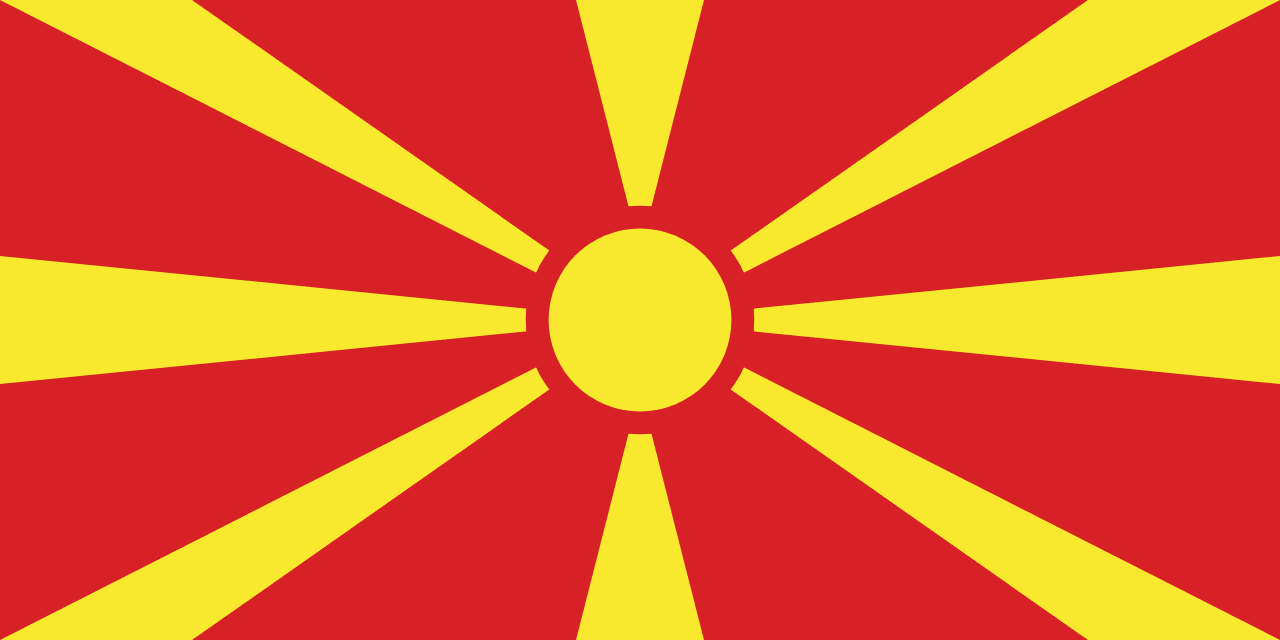
Few flags broadcast their meaning as boldly as the banner of North Macedonia. A single golden sun blazes across a deep red field, its eight thick rays stretching outward until they touch every edge of the cloth. There is nothing subtle about it, and that is precisely the point. Adopted in 1995, this is a young flag by European standards, born out of a tense diplomatic episode that forced a brand-new nation to rethink the very symbol meant to represent it. The result is one of the most instantly recognizable designs in the Balkans: warm, radiant, and impossible to confuse with anything else once you have seen it.
A Sun That Fills the Sky
The most striking feature of the flag is how the sun refuses to stay contained. Rather than floating as a tidy disc in the center, the golden orb sends out eight broad rays that widen as they travel and run all the way into the corners and sides of the rectangle. This gives the impression of a sunrise spilling across the entire field rather than a logo placed on top of it. Designers call this kind of element a "rising" or "radiating" sun, and on the North Macedonian flag it dominates so completely that the red almost reads as the spaces left between beams of light. It is a confident, maximalist composition that leaves no doubt about what the central image is meant to be.
Red and Gold and What They Stand For
The flag uses just two colors, and each carries weight. The red field connects to a long tradition in the region, where red has signified courage, sacrifice, and the blood shed in struggles for freedom. It is a color deeply woven into Macedonian heraldry and folk identity. The yellow or gold sun is described officially as the "new sun of liberty," an emblem of a fresh start and of hope for an independent future. Together the pairing feels almost elemental: fire and daylight, energy and warmth. The eight rays are not merely decorative either; they are commonly understood to evoke the eight regions of the country, tying the abstract symbol of the sun to the concrete geography of the land it represents.
How the Flag Came to Be
North Macedonia declared independence from Yugoslavia in 1991, and like every newly sovereign state it needed a flag of its own. Its first choice proved enormously controversial. The original 1992 design featured the Vergina Sun, an ancient sixteen-rayed star associated with the royal house of Macedon and famously discovered in northern Greece. To Greeks, that symbol was a piece of their own classical heritage, and its use on a neighboring country's flag became a flashpoint in a wider dispute over the name "Macedonia" itself. The objection was serious enough to spill into the economic and diplomatic arenas.
To resolve the tension, the country redesigned its flag in 1995, replacing the Vergina Sun with the simpler, eight-rayed golden sun used today. The new emblem kept the spirit of a radiant sun while sidestepping the contested ancient iconography. It was a rare and revealing case of a national flag being reshaped not for aesthetic reasons but to ease a real international standoff, and it remains one of the clearest modern examples of vexillology meeting geopolitics head-on. You can read more about the country's broader story in our north macedonia country guide.
Cousins in the Family of Sun Flags
North Macedonia's banner belongs to a small but vivid club of flags built around a radiating sun. The closest comparison many people reach for is the flag of Japan, though that design uses a plain crimson disc on white with no rays at all. More similar in feeling are the "sun of liberty" and "sun of May" emblems found across parts of Asia and Latin America, where golden sunbursts also symbolize independence and new beginnings. Argentina and Uruguay both feature faced suns with wavy and straight rays, while several Pacific and Asian flags incorporate solar imagery in different ways.
What sets North Macedonia apart is the sheer scale and geometry of its sun. Where most solar flags keep the emblem modest, this one lets the rays burst clear off the disc and into the borders, and it uses a warm red ground rather than white or blue. The eight-ray count is also distinctive; many sun flags favor higher or symbolic numbers of rays, so the deliberate choice of eight, tied to the country's regions, gives the design a national specificity that look-alikes lack. Side by side, no one would mistake it for the Vergina-bearing original it replaced, which is exactly what its designers intended.
A Symbol Woven into National Life
For a country that only gained independence in the early 1990s, the flag has become a powerful shorthand for identity. Its bold red-and-gold appears at government buildings, on official documents, and across the kits and banners of national sports teams competing on the European and world stages. Independence Day commemorations and other civic holidays see the colors displayed widely, and the sun motif turns up in everything from civic logos to merchandise. Because the design is so graphically clean, it reproduces beautifully at any size, whether stitched onto a tracksuit, painted on a stadium, or waved in a crowd.
There is also a generational dimension to the flag's meaning. Many citizens grew up entirely within an independent North Macedonia, and the sun flag is the only national banner they have ever known. The Vergina episode that shaped it is, for younger people, a story from history books rather than a lived memory, which has allowed the current design to settle firmly into the role of an unquestioned, everyday emblem of home.
Quick Facts Worth Knowing
- The flag was adopted in 1995, replacing the country's first post-independence design.
- It uses only two colors: a deep red field and a golden-yellow sun.
- The sun has eight rays, often linked to the eight regions of the country.
- The earlier flag featured the Vergina Sun, which triggered a dispute with neighboring Greece.
- North Macedonia is located in southeastern Europe, in the heart of the Balkan Peninsula.
- The rays widen as they extend and run all the way to the edges of the flag, a hallmark of "rising sun" designs.
Frequently Asked Questions
When was the flag of North Macedonia adopted?
The current flag was adopted in 1995. It replaced the very first flag the country flew after declaring independence in 1991, which had used the Vergina Sun and proved diplomatically contentious.
What do the colors and the sun on the flag mean?
The red field stands for courage and the sacrifices made in the struggle for freedom, a color long associated with Macedonian heraldry. The golden sun represents the "new sun of liberty" and the hope of an independent future, while its eight rays are commonly understood to symbolize the eight regions of the country.
Why did North Macedonia change its flag?
The original 1992 flag displayed the Vergina Sun, an ancient symbol that Greece considered part of its own classical heritage. The resulting diplomatic friction led North Macedonia to redesign the flag in 1995, swapping the sixteen-rayed Vergina star for the simpler eight-rayed golden sun used today.
What continent is North Macedonia on, and which flags is it similar to?
North Macedonia sits in southeastern Europe, within the Balkan Peninsula. Its flag belongs to the small family of "sun" flags that includes designs like Japan's red disc and the radiant suns of Argentina and Uruguay, but its oversized eight-rayed sun on a red field, with rays reaching the edges, makes it visually distinct from all of them.
