
Few national flags wear their family resemblances quite as openly as Uruguay's. Glance at it quickly and you might mistake the golden sun in its upper corner for something pulled straight off the Argentine banner, while the horizontal stripes echo a certain star-spangled cousin to the north. Yet the flag of Uruguay is no copy. Adopted in 1830, the year this small South American republic settled into independence, it blends borrowed ideas into something distinctly its own: nine white-and-blue stripes anchored by a radiant golden Sol de Mayo, the Sun of May. Understanding how those pieces fit together is a short course in the country's revolutionary origins and its sense of place among neighbors.
A Palette of White, Blue, and Gold
The flag works with three colors, and each carries weight. The white of the stripes and the canton speaks to peace, purity, and the idealism of a young nation forging its identity. The blue stripes evoke the open sky and, by extension, liberty and independence; the cool, light shade has come to be associated with the broader cause of freedom across the region. The third color, the warm yellow gold of the sun, lifts the design out of pure austerity and into something celebratory. Together the trio reads as calm and confident rather than aggressive, a tone that suits a country long known for its measured, civic-minded character.
The combination of light blue and white is not unique to Uruguay, of course. It threads through the flags of several nations and movements tied to the early-nineteenth-century independence struggles of South America, which is exactly why the golden sun matters so much as a distinguishing mark. Without it, the stripes alone would be far harder to place.
Reading the Design: Stripes and a Sunlit Canton
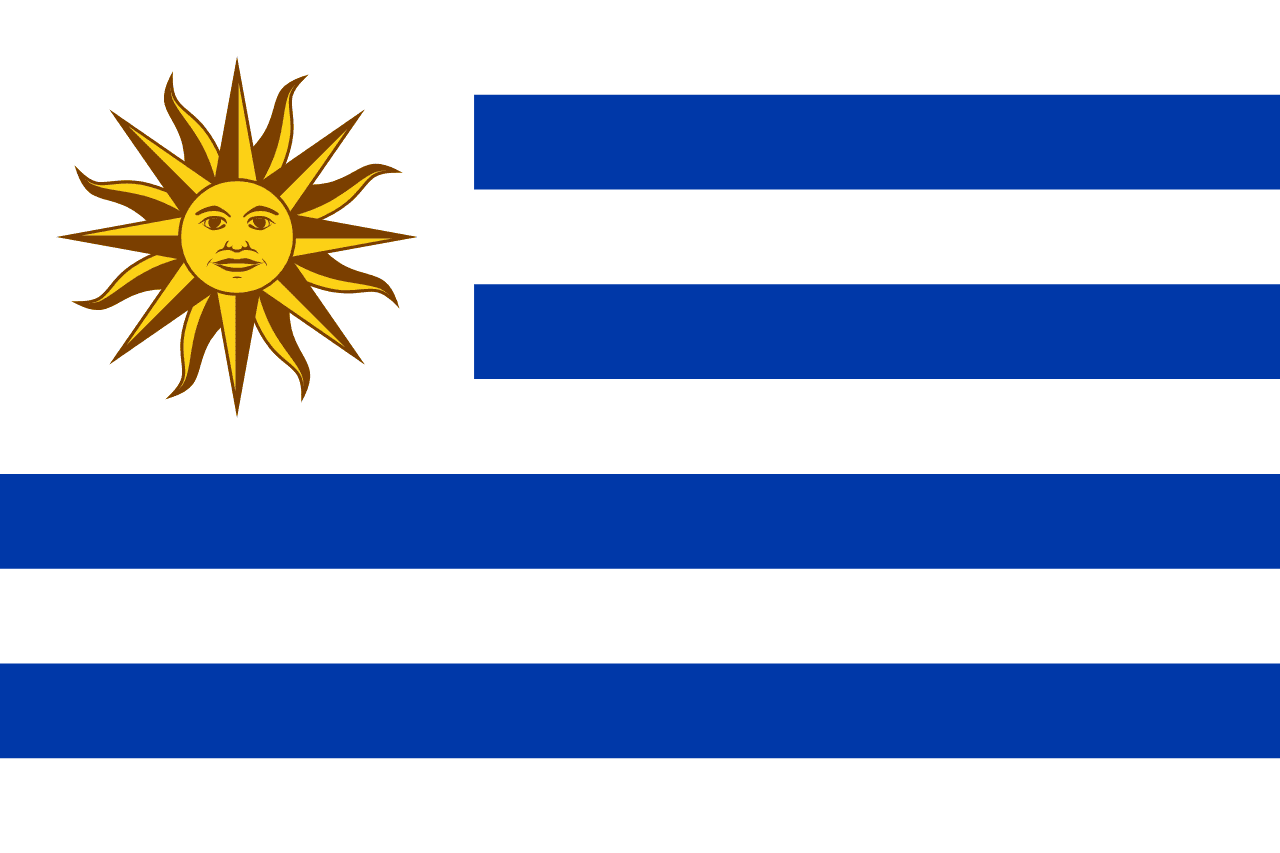
The layout is clean and easy to describe. The field carries nine horizontal stripes that alternate white and blue, beginning and ending with white, so five white stripes frame four blue ones. In the upper-left corner sits a white canton, a rectangle that interrupts the striping, and within it shines the Sun of May: a human-faced golden sun radiating sixteen rays, alternating straight and wavy, around a central disc with eyes, a nose, and a mouth.
That number nine is the heart of the symbolism. Each stripe stands for one of the nine original departments into which Uruguay was divided at the time the flag took its lasting form. The Sun of May, meanwhile, is borrowed directly from the iconography of the region's revolution, the same emblem that appears on the Argentine flag. In Uruguay's version it presides over the corner like a guardian, tying the local story of nine provinces to the wider continental dream of independence from colonial rule.
From Seventeen Stripes to Nine
The flag did not spring into existence fully formed. When Uruguay first adopted a national banner, an earlier version of the design carried seventeen stripes, one for each of the departments recognized at that moment. As anyone who has tried to draw seventeen thin bars on a single flag can imagine, the result was visually busy and difficult to render cleanly at any reasonable size. Within a short time the design was revised, and the stripe count was pared down to the nine we know today, while the meaning shifted to honor the original nine departments.
This pragmatic trimming is one of the more charming details of the flag's biography. It reflects a young government literally adjusting its symbol to make it work better, rather than treating the first attempt as sacred. The 1830 settlement of the design coincided with the consolidation of Uruguay as an independent state, wedged between two large powers, and the flag became a compact statement of that hard-won autonomy.
Cousins and Look-Alikes Across the Americas
Uruguay's flag is often described as combining elements of two famous banners, and the comparison is fair. The horizontal striping recalls the flag of the United States, a deliberate nod to a fellow republic that had thrown off colonial rule, while the Sun of May links it unmistakably to Argentina, with which Uruguay shares deep historical roots in the old Río de la Plata region. The result is a flag that feels both familiar and singular.
It is worth being precise about the distinctions. Argentina's flag is a simple three-band layout, light blue and white, with its sun centered on the middle band; it has no stripes-and-canton arrangement. The United States flag uses red, white, and blue with a field of stars rather than a sun. Uruguay alone marries the striped field to the sun-in-canton format. Travelers comparing the regional banners up close, perhaps after browsing our uruguay country guide, quickly learn to spot the country by that one detail: the sixteen-rayed golden face glowing in a white corner above blue and white bars.
A Symbol Woven Into National Life
For Uruguayans, the flag is more than government décor. It anchors classroom routines, official ceremonies, and the quiet pride of a nation that punches well above its size in culture and sport. The Sun of May in particular has become shorthand for the country's revolutionary heritage and is recognized instantly at home and abroad.
The flag travels especially well on the football pitch. Uruguay's national team, one of the most decorated in the early history of the World Cup, carries the white-and-blue palette into stadiums around the globe, and the flag waves in the stands whenever La Celeste, "the sky-blue one," takes the field. That nickname itself comes from the color of the flag, a reminder of how thoroughly the banner has soaked into everyday national identity. Civic buildings, schools, and ports fly it daily, and it appears at patriotic commemorations marking the milestones of independence.
Interesting Facts at a Glance
- The flag was adopted in 1830, the year Uruguay's independence was consolidated.
- An early version had seventeen stripes before the design was simplified to nine.
- The nine stripes represent the country's original nine departments.
- The Sun of May is shared with Argentina and ties to the region's independence movement.
- The horizontal striping is widely seen as a nod to the United States flag.
- The team nickname La Celeste comes directly from the flag's sky-blue color.
- Uruguay sits in South America, between Argentina and Brazil along the Atlantic coast.
Frequently Asked Questions
When was the flag of Uruguay adopted?
Uruguay's flag was adopted in 1830, the same period the country finalized its independence as a sovereign republic. An earlier seventeen-stripe version preceded the nine-stripe design that has remained in use since.
What do the colors and stripes of Uruguay's flag mean?
The white symbolizes peace and the idealism of the young nation, while the light blue stands for liberty and the open sky. The nine alternating white and blue stripes represent Uruguay's original nine departments, and the golden Sun of May in the canton ties the flag to the region's independence struggle.
Who designed the flag and where does the sun come from?
The flag's design emerged from Uruguay's independence era and was established by law in 1830. Its most distinctive feature, the human-faced golden Sun of May, was adopted from the shared revolutionary iconography of the Río de la Plata region, the same emblem found on Argentina's flag.
How is Uruguay's flag different from Argentina's and the United States'?
All three share parts of a visual vocabulary, but only Uruguay combines them. Argentina uses three light-blue-and-white bands with a centered sun and no canton; the United States uses red, white, and blue stripes with a field of stars. Uruguay alone pairs a striped field with the Sun of May tucked into a white upper-left canton, which is the surest way to tell it apart.