
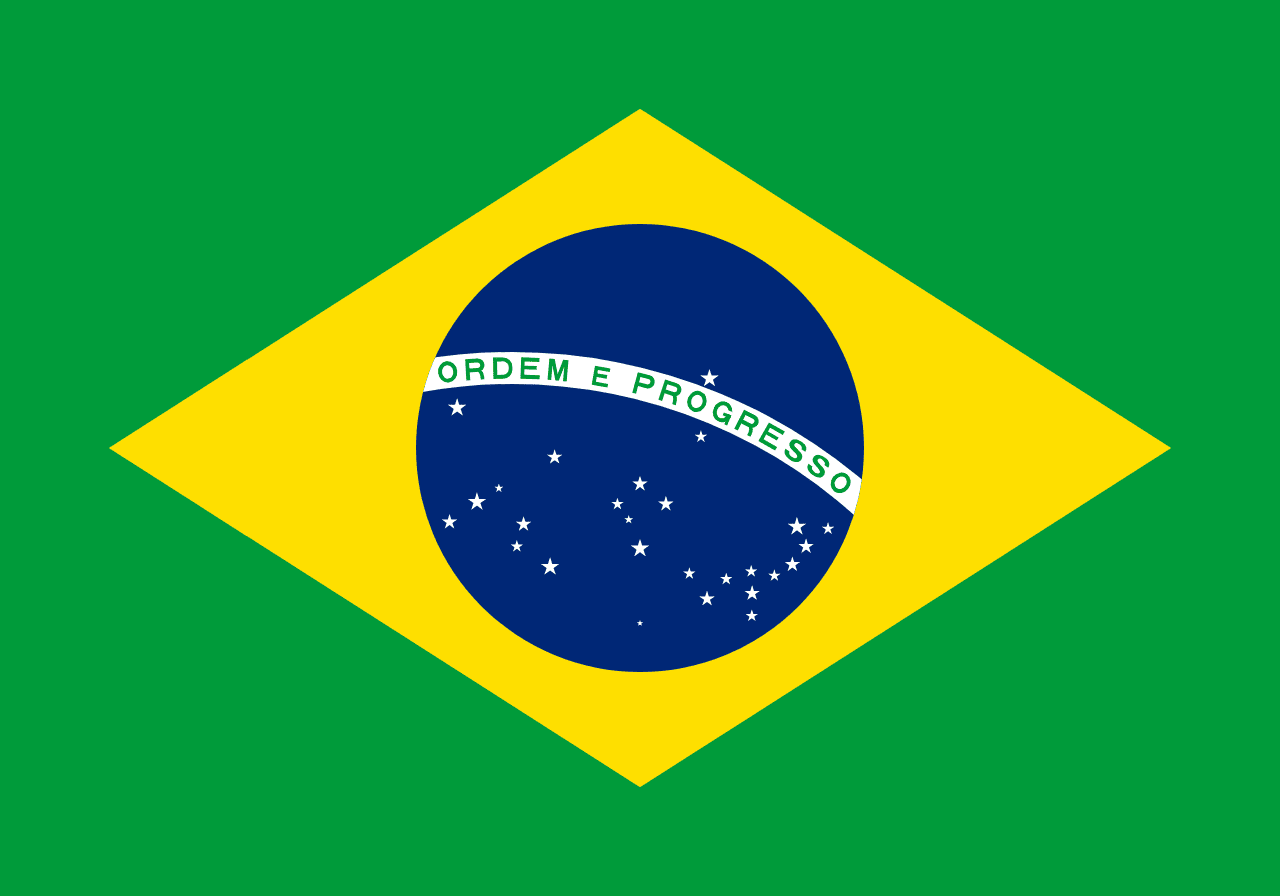
Few flags in the world ask you to look up at the night sky, but Brazil's does exactly that. Beneath its bold green field and golden diamond sits a dark blue globe scattered with white stars, frozen in the precise arrangement they held over Rio de Janeiro early on the morning of November 15, 1889. That single design choice makes the Brazilian flag one of the most distinctive on Earth: it is less a banner than a snapshot of a moment, an astronomical portrait of the instant a monarchy gave way to a republic. Add the curving white motto Ordem e Progresso across the globe, and you have a flag that reads like a small philosophical statement stitched in cloth.
A Sky Captured in Cloth
The Brazilian flag follows a 7:10 ratio and is built in clear, confident layers. The background is a vivid green. Centered on it is a large yellow diamond, or lozenge, that fills much of the field without touching the edges. Inside that diamond sits a dark blue circle representing the celestial sphere, and across it sweeps a white band carrying the national motto in green letters. Twenty-seven white stars of varying sizes are scattered across the blue, both above and below the band, each one placed to match a real star or constellation as it appeared in the southern sky.
What looks at first like decorative sparkle is in fact carefully plotted astronomy. The stars are not arranged for visual balance alone; they reproduce the heavens over Rio de Janeiro at 8:30 in the morning on the day the republic was proclaimed. The famous constellation of the Southern Cross appears clearly, and every star corresponds to a Brazilian state or the Federal District according to its relative celestial position. Because the design treats the sky as seen from outside the celestial sphere, the constellations appear mirror-reversed from how a person on the ground would see them, a detail that delights astronomers and confuses casual observers.
What the Colors Stand For
The two dominant colors carry layered meaning, and that meaning has shifted over time. Green and yellow were inherited from the earlier imperial flag, where they had dynastic origins. Green is widely understood to have referenced the House of Braganza, the Portuguese royal family from which Brazil's emperors descended, while yellow nodded to the House of Habsburg through the empress. When the republic adopted the new flag, those royal associations faded and gave way to readings rooted in the land itself.
Today green is most often described as a tribute to Brazil's vast forests and lush vegetation, an apt symbol for a country that holds much of the Amazon. Yellow is read as the gold and mineral wealth that ran through Brazilian history from the colonial mining boom onward. The blue globe represents the sky over Rio de Janeiro, and the white of the stars and band lends clarity and a sense of peace. Together the palette manages to be both a continuation of the imperial past and a fresh declaration of national identity.
From Empire to Republic
The flag was adopted on November 19, 1889, just four days after Brazil became a republic and the emperor was deposed. The speed mattered: the new government wanted a symbol that signaled change without erasing continuity. So the designers deliberately kept the green and yellow that Brazilians already recognized, while replacing the imperial coat of arms and crown at the center with the starry celestial globe of the new order.
The design is credited to Raimundo Teixeira Mendes and Miguel Lemos, leaders of Brazil's positivist movement, with technical astronomical assistance from Manuel Pereira Reis. Their intellectual fingerprints are everywhere. Rather than a generic emblem, they chose to encode an actual moment in time and a real configuration of the heavens, turning the flag into a kind of scientific monument. As Brazil's political map evolved, the flag kept pace: stars were added as new states came into being, with the most recent update arriving in 1992 to bring the count to its current 27.
How It Compares to Look-Alikes
At a glance, Brazil's green-and-yellow scheme can call to mind other flags, and the most direct historical link is to Portugal, the colonial power whose influence shaped so much of Brazilian culture. Yet the visual comparison only goes so far. Portugal's modern flag uses green and red rather than green and gold, so the resemblance is more about shared heritage than shared design.
The detail that truly sets Brazil apart from every other national flag is the astronomical globe. Plenty of flags feature stars, and several use a single star or a tidy constellation, but Brazil is the only country whose flag presents a literal map of the night sky at a specific date and time. Where other star-bearing flags arrange their points symmetrically or in neat circles, Brazil scatters its stars according to genuine celestial coordinates. That scientific accuracy, paired with the written motto, gives the flag a personality no look-alike can replicate.
A Banner of Football and Carnival
Beyond government buildings, the Brazilian flag lives a vivid second life in popular culture. It is one of the most instantly recognized flags anywhere, and much of that fame comes from sport. Brazilian football supporters carry it into stadiums across the world, draping themselves in green and yellow and waving it through victories and heartbreaks alike. The national teams wear its colors, and for many fans the flag and the beautiful game feel inseparable.
It is equally at home during Carnival, where green, yellow, and blue spill across costumes, floats, and crowds. The motto Ordem e Progresso, drawn from the positivist philosophy of Auguste Comte, reminds Brazilians of the ideals the young republic embraced, even as the flag itself has become a warm, almost joyful emblem of belonging. For travelers wanting the fuller picture of the nation behind the banner, the brazil country guide offers a deeper look at its regions, history, and culture.
Flag Facts Worth Knowing
- The stars depict the sky exactly as it looked over Rio de Janeiro at 8:30 AM on November 15, 1889.
- Brazil is the only country whose flag features a true astronomical representation of the heavens.
- New stars have been added over the years as new states were created, most recently in 1992.
- The motto Ordem e Progresso is inspired by the positivist thinking of Auguste Comte.
- Because there is no official "up" position for the star pattern, the flag is not designed to be flown upside down.
- Each of the 27 stars corresponds to a specific state or the Federal District based on its position in the sky.
Frequently Asked Questions
When was the Brazilian flag adopted?
The current flag was adopted on November 19, 1889, only four days after Brazil became a republic. While its general appearance has stayed the same, the number of stars has been updated over time as new states were created, with the latest change in 1992.
What do the colors of the Brazilian flag mean?
Green and yellow were inherited from the imperial flag, originally linked to the royal houses of Braganza and Habsburg. Today green is associated with Brazil's forests and yellow with its gold and mineral wealth. The blue globe represents the sky over Rio de Janeiro, and the white stars and band stand for the states and the national motto.
Who designed the Brazilian flag?
The flag was designed by Raimundo Teixeira Mendes and Miguel Lemos, both prominent figures in Brazil's positivist movement, with technical assistance from the astronomer Manuel Pereira Reis. Their positivist outlook is reflected in the motto Ordem e Progresso, meaning "Order and Progress."
What continent is Brazil on, and how does its flag compare to others?
Brazil is located in South America. Its flag shares a green-and-yellow palette that echoes its Portuguese colonial heritage, but its defining feature is unique: a starry celestial globe mapping the real night sky. Unlike other star-bearing flags that arrange stars symmetrically, Brazil places its stars by genuine astronomical position, making the flag truly one of a kind.