
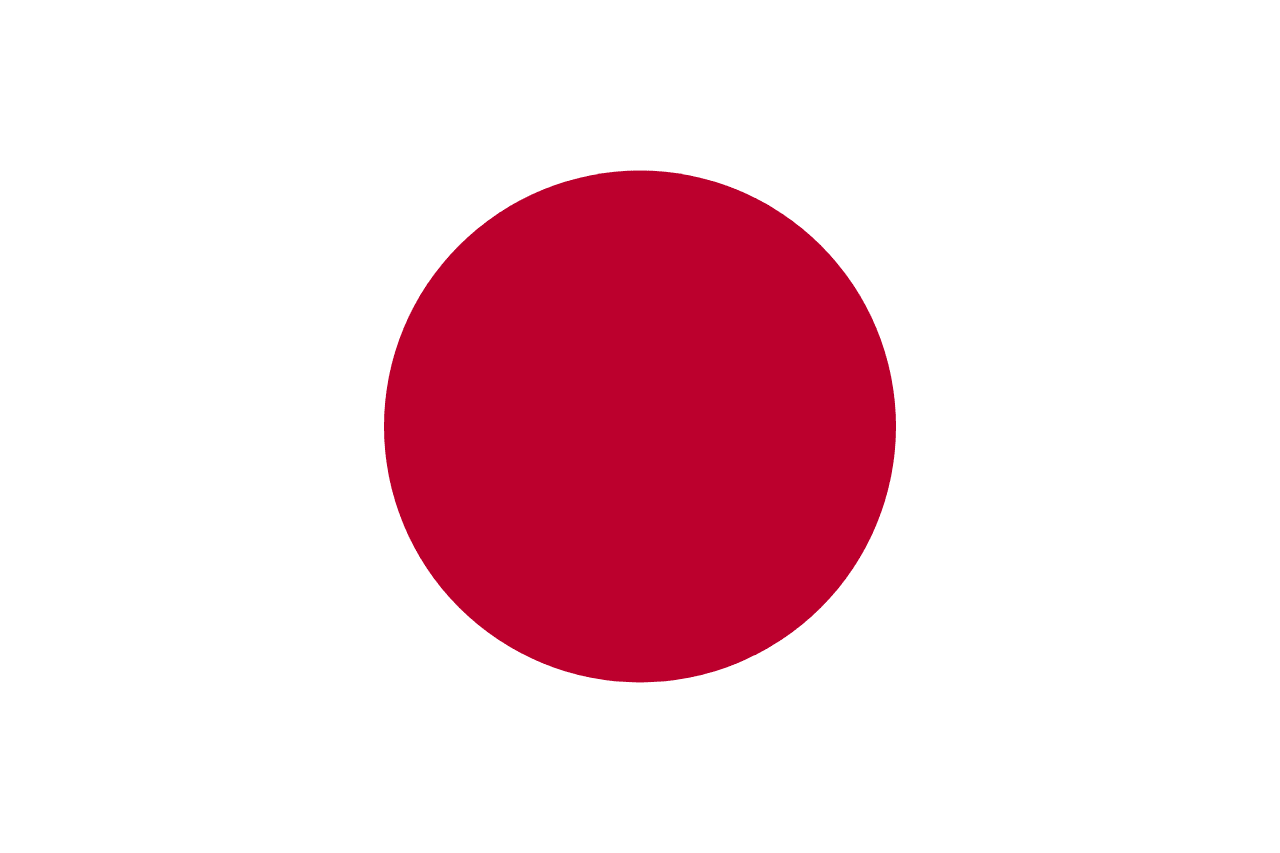
Few national flags are as instantly recognizable as Japan's. A single crimson disc, centered on a clean white field, with nothing else competing for attention. There are no stripes, no stars, no heraldic beasts, and no scattered emblems. This bold minimalism is exactly what makes the flag so powerful, and it carries a meaning that reaches straight to the heart of how Japan sees itself. Known as the Hinomaru, literally "circle of the sun," the design distills an entire national story into one shape and two colors. In this article we will look at what those colors mean, how the flag is built, where it came from, how it stacks up against its look-alikes, and the role it plays in Japanese life today.
A Study in Two Colors
The Japanese flag uses only white and red, and both pull their weight. The white field surrounding the disc traditionally evokes honesty, purity, and integrity, qualities long prized in Japanese culture. White also functions as a calm, neutral canvas that lets the central element speak without distraction.
The red disc is the star of the show. It represents the sun, tying directly to Japan's own name. The Japanese word Nippon (or Nihon) means "origin of the sun," which is why the country is so often called the "Land of the Rising Sun." The red is not a casual choice of paint either. Official specifications call for a deep crimson shade, formally defined in the Munsell color system as 2.5R 4/12, chosen to convey vitality and sincerity. That precise crimson, rather than a brighter or more orange red, gives the flag its grounded, dignified character.
The Geometry of the Hinomaru
For a design this simple, the rules are surprisingly exact. The flag uses a 2:3 ratio, meaning it is one and a half times as wide as it is tall. The sun disc sits at the precise geometric center of the field, and its diameter measures three-fifths of the flag's height. That careful proportion is what keeps the disc looking confident and balanced rather than too small and lonely or too large and overbearing.
Because the disc is centered both horizontally and vertically, the flag looks identical whether you view it normally or flip it left to right. This perfect symmetry reinforces the sense of stability and order that the design conveys, and it makes the Hinomaru one of the easiest flags in the world to reproduce accurately, from a child's drawing to a stadium-sized banner.
Centuries of the Sun
The sun has stood for Japan for an extraordinarily long time. In Japanese mythology the sun goddess Amaterasu is a central figure, and the imperial line was traditionally said to descend from her. A sun symbol therefore connects the nation to its oldest stories. The Hinomaru motif itself appears on war fans and banners used by samurai clans from at least the 12th century, long before it had any official status.
The modern history of the flag begins in earnest with the Meiji Restoration of 1868, when a rapidly modernizing Japan needed a clear emblem to fly on ships and represent the nation abroad. From that point the Hinomaru served as the de facto national flag. Curiously, though, it was not formally enshrined in law until much later. The flag became Japan's official national flag only on August 13, 1999, when the Law Regarding the National Flag and National Anthem was passed. So while the design is ancient, its legal status as the national flag is younger than many people assume.
Telling It Apart From Its Cousins
A red circle on a plain background is such a clean idea that a few other flags use the same concept, which sometimes leads to confusion. The most frequently cited comparison is Bangladesh, whose flag features a red disc on a green field. There the green represents the lush landscape and the red recalls the sacrifices of independence, and the disc is set slightly toward the hoist so it appears centered when the flag flutters. The difference is obvious once you note the background: Japan's is white, Bangladesh's is green.
The Pacific island nation of Palau also uses a disc on a solid field, but its circle is golden yellow on a sky-blue background and represents the moon rather than the sun. So although these three flags share a "disc on a field" family resemblance, the colors and the meaning behind each set them clearly apart. Within Japan's own history there are related designs too, such as the rising sun flag with radiating rays once flown by the Imperial Japanese Navy and still used today by the Japan Maritime Self-Defense Force, which is distinct from the plain civil Hinomaru.
A Symbol Woven Into Identity
The Hinomaru is deeply bound up with Japanese identity, and that relationship is not entirely simple. Because the flag flew during the era of Imperial Japan and the Second World War, it carries difficult associations for some people both inside and outside the country, and debates over its display have occasionally surfaced in schools and public life. The 1999 law that formalized the flag emerged partly from these very discussions. At the same time, for most citizens today the flag is a straightforward emblem of home, shared history, and belonging. If you want to understand more about the country behind the banner, the japan country guide is a good place to start.
The Flag in Everyday Modern Life
You will see the Hinomaru raised on government buildings and public institutions during national holidays, and it features prominently around celebrations such as the New Year, one of the most important times in the Japanese calendar. It is also a fixture of international sport. During the Olympics and the football World Cup, fans wave the rising-sun disc and paint it on their faces, and athletes drape it over their shoulders on the medal podium. Beyond official use, the rising-sun motif has seeped into commercial life as well, with many Japanese companies echoing the circular sun in their logos and branding. The shape is so embedded in the visual culture that it reads as "Japan" almost instantly, wherever it appears.
Quick Facts Worth Knowing
- The flag's formal name is the Nisshōki, meaning "sun-mark flag," though everyday speakers usually call it the Hinomaru, the "circle of the sun."
- It is widely regarded as one of the simplest and most recognizable national flags on Earth.
- Despite roots stretching back centuries, it was officially adopted only in 1999.
- A slightly off-center variant of the disc has historically appeared in certain military uses.
- The crimson red is precisely specified, helping ensure the flag looks consistent everywhere it is produced.
- Japan sits in Asia, an archipelago off the eastern edge of the continent.
Frequently Asked Questions
When was the flag of Japan officially adopted?
Although the Hinomaru had served as Japan's de facto flag since the Meiji Restoration of 1868, it was only formally adopted as the official national flag on August 13, 1999, through the Law Regarding the National Flag and National Anthem.
What do the colors of the Japanese flag mean?
The white field represents honesty, purity, and integrity, while the central red disc represents the sun. The sun reflects Japan's name, Nippon, meaning "origin of the sun," and its identity as the Land of the Rising Sun. The red specifically symbolizes vitality and sincerity.
What continent is Japan on?
Japan is located in Asia. It is an island nation, an archipelago lying off the eastern coast of the Asian mainland in the Pacific Ocean.
How is Japan's flag different from the flags of Bangladesh and Palau?
All three use a disc on a solid field, but the details differ. Japan places a red sun on white, Bangladesh sets a red disc on a green field with the circle shifted toward the hoist, and Palau uses a yellow moon on a blue field. The background colors and the symbolism of each disc make them easy to tell apart.