
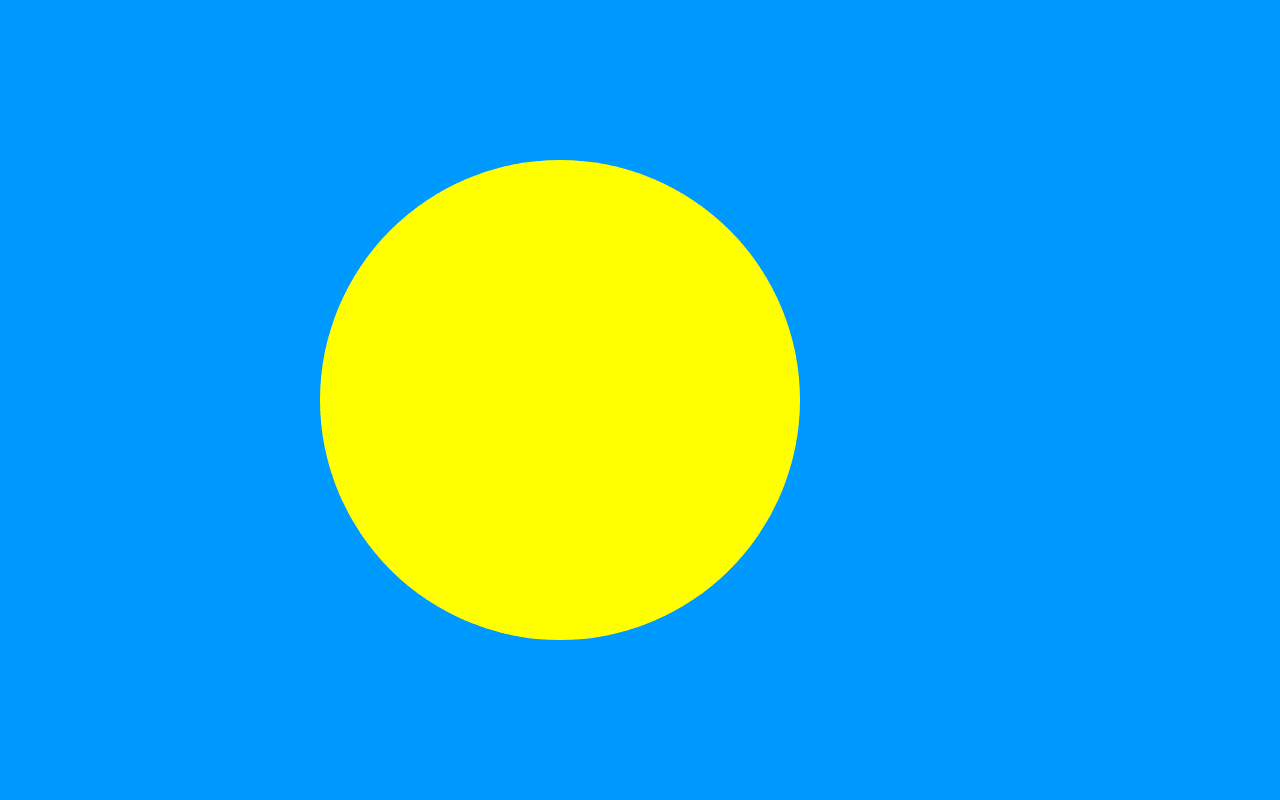
Few national flags manage to say so much with so little. The flag of Palau is a study in deliberate simplicity: a single golden disc resting on a calm sea of light blue. There are no stripes, no stars, no crests or coats of arms, just two shapes and two colors. Yet that minimalism is precisely what makes it memorable. For a young Pacific nation that adopted its banner in 1981, on the cusp of self-governance, the design captures an entire worldview, the open ocean and the full moon, in a form clear enough to recognize from across a stadium and rich enough to reward a second look.
A Flag Built From Two Elements
At its core, the Palauan flag consists of just two components. The background is a field of light blue, and centered upon it sits a large yellow disc. That is the entire composition. The restraint is intentional. Where many flags crowd their canvas with emblems and devices, Palau's designers stripped every extra decoration away and trusted the public to read meaning into pure color and shape. The result feels less like a heraldic badge and more like a glimpse of the sky over the Pacific at the precise moment a full moon hangs above the water.
This kind of design, a solid field carrying a single circular charge, places Palau in a small and distinctive club of flags worldwide. It also makes the banner instantly legible at any size, whether printed on a passport, stitched onto an athlete's jacket, or flown above a government building in the capital.
What the Colors Actually Mean
The two colors of the Palauan flag carry layered meaning. The light blue field represents the Pacific Ocean that surrounds the islands and sustains the nation, and it also stands for Palau's transition toward self-governance, a hopeful blue marking the country's emergence as a self-determining people. The blue is gentler than the navy seen on many maritime flags, a softer tone that evokes calm tropical waters rather than the deep open sea.
The yellow disc represents the full moon. In Palauan tradition, the full moon is regarded as the most favorable time for human activity. It is the season for harvesting, for fishing, for planting, for celebrations, and for ceremonies. Locals hold that the moon at its fullest brings out a sense of warmth, peace, love, and unity among the people. So the golden circle is not merely a celestial decoration; it is a cultural timekeeper, a symbol of the rhythms that have organized island life for generations.
Why the Moon Sits Slightly Off-Center
One of the most charming details of the Palauan flag is easy to miss at a glance. The yellow disc is not placed dead-center on the field. Instead, it is shifted very slightly toward the hoist, the edge nearest the flagpole. This subtle offset is a design choice, not an accident, and it serves a practical purpose: when the flag flies and ripples in the wind, the disc appears visually centered to an observer rather than drifting toward the fly end.
This places Palau in interesting company. The flag of Bangladesh uses the same trick, nudging its red circle toward the hoist so it looks balanced when the banner is in motion. The two flags share this elegant solution to an old problem of vexillology, even though the nations sit oceans and cultures apart. It is a small reminder that good flag design often solves the same physical puzzles in similar ways.
Adoption and the Road to Independence
The flag was adopted in 1981, during a pivotal chapter in Palau's modern history. For much of the twentieth century, the islands had been administered by outside powers, and by the late 1970s and early 1980s the territory was moving steadily toward greater autonomy. The flag emerged precisely in that period of transition, a visual declaration that the Palauan people were stepping into the management of their own affairs.
That timing is woven directly into the symbolism. The blue field's dual meaning, both the ocean and the transition to self-governance, makes the banner a kind of document of its moment. When Palauans raised this flag, they were not merely choosing attractive colors; they were marking a turning point. The design has remained unchanged since, accompanying the country through its later steps toward full sovereignty and serving as a steady emblem across decades of nation-building. For travelers curious about the wider story of these islands, the palau country guide offers a fuller picture of the archipelago and its people.
How It Compares to Other Disc Flags
Palau's flag invites comparison with the world's other famous single-disc designs, and the contrasts are revealing. Japan's flag, the Hinomaru, sets a red circle on a white field and is read as the rising sun. Bangladesh's flag places a red disc on a green field, with the off-center placement Palau shares. Palau alone pairs a soft blue field with a golden disc and asks viewers to see not the sun but the moon.
That distinction matters. Most circular-charge flags in the world reference the sun, the dominant celestial body in flag symbolism. By choosing the full moon instead, Palau set itself apart and rooted its identity in a specifically Pacific reading of the night sky. The color choices reinforce the difference: the warm yellow against cool blue produces a luminous, twilight effect that no sun-based flag quite replicates. So while Palau belongs to the broad family of disc flags, it is unmistakable within that family.
The Flag in National Life
Today the flag is a constant presence in Palauan public life. It flies over government offices, appears at official ceremonies, and identifies Palau on the international stage, from diplomatic functions to the marching of the national delegation at multi-sport events. For a country of relatively small population scattered across many islands, the flag functions as a unifying shorthand, a single image that gathers the whole nation under one symbol.
Its clean design also makes it a natural fit for the modern world of logos, jerseys, and digital icons, where complicated coats of arms tend to dissolve into illegible smudges at small sizes. The blue field and golden moon survive any reduction, which keeps the flag vivid wherever Palauans choose to display their identity.
Quick Facts Worth Knowing
- The flag was adopted in 1981, during Palau's transition toward self-governance.
- It uses only two colors: light blue and yellow.
- The yellow disc represents the full moon, traditionally the most auspicious time for fishing, harvesting, and celebration.
- The blue field stands for both the Pacific Ocean and the country's move to self-rule.
- The disc is deliberately set slightly off-center toward the hoist, so it looks balanced when the flag waves, exactly as on the flag of Bangladesh.
- Palau lies in the western Pacific Ocean and is part of Oceania.
Frequently Asked Questions
When was the flag of Palau adopted?
Palau adopted its national flag in 1981, during the period when the islands were transitioning toward self-governance. The design has remained unchanged since then, making it a stable emblem of the modern nation.
What do the colors of the Palauan flag mean?
The light blue field represents the Pacific Ocean surrounding the islands as well as Palau's transition to self-governance. The yellow disc represents the full moon, which in Palauan tradition is the most favorable time for activities like fishing, harvesting, and celebration, and a symbol of peace and unity.
Why is the moon on the Palau flag not in the center?
The yellow disc is placed slightly toward the hoist side rather than the exact center. This intentional offset makes the disc appear centered when the flag is flying and rippling in the wind. The flag of Bangladesh uses the same design technique for the same reason.
What continent is Palau on, and which flags is it similar to?
Palau is located in the western Pacific Ocean and belongs to the region of Oceania. Its flag resembles other single-disc designs such as those of Japan and Bangladesh, but it is distinguished by its soft blue field and golden moon, representing the moon rather than the sun.
