
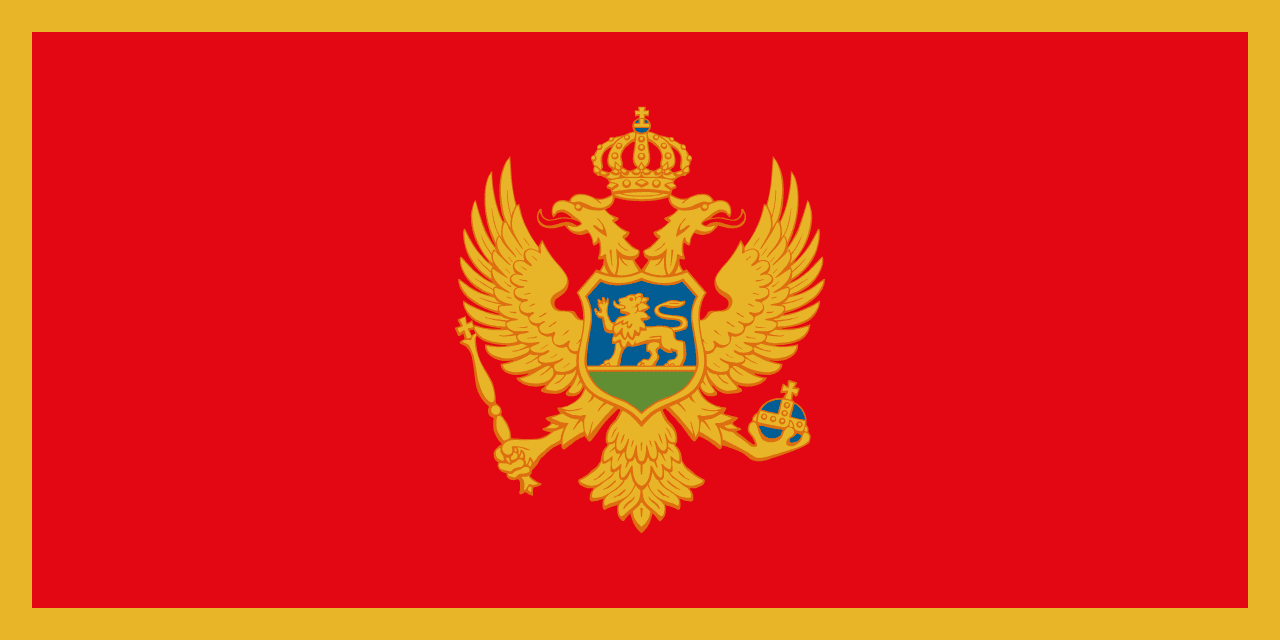
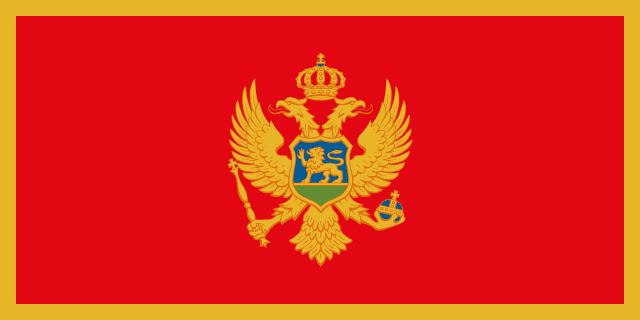
Among the flags of Europe, few make a first impression quite like Montenegro's. Where many neighbors favor simple horizontal stripes, Montenegro went the other way: a deep red field framed by a luminous gold border, with an ornate double-headed eagle and a striding lion planted firmly in the center. It looks less like a modern banner and more like a royal standard carried into a coronation, and that impression is no accident. Adopted in 2004, the flag deliberately reaches back to the kingdom of King Nicholas I to express a young state's old identity. This article unpacks what those colors and symbols mean, how the design came together, and why it stands out among the flags of the world.
A Banner of Red and Gold
The Montenegrin flag uses just two colors, but it uses them with unusual confidence. The dominant element is a rich red field, the kind of warm, saturated crimson that signals strength, bravery, and the blood spilled in centuries of struggle for independence. Around that field runs a band of gold, and gold appears again in the central emblem. In Montenegrin symbolism, the gold carries connotations of wealth, dignity, and the prestige of statehood, lending the whole design a deliberately regal air.
This pairing of red and gold is far from arbitrary. Red has long been associated with Montenegrin courage and sacrifice, a recurring theme in a nation whose history is bound up with resistance against larger empires. Gold elevates that message, turning a martial color scheme into something ceremonial and proud. The two together read as a single statement: a small country that insists on being seen as the equal of any kingdom.
Reading the Design Element by Element
Structurally, the flag is built from three layers. First comes the red field that fills the rectangle. Second is the gold border framing all four edges, a feature that immediately distinguishes Montenegro from almost every other national flag. Third, and most striking, is the coat of arms resting at the center.
That central emblem is dense with meaning. At its heart sits a double-headed eagle rendered in gold, its two heads facing outward and its wings spread wide. The eagle is crowned and holds the traditional symbols of authority, a scepter and an orb, signaling sovereignty over both church and state in the older royal tradition. Across the eagle's breast sits a shield bearing a golden lion, shown striding on a green field. Together the eagle and the lion are read as representations of the state itself, projecting power, vigilance, and continuity. The careful symmetry of the design, the framed field, the centered arms, the mirrored eagle heads, gives the flag a balanced, almost heraldic poise.
From Royal Standard to National Flag
Montenegro's modern flag did not emerge from a blank page. Its direct ancestor is the royal standard associated with King Nicholas I, the long-reigning monarch who guided Montenegro through the late nineteenth and early twentieth centuries and presided over its recognition as a fully independent kingdom. The double-headed eagle and the lion shield trace back to that era's royal heraldry, themselves rooted in much older traditions of Montenegrin and broader Balkan symbolism.
Through the twentieth century, Montenegro's political situation shifted repeatedly, as it was folded into the Kingdom of Yugoslavia, then socialist Yugoslavia, and later a state union with Serbia. During those decades it flew flags tied to those larger entities rather than its own historic emblem. The decisive change came in 2004, when Montenegro, then still in union with Serbia, formally adopted the red-and-gold flag with the royal coat of arms. When the country voted for full independence in 2006, the flag was already in place, ready to represent the new sovereign state. In that sense the 2004 adoption was a quiet but powerful act of national self-definition, reconnecting Montenegro to its royal past before it had even finished separating from its more recent one. Readers who want the broader national picture can explore our montenegro country guide.
How It Compares to Related Flags
Place Montenegro's flag beside its neighbors and the contrasts are immediate. Serbia, Croatia, Slovenia, and others in the region favor horizontal tricolors, often in variations of red, blue, and white, frequently with a coat of arms placed on stripes. Montenegro breaks that pattern entirely with its bordered, single-field layout.
The double-headed eagle does invite comparison with other flags and emblems that use the same motif, including Albania, whose flag features a black double-headed eagle on red, as well as the heraldry of Serbia and several historical empires. Yet Montenegro's treatment is distinct: its eagle is gold rather than black, it is crowned and holds royal regalia, and it sits within a fuller coat of arms that includes the lion shield. The most unmistakable distinguishing feature, however, is the gold frame. Many flags carry rich emblems, but the continuous golden border around the entire field is something Montenegro can claim almost as a signature. It is the detail that lets even a casual observer pick this flag out of a lineup.
National Identity Woven in Gold
For Montenegrins, the flag is more than decoration; it is a compact argument about who they are. By resurrecting the imagery of King Nicholas I's standard, the design asserts that Montenegrin statehood is not a product of the 2006 referendum alone but the renewal of an older, hard-won independence. The eagle and lion speak to ideals of strength, watchfulness, and pride, while the regal palette insists on dignity.
This matters in a country that spent much of the modern era inside larger federations. The flag offered a visible way to reclaim a separate identity, distinct from Serbia and from the Yugoslav legacy, and to root that identity in a recognizably Montenegrin tradition rather than inventing something new. It is a flag that argues from history.
The Flag in Everyday Modern Life
Today the flag is woven into the rhythm of Montenegrin public life. It flies over government buildings in the capital, appears at official ceremonies, and is raised on national holidays such as Statehood Day and Independence Day, occasions that celebrate exactly the sovereignty the flag was designed to embody. It accompanies Montenegrin athletes at international competitions, where the red-and-gold and the central eagle make the team instantly identifiable, a point of pride for a small nation that has produced strong water polo and other sporting traditions.
Beyond officialdom, the flag turns up at cultural festivals, in tourism imagery promoting the country's dramatic Adriatic coast and mountains, and in the everyday displays of citizens marking national moments. Its bold, heraldic look photographs well and travels well, which has helped make it a recognizable shorthand for Montenegro abroad.
Quick Facts at a Glance
- Adopted: 2004, ahead of full independence in 2006.
- Colors: Red field with gold border and gold emblem.
- Central emblem: A crowned golden double-headed eagle with a lion shield on its breast.
- Inspiration: The royal standard of King Nicholas I.
- Continent: Europe, on the Balkan Peninsula along the Adriatic Sea.
- Standout feature: Often described as the only national flag with a gold border running around its entire field.
Frequently Asked Questions
When was the flag of Montenegro adopted?
The flag was officially adopted in 2004, while Montenegro was still part of a state union with Serbia. When the country became fully independent following the 2006 referendum, this flag was already in use and simply continued as the banner of the new sovereign state.
What do the colors of the Montenegrin flag mean?
The flag uses red and gold. The red field is associated with bravery and the sacrifices made in Montenegro's long struggle for independence, while the gold border and golden emblem represent wealth, dignity, and the prestige of statehood, giving the flag a deliberately royal character.
Who designed the flag and where did it come from?
Rather than being invented from scratch, the flag was based on the royal standard of King Nicholas I, the monarch who led Montenegro to international recognition. Its double-headed eagle and lion shield are drawn from that historic royal heraldry, so the design is best understood as a revival of older Montenegrin symbolism.
What continent is Montenegro on, and how does its flag compare to similar ones?
Montenegro is in Europe, located on the Balkan Peninsula along the Adriatic coast. While its double-headed eagle echoes motifs seen on flags like Albania's and in Serbian heraldry, Montenegro's version is gold, crowned, and set within a full coat of arms. Its unmistakable gold border around the entire red field sets it apart from those look-alikes.
