

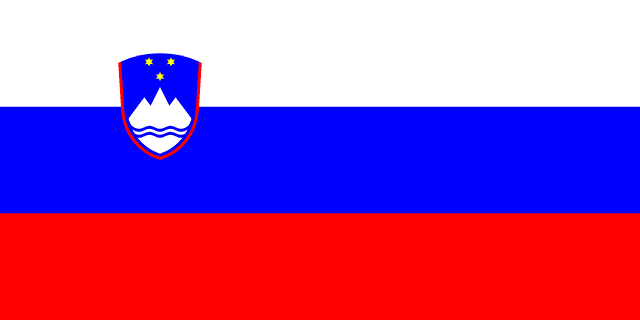
Few national flags pack a small country's geography, mythology, and political destiny into a single rectangle quite as neatly as Slovenia's. At first glance it is a calm horizontal tricolor of white, blue, and red. Linger a little longer, though, and you notice the small coat of arms riding high in the upper hoist, where a stylized mountain rises beneath three golden stars. That emblem turns an otherwise familiar Slavic banner into something unmistakably Slovenian, anchoring the flag to the nation's tallest peak and to a noble dynasty that vanished centuries ago. Adopted in 1991, the flag is younger than many of the people who wave it, yet it draws on symbols far older than the modern state.
A Tricolor Born From Independence
Slovenia raised this flag in 1991, the year it broke away from the disintegrating Socialist Federal Republic of Yugoslavia. For Slovenes, the moment was not just political housekeeping. It was the first time in modern history that the nation governed itself, and the flag needed to broadcast that fact instantly. The solution was elegant: keep the white-blue-red tricolor that Slovenes had flown in various forms for generations, but strip away the communist-era red star and replace it with a new national emblem. The result honored continuity and signaled a clean break at the same time. A flag people already recognized became, almost overnight, the banner of a sovereign country taking its place among the nations of Europe.
What the White, Blue, and Red Mean
The three horizontal bands are the Pan-Slavic colors, the white-blue-red combination shared across much of the Slavic world and historically traced to the Russian tricolor that inspired nineteenth-century Slavic national movements. For Slovenes, the colors carried a double meaning. They expressed solidarity with fellow Slavic peoples during an era when small nations were searching for collective identity under larger empires, and they offered a homegrown alternative to the imperial banners of Austria-Hungary, under which Slovene lands had long sat.
Rather than assigning each stripe a fixed literal meaning, Slovenia's tradition treats the trio as a unified statement of Slavic kinship and national belonging. That restraint is part of the flag's character: it lets the coat of arms carry the specific, local symbolism while the bands speak a broader regional language.
Reading the Coat of Arms
The detail that makes the flag distinctly Slovenian sits in the canton, the upper section nearest the flagpole. There the national coat of arms appears as a shield. Inside it, a stylized white peak with two slopes represents Mount Triglav, the country's highest mountain and a deeply held emblem of Slovene identity. Beneath the mountain, two wavy blue lines stand for the rivers and the Adriatic coastline that frame the small nation. Above the peak arc three golden, six-pointed stars.
Those stars are the flag's most charming historical Easter egg. They are borrowed from the heraldry of the Counts of Celje, the most powerful Slovene noble family of the late Middle Ages, whose own arms featured three gold stars. By lifting that motif into the modern emblem, the designers linked a brand-new state to a homegrown medieval dynasty rather than to any foreign crown, a quiet but pointed assertion of independent roots.
The Family of Slavic Tricolors
Slovenia's flag has plenty of cousins, and telling them apart is a favorite challenge for flag enthusiasts. Slovakia and Russia use the very same white-blue-red horizontal arrangement, and Serbia and Croatia rearrange the identical palette into different orders. Without their emblems, several of these flags would be nearly impossible to distinguish.
That is precisely why the coat of arms matters so much. Plain white-blue-red is Russia. The same stripes with a shield bearing a double-barred cross and mountains belong to Slovakia. Slovenia's marker is its mountain-and-stars shield set in the upper hoist. Slovakia places its emblem slightly toward the center, and the contents differ entirely: a Christian cross over hills versus Triglav beneath the Celje stars. For travelers trying to keep the region straight, the emblem is the reliable tell, and you can read more about the country itself in our slovenia country guide.
A Symbol Woven Into National Life
For a flag barely older than a single generation, this banner has settled deep into everyday Slovene culture. It flies over the parliament in Ljubljana, appears on official documents, and is hoisted on Statehood Day each June, which marks the 1991 declaration of independence, and on Independence and Unity Day in late December. The image of Triglav in particular resonates far beyond the flag. Slovenes have long said that every true Slovene should climb Triglav at least once in a lifetime, and the same triple-peaked silhouette that crowns the coat of arms appears on coins, postage, and countless tourism logos.
Because the colors are shared so widely, Slovenes tend to feel a strong attachment specifically to the emblem. It is the part of the flag that says us rather than merely Slavic, and proposals over the years to redesign or strengthen the flag's distinctiveness usually revolve around making that national shield even more prominent.
The Flag on the World Stage
In modern civic and sporting life the flag is everywhere Slovenia competes. At the Olympics, at World Cup qualifiers, and across the basketball and cycling events where the country punches well above its size, fans drape themselves in white, blue, and red and wave the mountain-crested banner. Slovenia joined the European Union in 2004, so its national flag now flies alongside the circle of EU stars at official buildings, a pairing that neatly captures the country's self-image as a small, outward-looking European nation. Whether on a podium, a ministry, or a mountain hut high on the slopes of Triglav itself, the flag reads at a glance as compact, confident, and rooted in place.
Quick Facts Worth Knowing
- Slovenia is located in Central Europe, bordering Italy, Austria, Hungary, and Croatia.
- The flag is a horizontal triband of white (top), blue (middle), and red (bottom).
- The national coat of arms sits in the upper hoist, overlapping the white and blue bands.
- The three golden stars come from the medieval Counts of Celje, not from any modern political party.
- Mount Triglav, depicted on the shield, is Slovenia's highest peak at 2,864 meters.
- The current design dates to 1991, the year of independence from Yugoslavia.
Frequently Asked Questions
When was the flag of Slovenia adopted?
The current flag was adopted in 1991, when Slovenia declared independence from Yugoslavia. The underlying white-blue-red tricolor had been used by Slovenes for generations, but the modern national coat of arms replaced the earlier communist-era star at independence.
What do the colors of the Slovenian flag mean?
White, blue, and red are the Pan-Slavic colors, shared by many Slavic nations and historically linked to the broader Slavic national movement. Rather than each stripe carrying a separate literal meaning, the combination expresses Slovenia's Slavic heritage and sense of national belonging, while the coat of arms supplies the specifically Slovenian symbolism.
What does the coat of arms on the flag represent?
The shield shows Mount Triglav, Slovenia's tallest and most beloved mountain, above two wavy blue lines that stand for its rivers and the Adriatic Sea. The three golden six-pointed stars above the peak are taken from the heraldry of the Counts of Celje, a powerful medieval Slovene noble family.
How is Slovenia's flag different from similar flags like Slovakia's or Russia's?
All three use a white-blue-red horizontal tricolor. Russia's flag has no emblem at all. Slovakia's flag carries a shield with a double-barred Christian cross over three hills, positioned toward the center. Slovenia's distinguishing feature is its upper-hoist shield depicting Mount Triglav beneath three gold stars, which sets it apart from every other flag in the family.