
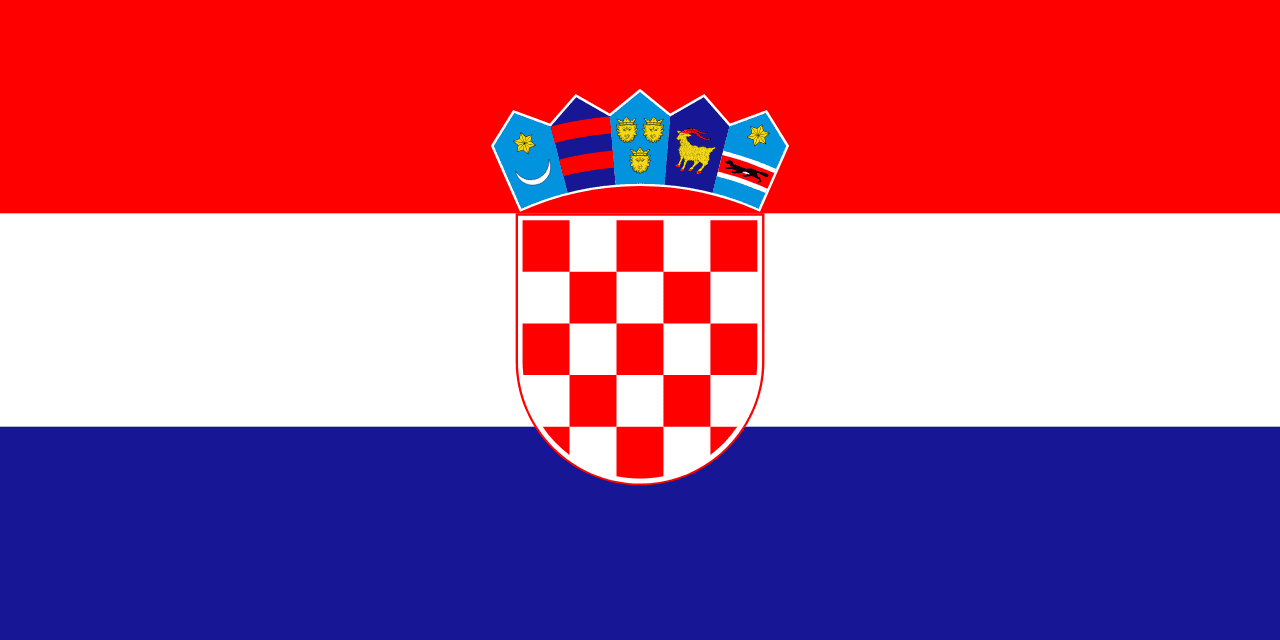
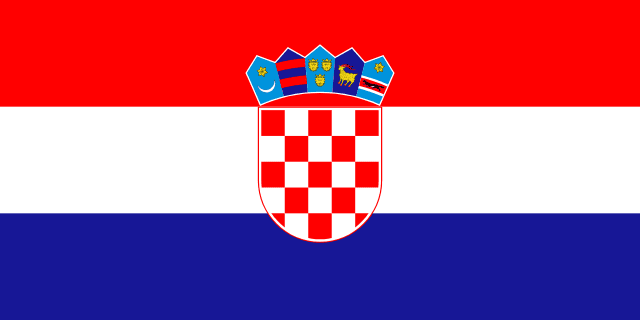
Few national emblems are as instantly recognizable as the bold red-and-white checkerboard that sits at the heart of Croatia's flag. Where many European tricolors rely on stripes alone, Croatia layers something distinctly its own onto a familiar Pan-Slavic palette: a grid of alternating red and silver squares topped by a crown of regional shields. The result is a banner that manages to feel both part of a wider Slavic family and unmistakably Croatian. Adopted in 1990 as the country emerged into independence, the flag tells a story of medieval heraldry, twentieth-century upheaval, and a people determined to fly a symbol that was theirs alone.
A Tricolor Born from a Slavic Tradition
At first glance, Croatia's flag follows a pattern familiar across much of Eastern and Central Europe: three equal horizontal bands of red, white, and blue running from top to bottom. These are the Pan-Slavic colors, a palette embraced by numerous Slavic nations during the national awakenings of the nineteenth century. Russia, Serbia, Slovakia, and Slovenia all draw on the same red-white-blue combination, a visual shorthand for shared linguistic and cultural roots stretching back centuries.
Yet Croatia refuses to be just another tricolor. Where its neighbors often leave the bands plain or add a simpler emblem, Croatia centers a detailed coat of arms across all three stripes. That single design choice transforms a generic Slavic banner into a national statement, and it is the reason no one is likely to confuse the Croatian flag with any other on the world stage.
The Šahovnica: A Checkerboard Like No Other
The undisputed star of the flag is the šahovnica, the red-and-white checkerboard shield that gives the banner its character. The word itself derives from the Croatian for chessboard, and the resemblance is no accident: thirteen red and twelve silver-white squares are arranged in a grid that looks ready for a game of chess. This checkered motif is one of the oldest national symbols in Europe, appearing in Croatian heraldry for centuries before the modern state existed.
Above the shield runs a crown of five smaller coats of arms, each representing a historic Croatian region. These include the emblems associated with the ancient Croatian kingdom, the Republic of Dubrovnik, Dalmatia, Istria, and Slavonia. Read together, this little arc of shields functions almost like a map of the country's territorial heritage, gathering its coastal, inland, and historic lands into a single crest. The arrangement was carefully chosen so the flag would speak not just for one region but for the whole of Croatia.
What the Colors Are Meant to Say
The symbolism of Croatia's flag works on two levels. The broad horizontal bands carry the collective meaning of the Pan-Slavic colors, signaling Croatia's place within the larger family of Slavic peoples and the ideals of freedom and national revival that those colors came to represent during the era of European nation-building.
The checkerboard, by contrast, is purely Croatian. The šahovnica has long been treated as the emblem of the Croatian nation itself, an identity marker that predates flags as we understand them today. While popular tradition has spun various tales about the red and white squares, what matters most is the role the pattern plays: it anchors the flag to a specific homeland and a specific history. Red, white, and blue may be shared, but the checkered shield belongs to Croatia and Croatia alone.
How the Flag Evolved Through Turbulent Times
Croatia's banner did not appear from nowhere in 1990. The red-white-blue tricolor traces its lineage to the nineteenth century, when Croatian national movements adopted the Pan-Slavic colors to express their aspirations within the larger empires that ruled the region. The checkerboard, far older still, had served as a heraldic symbol of the Croatian lands for centuries.
Through the twentieth century, the flag passed through many hands and many regimes. Croatia spent decades as part of Yugoslavia, during which the tricolor was retained but often modified with emblems reflecting the politics of the day, including a red star during the socialist era. When Croatia moved toward independence at the start of the 1990s, designers restored the historic checkerboard and added the crown of regional shields to create the modern coat of arms. This redesigned flag was adopted in 1990, just as the country broke away from Yugoslavia, making it a direct emblem of renewed sovereignty. For broader context on the nation's regions and heritage, see our croatia country guide.
Telling It Apart from Its Look-Alikes
Because so many Slavic nations share the red-white-blue scheme, the Croatian flag invites comparison with several others. Slovenia, Croatia's neighbor to the northwest, uses the same three colors in the same horizontal order and adds an emblem to the upper hoist; Slovakia and Russia likewise build on red, white, and blue. The Netherlands and Luxembourg use related palettes too, though they sit outside the Slavic tradition entirely.
So how do you spot Croatia at a glance? Look to the center. No other national flag carries the distinctive red-and-white checkerboard shield, and the crown of five regional coats of arms above it is unique as well. Where Slovenia tucks its emblem into the corner, Croatia plants its crest squarely in the middle, spanning all three bands. That bold central placement and the unmistakable chessboard grid make the flag impossible to mistake for any of its color cousins once you know what to look for.
The Flag in National Life Today
For Croatians, the flag is woven into both solemn and celebratory moments. It flies over government buildings, schools, and embassies, and appears at national holidays such as Statehood Day and Independence Day. The checkerboard in particular has taken on a life beyond the flag itself, splashed across the jerseys of the national football and water polo teams, where the red-and-white squares have become a globally familiar sight at tournaments. Fans paint the pattern on their faces and wave it in stadiums, turning a centuries-old heraldic device into a modern emblem of sporting pride.
In everyday civic use, the flag and its central crest serve as a unifying image for a country that gathers several distinct historic regions under one roof. Whether stitched onto a sports kit, raised at a state ceremony, or printed on souvenirs along the Adriatic coast, the šahovnica functions as visual shorthand for Croatian identity at home and abroad.
Quick Facts Worth Knowing
- The flag is a horizontal triband of red, white, and blue, the classic Pan-Slavic color set.
- The central coat of arms features the šahovnica, a checkerboard of thirteen red and twelve white squares.
- A crown of five smaller shields above the checkerboard represents historic Croatian regions, including Dalmatia, Istria, and Slavonia.
- The modern flag was adopted in 1990 as Croatia moved to independence from Yugoslavia.
- Croatia is located in Southeast Europe, along the Adriatic Sea.
- The checkerboard is one of the oldest national symbols in Europe and is widely used in Croatian sports.
Frequently Asked Questions
When was the Croatian flag adopted?
The current flag was adopted in 1990, at the time Croatia was breaking away from Yugoslavia and asserting its independence. Although the red-white-blue tricolor and the checkerboard emblem are both far older, this particular design with its restored coat of arms dates to that pivotal moment of renewed sovereignty.
What do the colors of the Croatian flag mean?
The red, white, and blue bands are the Pan-Slavic colors, shared with other Slavic nations to signal common heritage and the ideals of national freedom. The red-and-white checkerboard at the center is uniquely Croatian, representing the nation itself through a heraldic symbol used for centuries.
What is the checkerboard on the Croatian flag called?
It is called the šahovnica, a word derived from the Croatian term for a chessboard. The grid of alternating red and silver-white squares is the country's defining national emblem and appears not only on the flag but also on the uniforms of Croatian national sports teams.
What continent is Croatia on, and which flags look similar?
Croatia sits in Southeast Europe on the Adriatic coast. Its flag shares the red-white-blue palette with several other European tricolors, including those of Slovenia, Slovakia, and Russia. The decisive difference is the central checkerboard shield and the crown of regional coats of arms, which together make the Croatian flag unique.