

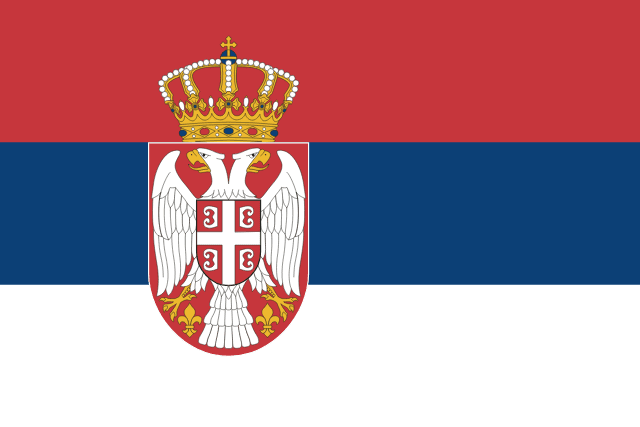
Few flags pack as much layered meaning into three simple stripes as the flag of Serbia. At first glance it looks like a familiar Eastern European tricolor, yet the moment your eye drifts toward the shield resting on its left side, the banner reveals a tangle of dynastic memory, Orthodox faith, and centuries of struggle for self-rule. It is a flag that wants to be read slowly, color by color and symbol by symbol, because every element was chosen to anchor a modern republic to a very old idea of what it means to be Serbian.
The version flying today over government buildings in Belgrade was standardized in 2010, but the visual language it speaks is far older. Understanding it means looking past the surface and into the colors, the heraldry, and the long road that brought this design to its current form.
A Tricolor Built From Three Colors
The Serbian flag is a horizontal triband of three equal stripes: red on top, blue in the middle, and white at the bottom. These are the classic Pan-Slavic colors, and their presence is no accident. Across the nineteenth and twentieth centuries, Slavic peoples reached repeatedly for this red-blue-white palette as a way of signaling kinship and shared destiny, and Serbia embraced it as wholeheartedly as any nation in the family.
The symbolism is deliberately collective rather than narrowly national. Rather than assigning each band a separate civic virtue, the Serbian tricolor reads as a single statement of Slavic unity — a declaration that Serbia belongs to a wider cultural and linguistic world. The colors were drawn from the Russian flag, whose red, blue, and white were widely admired and imitated by Slavic movements seeking inspiration from the largest Orthodox Slavic state. In that sense, the palette is an act of solidarity, a visual handshake extended across borders.
How the Stripes and Shield Fit Together
The construction of the flag is straightforward in its geometry but rich in its detail. Three horizontal bands of identical height divide the field, and centered over them — shifted slightly toward the hoist on the state version — sits the lesser coat of arms of Serbia. This emblem is what transforms a generic Slavic tricolor into something unmistakably Serbian.
The arms are dominated by a double-headed eagle, white and spread wide against a red shield, a heraldic device with deep roots in Byzantine and Orthodox tradition. On the eagle's breast rests a smaller red shield bearing a white cross flanked by four firesteels, the celebrated emblem often interpreted through the motto associated with Serbian endurance. A royal crown traditionally crests the composition, linking the modern republic to its medieval and monarchical heritage. The placement of so much dense symbolism over the calm horizontal stripes creates a satisfying visual tension: order beneath, intricacy above.
From Uprising Banners to a Standardized Republic
Serbia's tricolor did not appear fully formed. Its lineage stretches back to the early nineteenth century, when Serbs rose against Ottoman rule and began flying red-blue-white banners as symbols of an emerging national consciousness. As the Principality and later the Kingdom of Serbia took shape, the tricolor with its dynastic arms became the recognized standard of the state.
Through the turbulent twentieth century the design traveled a complicated path. The red-blue-white sequence endured through the Yugoslav era, though the emblems layered upon it shifted with each change of government — a red star during the socialist decades, then a return to historic heraldry as Yugoslavia dissolved. When Serbia re-emerged as a fully independent state following the breakup of the union with Montenegro, it needed a flag that reaffirmed continuity with its older identity. The modern standard, with its restored coat of arms, was adopted and then formally regulated in 2010, fixing the precise shades, proportions, and emblem placement that had previously varied. That standardization is why the Serbian flag you see today is so consistent across contexts.
Telling It Apart From Its Slavic Cousins
Because so many Slavic nations share the red-blue-white palette, the Serbian flag lives in crowded company, and confusion is easy if you ignore the details. The Russian flag, the flag's direct color ancestor, runs white-blue-red from top to bottom — essentially Serbia's stripe order inverted — and carries no emblem at all on its civil version. Slovakia and Slovenia also use the same three colors with their own shields, while the Czech Republic adds a blue triangle to the mix.
The single most reliable way to identify Serbia's banner is the coat of arms. No other red-blue-white tricolor carries that particular white double-headed eagle over a red shield with its cross and firesteels. The closest visual sibling is the flag of Slovakia, which also places a shield toward the hoist over a similar stripe arrangement — but Slovakia's emblem features a white double cross on blue mountains rather than an eagle, and its top stripe is white rather than red. Once you know to look for the eagle and the red-over-blue-over-white order, the Serbian flag becomes instantly recognizable. For more on the country behind the banner, our serbia country guide explores its geography and culture in depth.
A Banner Woven Into National Identity
For Serbs, the flag is inseparable from a sense of historical continuity. The double-headed eagle in particular carries enormous cultural weight, linking the contemporary state to the medieval Serbian kingdom and to the broader Orthodox Christian world that shaped Serbian identity over many centuries. To raise this flag is to claim that long inheritance.
That emotional charge means the flag appears far beyond official settings. It is wrapped around shoulders at cultural festivals, painted on faces, embroidered onto traditional costumes, and displayed in homes and diaspora communities scattered across the globe. The colors function as shorthand for belonging — a way for Serbs abroad to find one another and to keep a connection to home visible and alive.
The Flag in Everyday and Ceremonial Life
In modern Serbia the tricolor is woven through both solemn ritual and joyful celebration. It flies over the National Assembly, presidential residences, embassies, and schools, and it is hoisted with particular ceremony on national holidays such as Statehood Day, when Serbs commemorate the uprisings and constitutional milestones that built their state.
Sport is where the flag becomes loudest. Serbia's passionate following in basketball, water polo, volleyball, and football turns arenas into seas of red, blue, and white, and tennis crowds rallying behind their champions have made the banner familiar on courts worldwide. In these settings the eagle-crested shield is often simplified or waved on the plain civil tricolor, but the meaning is unmistakable: a small nation announcing itself with pride on the international stage.
Interesting Facts About the Serbian Flag
- The flag uses the Pan-Slavic colors of red, blue, and white, chosen to express kinship with the wider Slavic world.
- Its palette was drawn directly from the Russian flag, though the stripe order is reversed.
- The coat of arms features a striking two-headed white eagle, a symbol rooted in Byzantine and Orthodox tradition.
- The current standardized design and its precise specifications were fixed in 2010.
- A civil version of the flag exists without the elaborate emblem, while the state version carries the full coat of arms.
- Serbia sits in southeastern Europe, in the heart of the Balkan Peninsula.
Frequently Asked Questions
When was the current flag of Serbia adopted?
The modern flag was standardized in 2010, when Serbia formally regulated the exact shades, proportions, and placement of the coat of arms. The underlying red-blue-white tricolor, however, has served as a Serbian national symbol since the nineteenth century.
What do the colors of the Serbian flag mean?
The red, blue, and white are the Pan-Slavic colors, and together they represent Slavic unity rather than three separate ideas. They were adopted from the Russian flag as a gesture of kinship with the larger Slavic and Orthodox world.
What is the eagle on the Serbian flag?
The emblem is a white double-headed eagle set on a red shield, drawn from Byzantine and Orthodox heraldic tradition. On the eagle's breast sits a smaller shield with a cross and four firesteels, and the whole arms are typically crowned, tying the republic to its medieval heritage.
What continent is Serbia on, and how does its flag compare to similar ones?
Serbia is located in southeastern Europe, on the Balkan Peninsula. Its flag shares the red-blue-white palette with Russia, Slovakia, Slovenia, and others, but the unmistakable double-headed eagle on the coat of arms — combined with the red-over-blue-over-white stripe order — sets it apart from every look-alike.
