

At first glance the flag of the Czech Republic looks like a tidy little geometry lesson: a white stripe on top, a red stripe on the bottom, and a blue triangle wedged in from the pole. Yet that calm arrangement hides one of central Europe's more tangled stories. This is a banner that once flew over a country that no longer exists, that was supposed to be retired and never was, and that quietly carries the heraldic memory of two nations inside three colors. For something so simple to draw, it is surprisingly loaded with history.
A Quick Visual Inventory
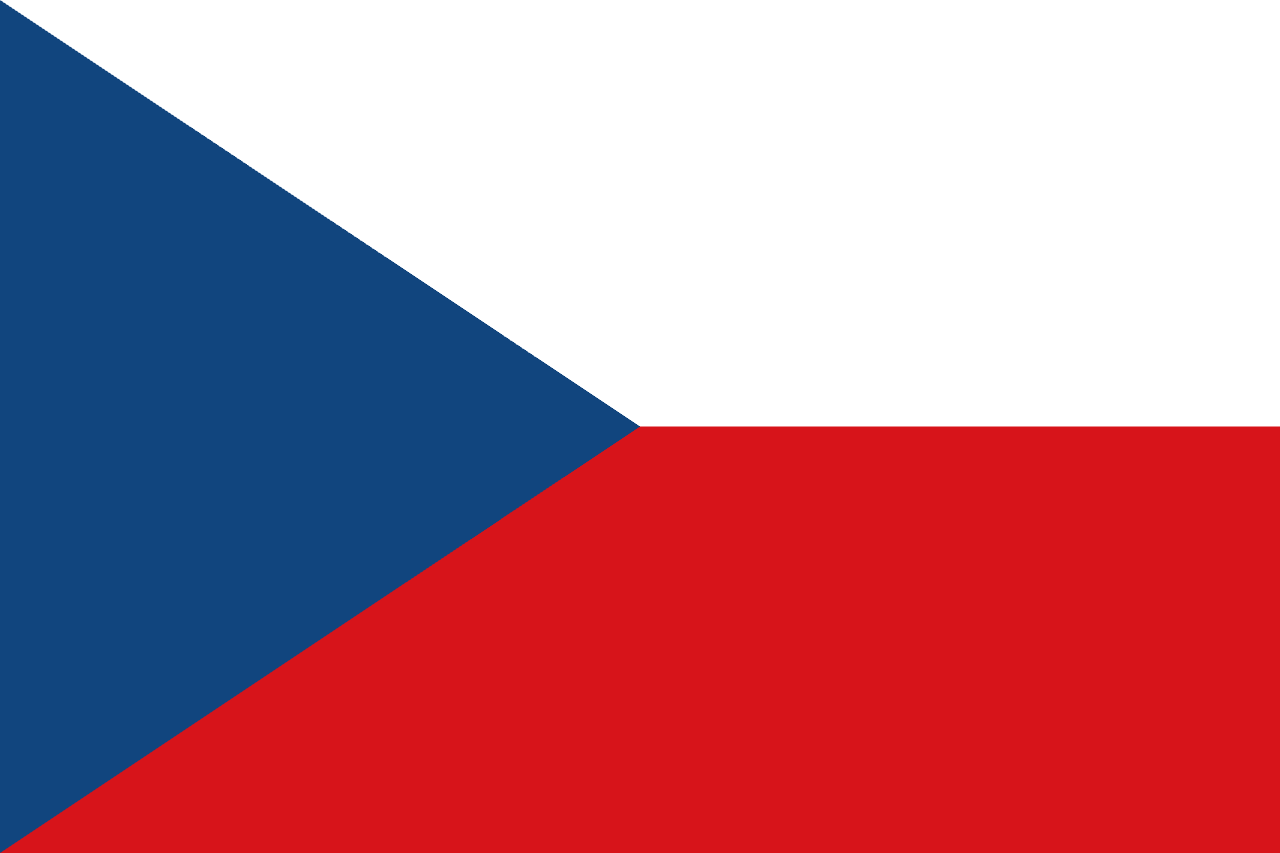
The Czech flag is a horizontal bicolor with a twist. Two equal horizontal bands run across the field, white above and red below. Layered over the hoist side, a blue isosceles triangle reaches inward, its point landing at the midline where the white and red meet. Because the triangle slices into both stripes, the design avoids feeling top-heavy or bottom-heavy; the eye is pulled toward that blue arrowhead, which gives the otherwise flat layout a sense of direction and motion.
The three colors, blue, white, and red, are the classic Pan-Slavic palette, the same trio that turns up across much of Slavic Europe. What sets the Czech version apart is not the colors themselves but the way they are arranged: the triangle is the signature move, and it is the reason you can pick this flag out of a crowded lineup of red-white-and-blue banners.
What the Colors Actually Stand For
The meaning of the Czech flag is easiest to understand by tracing where each color came from. The white and red are the ancient colors of Bohemia, drawn straight from the Bohemian coat of arms, which features a silver (white) lion on a red shield. Those two shades had represented the Czech lands for centuries before any modern flag existed.
The blue is the newcomer and the storyteller. It was added to represent Slovakia, the partner region with which the Czech lands were joined when a new state was formed in the early twentieth century. So the flag is, in a sense, a small diagram of a union: red and white for the Czech half, blue for the Slovak half. There is no official decree assigning lofty abstractions like "courage" or "purity" to each band in the way some countries do; the colors are read more honestly as heraldry and geography than as a list of virtues.
From Czechoslovakia to Today
This flag was adopted in 1920, but not for the country that flies it now. It was designed as the flag of Czechoslovakia, the state created after the First World War from Czech and Slovak lands. The very first Czechoslovak flag had been a plain white-over-red bicolor, but that was nearly identical to the flag of Poland, so the blue triangle was introduced to make it distinct and to fold Slovakia into the symbolism.
For most of the twentieth century this design represented Czechoslovakia through dramatic upheavals, from interwar independence to occupation, communist rule, and finally the peaceful revolution of 1989. Then, at the start of 1993, Czechoslovakia split into two countries in the so-called Velvet Divorce. Slovakia adopted its own flag, while the Czech Republic kept the old Czechoslovak banner essentially unchanged. The result is a flag that is simultaneously brand-new in its national role and decades old in its actual design.
The Promise That Was Quietly Broken
Here is the wrinkle that flag enthusiasts love. When Czechoslovakia divided, there was an agreement that neither successor state would simply keep the federal symbols, including the flag. Slovakia honored that and created a fresh design. The Czech Republic, however, held on to the old Czechoslovak tricolor with its blue triangle and never replaced it. In effect, the flag that was meant to disappear with the country instead outlived it and became the emblem of just one of its halves.
There is a faint irony baked into this. The blue triangle originally stood for Slovakia, the partner that left, yet the Czech Republic kept the blue all the same. Today the colors are simply read as the national colors of the Czech state, and the historical link to Slovakia lives on as a piece of trivia rather than a daily reminder. If you want more context on the country behind the banner, the czech republic country guide fills in the geography and culture.
Telling It Apart From Look-Alikes
Because blue, white, and red are so common, the Czech flag swims in a sea of relatives, and a few comparisons help pin down what makes it unique.
- The Philippines also uses a blue triangle at the hoist with horizontal bands, which leads to genuine confusion. The differences are clear once you look: the Philippine flag has blue and red horizontal bands (not white and red) plus a golden sun and stars inside the triangle, all of which the Czech flag lacks.
- Poland is essentially the white-over-red bicolor that the Czech flag started as, before the triangle was added precisely to avoid this clash.
- Russia, Slovakia, Slovenia and others share the same blue-white-red Pan-Slavic colors but arrange them as plain horizontal stripes with no triangle.
The takeaway is that the blue isosceles triangle reaching to the center is the Czech flag's fingerprint. Strip it away and you have Poland; add a sun and swap a stripe and you have the Philippines. That single wedge does all the distinguishing work.
The Flag in National Life
For Czechs, the flag is a steady presence rather than a contested one. It flies from government buildings, appears on national holidays, and waves enthusiastically at international sporting events, where Czech fans, especially around ice hockey and football, turn it into a wall of red, white, and blue. Because the design is clean and instantly recognizable, it also lends itself well to merchandise, lapel pins, and the kind of casual patriotism you see in everyday public life.
There is also a quiet sense of continuity in keeping the old Czechoslovak banner. For many people, retaining the flag through the country's transformation symbolized that the nation's identity did not start from scratch in 1993 but carried forward a long story. The flag became a thread linking the modern republic back to the founders of the original Czechoslovak state and to the medieval Bohemian colors beneath them.
Quick Facts Worth Remembering
- The design was adopted in 1920 for Czechoslovakia, not originally for the Czech Republic.
- White and red come from the historic Bohemian coat of arms; the blue triangle was added to represent Slovakia.
- The blue triangle was introduced largely to differentiate the flag from Poland's white-and-red.
- The Czech Republic is located in central Europe.
- After the 1993 split, the flag was supposed to change but was kept unchanged, making it one of vexillology's better-known broken promises.
- Its blue-white-red scheme places it firmly in the Pan-Slavic color family.
Frequently Asked Questions
When was the Czech flag adopted?
The design dates to 1920, when it was created for Czechoslovakia. When Czechoslovakia dissolved at the end of 1992, the newly independent Czech Republic continued using the same flag from 1993 onward, keeping the design without alteration.
What do the colors of the Czech flag mean?
The white and red are the traditional colors of Bohemia, taken from the Bohemian coat of arms with its white lion on a red field. The blue triangle was added to represent Slovakia, the partner region in the original Czechoslovak union. There is no official list of virtues attached to the colors; their meaning is heraldic and geographic.
Who designed the Czech flag and why the triangle?
The flag emerged from the search for a distinct Czechoslovak emblem in 1920. The first attempt, a plain white-over-red bicolor, looked too much like the flag of Poland, so a blue triangle at the hoist was introduced both to make the flag unmistakable and to incorporate Slovakia into the symbolism. Rather than crediting a single inventor, it is most accurate to describe it as the outcome of that official design process.
What continent is the Czech Republic on, and how does its flag compare to similar ones?
The Czech Republic sits in central Europe. Its flag shares the Pan-Slavic blue-white-red palette with countries like Russia, Slovenia, and Slovakia, but the hoist triangle distinguishes it. The closest visual cousin is actually the flag of the Philippines, which also uses a triangle, though it adds a sun, stars, and a blue band where the Czech flag stays plain.