
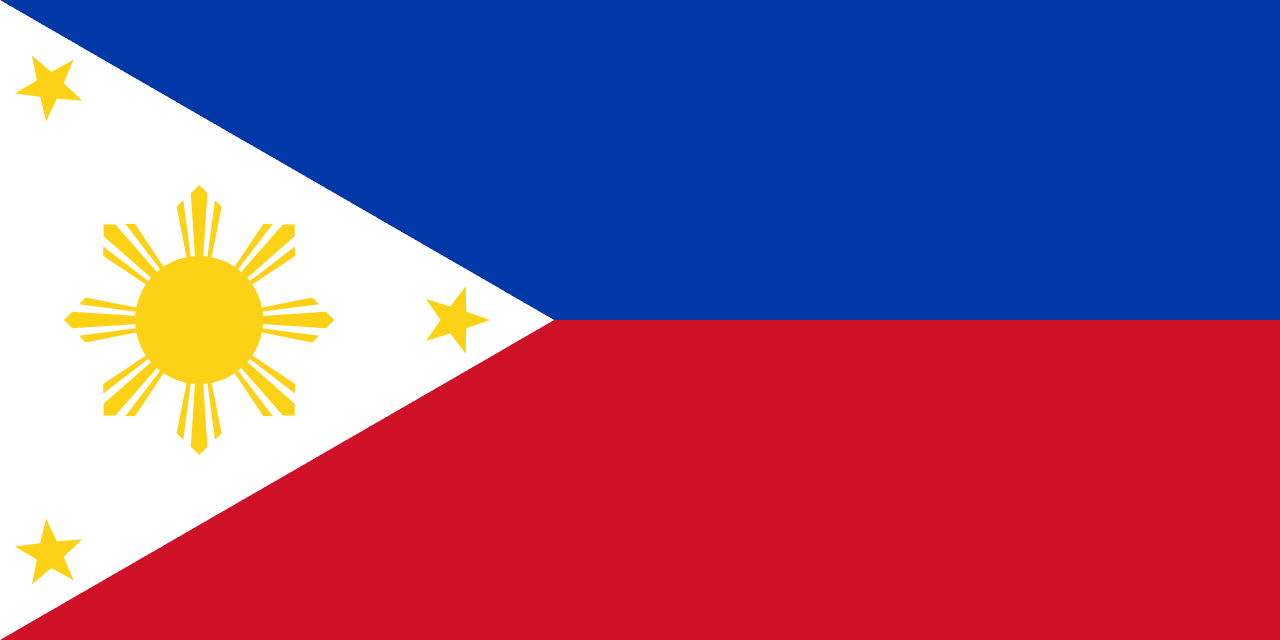
Few national flags carry instructions for how to fly them, but the flag of the Philippines does exactly that. Hoist it with the blue stripe on top and the country signals peace; hoist it with the red stripe on top and it announces a state of war. This single, dramatic rule makes the Philippine flag one of the most expressive banners in the world, a piece of cloth that speaks differently depending on the moment. Beyond that wartime quirk lies a carefully composed emblem of golden sun, scattered stars, and a white triangle, first unfurled in 1898 during the revolution that ended more than three centuries of colonial rule.
A Banner Born in Revolution
The Philippine flag made its debut in 1898, a year etched into national memory. It was first flown during the Philippine Revolution, the uprising against Spanish colonial authority that had simmered for decades before erupting into open struggle. Where many flags were designed in quiet committee rooms, this one was a battle standard, sewn and raised by people declaring their right to govern themselves.
That revolutionary origin shaped everything about the design. Each color, each star, and the very triangle that anchors the layout were chosen to tell the story of a people demanding liberty. The flag did not merely represent a finished nation; it represented an aspiration still being fought for, which is part of why its symbolism leans so heavily on words like patriotism, freedom, and sacrifice.
Reading the Colors
The Philippine flag works with a palette of four colors: blue, red, white, and yellow. Each one has been assigned a clear meaning that anyone in the country can recite.
- Blue stands for peace, truth, and the calm dignity a nation hopes to maintain among its neighbors.
- Red represents patriotism and the courage and sacrifice of those who fought for independence.
- White, the field of the triangle, signals equality and the purity of the cause.
- Yellow appears in the golden sun and stars, where the sun represents liberty and the dawn of freedom breaking over the islands.
The blue and red are not decorative accidents; they are read like a sentence. With blue uppermost, the flag is a statement of peacetime confidence. The deliberate inversion during conflict gives those two bands a civic function found in almost no other national flag.
The Geometry of the Design
Structurally, the Philippine flag is a horizontal bicolor: two equal bands, one blue and one red, stretching across the field. At the hoist side a white equilateral triangle cuts into those bands, and within that triangle sit the flag's signature emblems.
At the heart of the triangle blazes a golden sun with radiating rays, the symbol of liberty and the emergence of a free people. Tucked into each of the triangle's three corners is a five-pointed golden star. These three stars stand for the country's three principal geographic groupings, the major island regions that together make up the archipelago. The arrangement is balanced and unmistakable: the eye is drawn first to the white wedge, then to the sun at its center, then outward to the trio of stars.
This triangular device is one of the flag's most distinctive features. Triangles in flag design often nod to ideas of equality and fraternity, and here the white triangle frames the most meaningful symbols, giving them a stage rather than scattering them across the stripes.
Cousins and Look-Alikes Around the World
A flag built from red, white, and blue with a triangle at the hoist invites comparison, and the Philippine banner does share visual DNA with several others. The hoist triangle, in particular, recalls flags like those of Cuba, the Czech Republic, and a number of nations that use a wedge driving into horizontal bands. Cuba's flag, for instance, pairs a red triangle with a single white star, an arrangement that at a glance rhymes with the Philippine layout even though the colors and meanings diverge entirely.
What sets the Philippine flag apart is the combination of elements no other flag replicates: a white triangle rather than a colored one, a fully rayed golden sun rather than a lone star, and a constellation of three stars in the corners. Add the famous war-and-peace inversion of the blue and red bands, and the design becomes genuinely one of a kind. Where look-alikes share a silhouette, the Philippines fills that silhouette with a unique grammar of sun and stars. For travelers curious about the country behind the banner, the philippines country guide explores the islands in more depth.
A Symbol Woven Into National Identity
For Filipinos, the flag is inseparable from the idea of nationhood itself. Because it was raised in the act of declaring independence, it carries an emotional charge that goes beyond ordinary civic symbolism. The sun and stars appear on government seals, in classrooms, on uniforms, and in countless everyday designs, keeping the imagery of the 1898 banner in constant circulation.
The colors function almost as a shared vocabulary. Schoolchildren learn that blue means peace and red means patriotism, and that knowledge becomes part of how citizens understand their own history. The flag also reinforces the geographic reality of the country as an archipelago: those three corner stars remind everyone that the nation is a union of distinct island regions bound into a single whole.
The Flag in Modern Life
Today the Philippine flag is everywhere a national symbol tends to appear, and a few moments stand out. It is hoisted at civic ceremonies and government buildings, displayed during national holidays that commemorate independence and revolutionary heroes, and waved enthusiastically at international sporting events where Filipino athletes compete. Boxing matches, basketball tournaments, and global pageants all become occasions for the blue-red-and-gold to fly.
The wartime inversion remains a living rule rather than a historical footnote. During periods of armed conflict the flag is officially displayed with the red band uppermost, a visible declaration that the nation is at war. In peacetime, the blue band sits on top, and most Filipinos will only ever see it that way. This deliberate flexibility, baked into law, keeps the flag responsive to the country's circumstances in a manner few other banners can claim.
Interesting Facts at a Glance
- The flag is the only national flag in the world routinely flown upside down to indicate a state of war, with the red stripe rising above the blue.
- The golden sun's rays and the three corner stars together form the flag's most reproduced motifs, appearing across seals and official insignia.
- The three stars correspond to the country's three principal island groupings, mapping the geography of an archipelago onto the cloth.
- The white triangle is equilateral, a shape long associated in flag design with ideals of equality.
- The banner traces directly to 1898 and the Philippine Revolution, tying its very existence to the fight for independence.
Frequently Asked Questions
When was the flag of the Philippines adopted?
The flag dates to 1898, when it was first flown during the Philippine Revolution. That year marks both its origin and the moment the country declared its intent to be free of colonial rule, which is why the design is so closely tied to the revolutionary struggle.
What do the colors of the Philippine flag mean?
The flag uses blue, red, white, and yellow. Blue represents peace, red stands for patriotism and the courage of those who fought for independence, white symbolizes equality, and the golden sun stands for liberty. The three golden stars represent the country's three main island groupings.
Why is the Philippine flag sometimes flown upside down?
The flag is intentionally flown with the red band on top during wartime. In peacetime the blue band sits uppermost. This makes the orientation of the two bands an official signal of whether the nation is at peace or at war, a feature unique among national flags.
What continent is the Philippines on, and how does its flag compare to similar ones?
The Philippines is located in Asia, an archipelago in the western Pacific. Its flag shares a hoist-triangle layout with flags such as Cuba's, but it is distinguished by a white triangle, a rayed golden sun, and three corner stars, plus the famous war-and-peace inversion, making it instantly recognizable.