
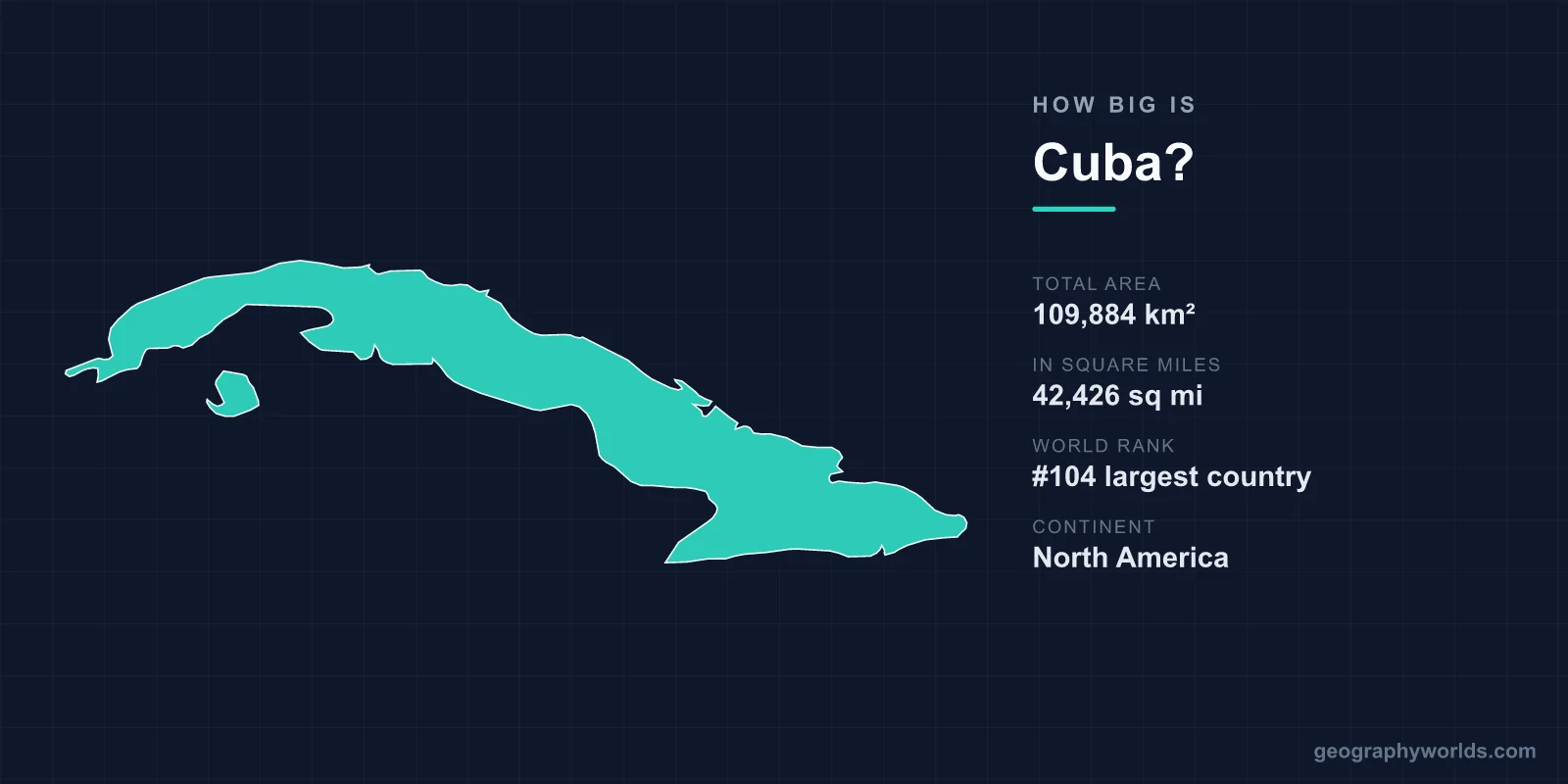
Cuba covers a total area of 109,884 km² (42,426 square miles), making it the 104th largest country in the world and by far the largest island in the Caribbean. Roughly the size of the U.S. state of Tennessee, the island nation accounts for about 0.07% of Earth's total land area, yet it stretches across more territory than every other Caribbean island combined.
Cuba's Size at a Glance
Cuba's 109,884 km² of land make it a mid-sized country by global standards, ranking 104th out of roughly 195 nations. While that places it in the lower half of the table, its footprint is enormous within its own region. The main island alone holds nearly all of the country's territory, with the smaller Isla de la Juventud and an archipelago of more than 4,000 cays and islets making up the remainder.
- Total area: 109,884 km² (42,426 sq mi)
- World rank: 104th largest country
- Continent: North America (Caribbean region)
- Capital: Havana
- Coastline: approximately 3,735 km
For comparison, Cuba is close in size to Tennessee (about 109,000 km²) and slightly larger than South Korea (100,210 km²). It is roughly 45% the size of the United Kingdom and a little smaller than the U.S. state of Ohio.
How Long and Wide Is the Island?
Cuba is famously long and narrow, shaped a bit like a crocodile lying across the mouth of the Gulf of Mexico. The main island runs about 1,250 km from its western tip near Cabo de San Antonio to its eastern point at Punta de Maisí — roughly the same as the driving distance between New York City and Miami. Yet it is rarely wide, measuring only around 250 km at its broadest and narrowing to less than 32 km in places.
That long, slender form gives Cuba an unusually generous coastline of about 3,735 km relative to its land area. No point on the island sits very far from the sea, which has shaped everything from the country's climate to its history as a hub of Caribbean trade and naval strategy.
The Biggest Island in the Caribbean
Cuba's most striking size statistic is regional: it is the largest island in the Caribbean, with more land than all the other islands of the West Indies combined. Hispaniola, home to Haiti and the Dominican Republic, is the second largest at roughly 76,000 km², while Jamaica covers only about 11,000 km² — meaning Cuba is nearly ten times Jamaica's size.
This dominance helped make Cuba the strategic heart of the Spanish Caribbean for centuries, with Havana serving as the assembly point for treasure fleets sailing back to Europe. The island's scale also supports a remarkable diversity of ecosystems, from fertile farmland and tobacco-growing valleys to mountains, swamps, and coral reefs. You can learn more in our cuba country guide.
Terrain Within That Area
Although much of Cuba is flat or gently rolling plain — ideal for the sugarcane and tobacco that long defined its economy — about a quarter of the country is mountainous. Three main mountain systems break up the lowlands: the Sierra Maestra in the southeast, the Sierra del Escambray in the center, and the Cordillera de Guaniguanico in the west.
The highest point is Pico Turquino in the Sierra Maestra, rising to 1,974 m (6,476 ft) above sea level. Other notable features packed into Cuba's territory include the limestone mogotes of the Viñales Valley, the Zapata Swamp — the largest wetland in the Caribbean — and the extensive coral reef systems that ring the island, the most developed in the region.
Climate Across the Island
Despite its length, Cuba sits entirely within the tropics, so the whole island shares a warm, tropical climate. There is a wet season from May to October and a drier season from November to April, with average temperatures ranging from about 22°C in winter to 28°C in summer. The island's position also places it squarely in the Atlantic hurricane belt, and powerful storms regularly cross its long axis between June and November.
Frequently Asked Questions
Is Cuba bigger than Jamaica?
Yes, by a wide margin. Cuba covers 109,884 km², while Jamaica is only about 11,000 km². Cuba is roughly ten times larger and is the biggest island in the entire Caribbean.
What U.S. state is Cuba comparable to in size?
Cuba is most often compared to Tennessee, which has a nearly identical area of around 109,000 km². It is also similar in size to Ohio and Pennsylvania.
How long is the island of Cuba?
The main island stretches about 1,250 km (roughly 777 miles) from its western tip to its eastern end, while measuring as little as 32 km wide in its narrowest sections.
How many islands make up Cuba?
Cuba is an archipelago of more than 4,000 islands, cays, and islets. The main island holds the vast majority of the land, followed by Isla de la Juventud, the second largest.